
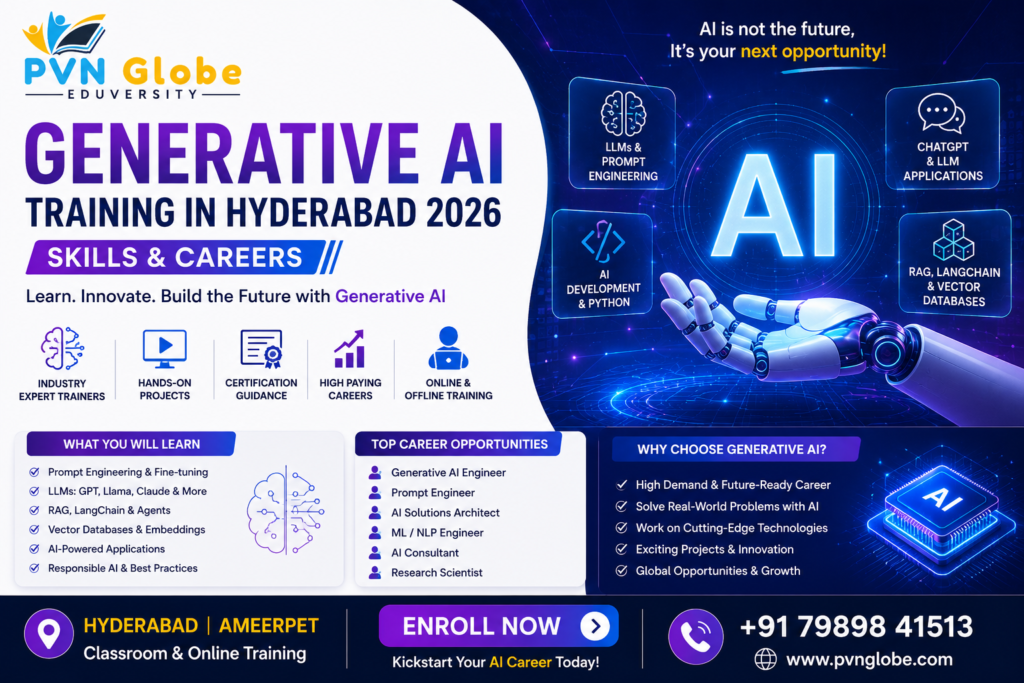
Introduction
Generative AI Training in Hyderabad: Build a Future-Ready AI Career in 2026
Generative Artificial Intelligence has become one of the fastest-growing areas of technology. From generating text and images to writing code, analyzing information, creating marketing content, building AI assistants, and automating business processes, Gen AI is changing how organizations work.
For students, software professionals, developers, data scientists, testers, business analysts, and IT professionals, learning Generative AI can create opportunities across multiple technology domains.
If you are searching for Generative AI Training in Hyderabad, or a practical Generative AI Certification Course, choosing training that combines concepts, tools, prompt engineering, APIs, Python, projects, and real-world applications is important.
PVN Globe provides career-focused technology training designed around practical learning and industry-oriented skills.
What You Will Learn
A comprehensive Gen AI course can cover:
- Generative AI fundamentals
- Large Language Models (LLMs)
- Prompt Engineering
- Python for AI
- OpenAI-style APIs and LLM APIs
- Retrieval-Augmented Generation (RAG)
- Vector databases
- AI agents
- LangChain and related frameworks
- Embeddings
- Fine-tuning concepts
- AI application development
- Responsible AI
- Real-time Gen AI projects
- Deployment concepts
- Interview preparation
What Is Generative AI?
Generative AI is a branch of artificial intelligence that can create new content based on patterns learned from large datasets.
Unlike traditional AI systems that are often designed primarily to classify, predict, or recognize information, generative AI can produce new outputs.
These outputs can include:
- Text
- Images
- Audio
- Video
- Code
- Documents
- Summaries
- Synthetic data
- Conversational responses
For example, an organization could use a generative AI application to summarize customer complaints, create draft emails, generate documentation, or answer questions about internal company documents.
Simple Definition
Generative AI is technology that uses machine learning models to generate new content from user instructions or input data.
This simple definition makes Generative AI accessible to beginners while providing a foundation for more advanced topics.
Why Is Generative AI Important in 2026?
Generative AI is becoming an important skill across software development, data engineering, analytics, cybersecurity, marketing, finance, healthcare, customer service, and enterprise automation.
Organizations are increasingly exploring AI-powered workflows to improve productivity and automate repetitive tasks.
Major Reasons to Learn Gen AI
- Growing AI adoption
Companies are integrating AI into existing applications and workflows.
- Cross-industry applications
Gen AI is relevant to technology, finance, healthcare, retail, education, manufacturing, and many other sectors.
- Developer demand
Developers increasingly need to understand how to integrate LLMs and AI services into applications.
- Automation opportunities
AI can automate content generation, summarization, classification, document processing, and conversational workflows.
- New career paths
Gen AI knowledge can complement existing careers in:
- Software development
- Data science
- Data engineering
- Cloud computing
- DevOps
- Cybersecurity
- Business analysis
- Testing
Why Choose a Generative AI Course in Hyderabad?
Hyderabad is one of India’s major technology and IT education hubs. Professionals and students looking to build AI careers frequently search for practical training programs that combine technical concepts with projects.
When selecting a Generative AI Course in Hyderabad, evaluate the course based on:
- Curriculum
- Trainer experience
- Hands-on exercises
- Real-world projects
- AI tools covered
- Python programming
- LLM concepts
- Prompt engineering
- RAG
- AI agents
- Interview preparation
- Career guidance
PVN Globe Gen AI Training
A career-oriented PVN Globe Gen AI Course can help learners move from AI fundamentals toward practical AI application development.
The goal should not simply be to learn how to write prompts. Learners should understand how AI systems work and how to build useful applications around them.
Skills Required for a Generative AI Career
A successful Gen AI professional needs a combination of programming, AI, cloud, data, and problem-solving skills.
Core Skills
1. Python
Python is widely used for AI and machine learning development.
Learners should understand:
- Variables
- Functions
- Classes
- Lists and dictionaries
- File handling
- APIs
- Exception handling
- Libraries
2. Machine Learning Fundamentals
Basic understanding of:
- Training
- Validation
- Features
- Models
- Inference
- Evaluation
3. Deep Learning
Knowledge of neural networks helps learners understand the technology behind modern AI systems.
4. LLM Fundamentals
Learners should understand:
- Tokens
- Context windows
- Transformers
- Attention
- Embeddings
- Inference
5. Prompt Engineering
Prompt engineering involves designing effective instructions for AI models.
6. RAG
Retrieval-Augmented Generation allows AI applications to retrieve relevant information before generating responses.
What Are Large Language Models?
Large Language Models, commonly called LLMs, are AI models trained on large amounts of text and other data.
They can perform tasks such as:
- Question answering
- Summarization
- Translation
- Content generation
- Code generation
- Classification
- Information extraction
- Conversational interaction
Modern AI applications frequently use LLMs as a central reasoning or generation component.
Important LLM Concepts
A good Gen AI Training Course should explain:
- Tokens
- Tokenization
- Embeddings
- Transformer architecture
- Attention
- Context windows
- Inference
- Temperature
- Model parameters
- Prompt structure
- Model evaluation
Understanding these concepts helps learners move beyond basic AI-tool usage.
What Is Prompt Engineering?
Prompt engineering is the process of designing instructions that guide an AI model toward a useful output.
A prompt can contain:
- Role
- Task
- Context
- Constraints
- Examples
- Output format
Example
Instead of asking:
“Explain sales.”
A more structured prompt could request:
“Act as a sales analyst. Summarize the following sales data in five bullet points and identify the three most important business trends.”
The second approach provides the model with clearer instructions.
Prompt Engineering Techniques
A Gen AI learner should understand:
- Zero-shot prompting
- Few-shot prompting
- Role prompting
- Structured prompting
- Chain-of-thought concepts
- Output formatting
- Context injection
- Prompt templates
- Prompt evaluation
Generative AI with Python
Python is one of the most useful programming languages for developing Gen AI applications.
A learner can use Python to:
- Connect to AI APIs
- Process documents
- Generate embeddings
- Build RAG systems
- Create chatbots
- Build AI agents
- Integrate databases
- Develop automation workflows
Typical Gen AI Development Flow
User → Python Application → AI API/Model → Processing → Response
More advanced systems may follow:
User → Application → Retriever → Vector Database → LLM → Response
This combination of Python and Gen AI can be valuable for developers and data professionals.
What Is Retrieval-Augmented Generation?
Retrieval-Augmented Generation, or RAG, is an architecture that allows an AI application to retrieve relevant information from an external knowledge source before generating a response.
This is particularly useful when organizations want AI applications to work with private or domain-specific information.
Example
Imagine a company has thousands of:
- PDFs
- Policies
- Manuals
- Product documents
- Technical documents
- FAQs
A RAG application can retrieve relevant information from those documents and provide it to the language model as context.
RAG Pipeline
Documents → Chunking → Embeddings → Vector Database → Retrieval → LLM → Answer
RAG is one of the most important concepts for learners pursuing practical Generative AI Training in Hyderabad.
What Are Embeddings?
Embeddings represent information as numerical vectors that capture semantic relationships.
For example, two sentences with similar meanings may have vectors that are mathematically close in embedding space.
Embeddings are commonly used for:
- Semantic search
- Document retrieval
- Recommendation systems
- RAG
- Similarity search
- Knowledge assistants
Vector Databases
Vector databases are designed to store and retrieve vector representations efficiently.
A Gen AI curriculum may introduce learners to concepts such as:
- Vector indexing
- Similarity search
- Metadata filtering
- Document chunking
- Embedding generation
- Retrieval strategies
These concepts are particularly useful when building enterprise AI applications.
What Are Generative AI Agents?
AI agents are systems that can use models, tools, data sources, and workflows to accomplish tasks.
A basic chatbot may simply answer questions.
An AI agent can potentially:
- Understand a request
- Determine what action is required
- Select an appropriate tool
- Retrieve information
- Perform an operation
- Evaluate the result
- Return an answer
Examples of AI Agents
- Customer support agents
- Research assistants
- Coding assistants
- Data analysis agents
- Sales assistants
- HR assistants
- IT support agents
Agent-based systems are an important emerging area within Gen AI development.
Important Tools for Gen AI Professionals
A comprehensive Generative AI Course can introduce learners to a range of technologies.
AI and LLM Technologies
- Large Language Models
- LLM APIs
- Embeddings
- Prompt engineering
- RAG
Development
- Python
- REST APIs
- JSON
- Git
- Application development
AI Frameworks
Depending on the curriculum and project requirements, learners may explore:
- LangChain
- LlamaIndex
- Hugging Face
- Model APIs
- Vector databases
Cloud AI
Cloud platforms increasingly provide services for:
- Model hosting
- AI APIs
- AI application development
- Data processing
- Monitoring
- Deployment
Real-Time Generative AI Projects
Projects are essential for converting theoretical knowledge into practical skills.
Project 1: AI Chatbot
Build a conversational assistant capable of answering user questions.
Project 2: PDF Question-Answering System
Create a RAG application that allows users to upload documents and ask questions.
Project 3: Enterprise Knowledge Assistant
Build an AI assistant that retrieves information from company documents.
Project 4: AI Resume Analyzer
Create an application that analyzes resumes and extracts skills, experience, and qualifications.
Project 5: Customer Support Assistant
Build an AI application that classifies customer queries and generates responses.
Project 6: AI Research Assistant
Develop a system that summarizes and organizes information from multiple sources.
These projects can help learners create a portfolio for interviews.
Career Opportunities After Learning Generative AI
Gen AI skills can complement several existing technology roles.
Potential career paths include:
Generative AI Developer
Develop applications using LLMs, APIs, RAG, and AI frameworks.
AI/ML Engineer
Work on machine learning and AI systems.
Prompt Engineer
Design, test, and optimize prompts and AI workflows.
LLM Application Developer
Build applications powered by language models.
AI Solutions Engineer
Design AI solutions for business requirements.
AI Automation Developer
Create AI-powered business automation workflows.
Data Scientist with Gen AI Skills
Combine data science and generative AI techniques.
Software Developer with Gen AI Skills
Integrate AI capabilities into enterprise applications.
Generative AI Jobs in Hyderabad
Hyderabad has a strong technology ecosystem, making it an important market for professionals building skills in artificial intelligence and cloud technologies.
Job opportunities can vary based on:
- Experience
- Programming ability
- AI knowledge
- Cloud skills
- Project portfolio
- Communication
- Problem-solving
- Domain knowledge
Skills Employers May Look For
Employers may seek professionals who understand:
- Python
- LLMs
- APIs
- RAG
- Prompt engineering
- Vector databases
- AI agents
- Cloud platforms
- Software development
- Data processing
A certification alone is not enough. Candidates should demonstrate practical ability through projects.
Is Generative AI Certification Worth It?
A Generative AI Certification can help demonstrate structured learning and knowledge of AI concepts.
However, certification should be combined with practical experience.
A Strong Gen AI Profile Should Include
Knowledge + Projects + Tools + Programming + Communication
For example:
Python + LLMs + Prompt Engineering + RAG + Vector Database + AI Project
is stronger than simply listing “Generative AI” on a resume.
How PVN Globe Can Help
A structured PVN Globe Generative AI Training program can help learners organize their learning journey from fundamentals to projects.
Is Generative AI Suitable for Freshers?
Yes. Freshers can start learning Gen AI if they build the required fundamentals gradually.
Recommended Learning Path for Freshers
Step 1: Learn Python basics.
Step 2: Understand AI and machine learning fundamentals.
Step 3: Learn LLM concepts.
Step 4: Practice prompt engineering.
Step 5: Learn APIs.
Step 6: Build simple AI applications.
Step 7: Learn embeddings and RAG.
Step 8: Build portfolio projects.
Step 9: Learn AI agents.
Step 10: Prepare for interviews.
Freshers should focus on understanding rather than simply memorizing AI terminology.
Generative AI Training for Working Professionals
Professionals can use Gen AI skills to enhance their existing technology careers.
Software Developers
Learn how to integrate LLMs into applications.
Data Engineers
Explore AI-powered data processing and RAG pipelines.
Data Scientists
Combine machine learning, NLP, and generative AI.
Cloud Engineers
Learn AI infrastructure and deployment concepts.
Test Engineers
Use AI for test generation, analysis, and automation.
Business Analysts
Use AI for documentation, requirement analysis, summarization, and productivity.
Cybersecurity Professionals
Explore AI-assisted security analysis and automation while understanding security risks.
Gen AI is therefore not limited to people starting completely new careers.
Why Choose PVN Globe for Generative AI Training?
When searching for Gen AI Training in Hyderabad, learners should look for a program that balances theory with practical development.
PVN Globe Gen AI Training Can Focus On:
✔ Industry-oriented curriculum
✔ Practical Gen AI concepts
✔ Python-based learning
✔ Prompt engineering
✔ LLM fundamentals
✔ RAG applications
✔ Vector databases
✔ AI agents
✔ Hands-on projects
✔ Interview preparation
✔ Career-focused learning
PVN Globe Learning Approach
A practical learning journey can follow:
Learn → Practice → Build → Deploy → Prepare → Apply
This approach helps learners turn Gen AI concepts into demonstrable skills.
Generative AI Learning Roadmap
A beginner-to-job-ready roadmap can be structured as follows:
Phase 1 — Fundamentals
- AI basics
- Machine learning fundamentals
- Python
- APIs
Phase 2 — Generative AI
- LLMs
- Tokens
- Transformers
- Prompt engineering
- Model parameters
Phase 3 — Application Development
- LLM APIs
- Python applications
- Prompt templates
- Embeddings
Phase 4 — Advanced Gen AI
- RAG
- Vector databases
- AI agents
- Tool calling
- Evaluation
Phase 5 — Projects
- AI chatbot
- PDF assistant
- Enterprise knowledge assistant
- Customer support AI
- AI automation
Phase 6 — Career Preparation
- Resume
- GitHub portfolio
- Technical interviews
- Project explanation
- Mock interviews