
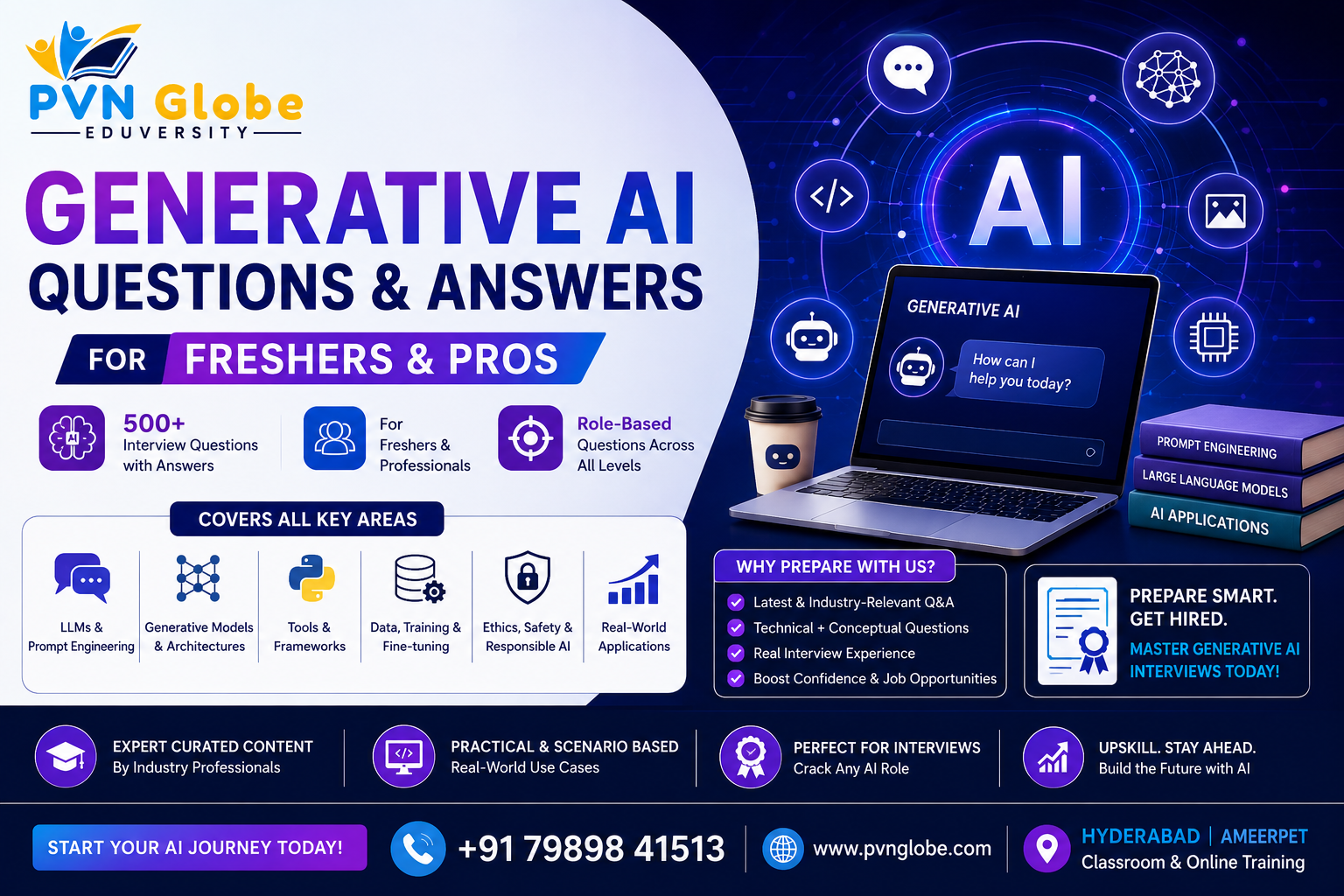
PVN GLOBE Academy – Generative AI Questions & Answers
Generative AI Training in Hyderabad – Beginner to Professional Guide
Generative AI is transforming software development, data analytics, automation, customer support, content creation, and enterprise applications. As businesses increasingly adopt AI-powered solutions, professionals with practical Generative AI skills are becoming valuable across technology domains.
PVN GLOBE Academy provides career-oriented Generative AI Training in Hyderabad designed for both freshers and working professionals. The learning journey can cover Python, AI fundamentals, Large Language Models, Prompt Engineering, APIs, embeddings, RAG, vector databases, AI agents, projects, and interview preparation.
Whether you are searching for a Generative AI Course in Hyderabad, Gen AI Training, LLM Training, or practical Generative AI Certification preparation, this FAQ guide helps you understand the concepts from beginner to professional level.
50 Generative AI Questions & Answers for Freshers
1. What is Generative AI?
Answer: Generative AI is a branch of artificial intelligence that can create new content such as text, images, audio, video, code, and documents based on user input or learned patterns.
2. What is the difference between AI and Generative AI?
Answer: AI is a broad field focused on making machines perform intelligent tasks. Generative AI specifically focuses on creating new content using AI models.
3. What is an LLM?
Answer: LLM stands for Large Language Model. It is an AI model trained on large amounts of data to understand and generate human-like language.
4. What is ChatGPT?
Answer: ChatGPT is a conversational AI application powered by language models. It can answer questions, summarize information, generate content, assist with coding, and perform many language-based tasks.
5. What is a prompt?
Answer: A prompt is an instruction or input provided to an AI model to obtain a desired response.
6. What is Prompt Engineering?
Answer: Prompt engineering is the practice of designing effective instructions for AI models to improve the quality, relevance, and consistency of their responses.
7. Why is Prompt Engineering important?
Answer: Well-designed prompts provide better context and instructions, helping AI models produce more useful and consistent outputs.
8. What is a token?
Answer: A token is a unit of text processed by a language model. Depending on the language and tokenizer, a token can represent part of a word, a complete word, punctuation, or another text unit.
9. What is tokenization?
Answer: Tokenization converts text into smaller units called tokens that an AI model can process.
10. What is a Transformer?
Answer: A Transformer is a neural-network architecture that uses attention mechanisms to process relationships between elements in sequential data. Modern LLMs are largely based on Transformer architectures.
11. What is attention in AI?
Answer: Attention is a mechanism that helps a model determine which parts of the input are important when processing or generating information.
12. What is an AI model?
Answer: An AI model is a trained computational system that can analyze inputs and produce predictions, classifications, or generated outputs.
13. What is an AI API?
Answer: An AI API allows developers to connect applications to AI models and services programmatically.
14. Why is Python used in Generative AI?
Answer: Python has a large ecosystem of AI, machine learning, data-processing, and application-development libraries, making it highly useful for Gen AI development.
15. Is Python mandatory for Generative AI?
Answer: Python is not mandatory for every Gen AI use case, but it is highly valuable for professionals who want to build and integrate AI applications.
16. What is zero-shot prompting?
Answer: Zero-shot prompting asks an AI model to perform a task without providing task-specific examples in the prompt.
17. What is few-shot prompting?
Answer: Few-shot prompting provides a small number of examples to demonstrate the expected task or output format.
18. What is a system prompt?
Answer: A system prompt provides high-level instructions that guide how an AI assistant should behave or respond.
19. What is an embedding?
Answer: An embedding is a numerical representation of information such as text that captures semantic relationships and can be used for similarity search and retrieval.
20. What is a vector database?
Answer: A vector database stores vector representations and supports similarity-based searches. It is commonly used in semantic search and RAG applications.
21. What is RAG?
Answer: RAG stands for Retrieval-Augmented Generation. It combines information retrieval with language generation so an AI system can use relevant external information when producing an answer.
22. Why is RAG useful?
Answer: RAG is useful when an application needs to answer questions using external or organization-specific information rather than relying only on the model’s original training.
23. What is a chatbot?
Answer: A chatbot is a software application that communicates with users through conversational interfaces. Gen AI can make chatbots more flexible and capable of handling natural-language interactions.
24. What is an AI agent?
Answer: An AI agent is an AI-powered system that can reason about a task, use tools or information sources, and execute steps toward accomplishing a goal.
25. What is fine-tuning?
Answer: Fine-tuning is the process of further training a pretrained model on a specific dataset to adapt its behavior to a particular task or domain.
26. What is the difference between RAG and fine-tuning?
Answer: RAG provides external information to the model during inference, while fine-tuning modifies the model’s learned parameters through additional training.
27. What is hallucination in Generative AI?
Answer: An AI hallucination occurs when a model produces information that appears plausible but is incorrect, unsupported, or fabricated.
28. How can hallucinations be reduced?
Answer: Techniques include better prompts, reliable retrieval, grounding responses in trusted data, appropriate model configuration, evaluation, and human review for important use cases.
29. What is an AI workflow?
Answer: An AI workflow is a sequence of processes connecting inputs, models, tools, data sources, decision logic, and outputs to accomplish a task.
30. What is multimodal AI?
Answer: Multimodal AI can work with multiple types of information, such as text, images, audio, or video.
31. What is NLP?
Answer: NLP stands for Natural Language Processing. It is an AI field focused on enabling computers to process, understand, and generate human language.
32. What is machine learning?
Answer: Machine learning is a branch of AI where systems learn patterns from data to make predictions or decisions.
33. What is deep learning?
Answer: Deep learning uses neural networks with multiple layers to learn complex patterns from data.
34. What is inference?
Answer: Inference is the process of using a trained AI model to generate an output from new input.
35. What is model training?
Answer: Model training is the process of optimizing an AI model using data so that it learns useful patterns for a specific objective.
36. What is context window?
Answer: A context window represents the amount of information a model can consider as input and context during a particular interaction.
37. What is temperature in an LLM?
Answer: Temperature is a model-generation parameter that can influence the variability or randomness of generated responses. Its effect depends on the model and implementation.
38. What is semantic search?
Answer: Semantic search retrieves information based on meaning rather than relying only on exact keyword matches.
39. What is document chunking?
Answer: Document chunking divides large documents into smaller sections so they can be processed, embedded, indexed, and retrieved more effectively.
40. What is LangChain?
Answer: LangChain is a framework ecosystem used to develop applications around language models, including workflows involving prompts, retrieval, tools, and agents.
41. What is Hugging Face?
Answer: Hugging Face provides an ecosystem of models, datasets, libraries, and tools widely used for machine learning and natural language processing.
42. What is an AI-powered application?
Answer: An AI-powered application uses one or more AI models or services to provide intelligent functionality such as generation, classification, summarization, recommendation, or conversational assistance.
43. What projects can a Gen AI fresher build?
Answer: Freshers can build projects such as PDF chatbots, FAQ assistants, resume analyzers, customer-support assistants, document summarizers, and RAG-based knowledge assistants.
44. Is Generative AI suitable for freshers?
Answer: Yes. Freshers can start with Python and AI fundamentals and gradually learn LLMs, prompt engineering, RAG, APIs, and AI application development.
45. What skills are required for a Gen AI fresher?
Answer: Useful skills include Python, AI fundamentals, LLM concepts, prompt engineering, APIs, embeddings, RAG, basic databases, Git, and project development.
46. What is a Generative AI certification?
Answer: A Generative AI certification is a credential that demonstrates completion of or competency in a Gen AI learning or assessment program.
47. How can projects help a fresher get a Gen AI job?
Answer: Projects demonstrate practical skills and give candidates concrete examples to discuss during technical interviews.
48. What is a Generative AI course?
Answer: A Generative AI course teaches concepts and practical techniques related to LLMs, prompting, AI APIs, RAG, embeddings, AI agents, and Gen AI application development.
49. Where can I learn Generative AI in Hyderabad?
Answer: Learners searching for Generative AI Training in Hyderabad can evaluate programs based on curriculum, hands-on projects, trainer expertise, practical tools, and career support. PVN Globe can be considered as a training option for learners seeking career-focused Gen AI education.
50. What should a fresher learn first in Gen AI?
Answer: A practical sequence is Python → AI fundamentals → LLM basics → Prompt Engineering → APIs → Embeddings → RAG → AI Agents → Projects → Interview Preparation.
50 Generative AI Questions & Answers for Professionals
1. What is the architecture of a production Gen AI application?
Answer: A production Gen AI application may include a user interface, application layer, authentication, prompt management, model/API layer, retrieval system, vector database, business logic, monitoring, security controls, and evaluation framework.
2. How would you design a production RAG system?
Answer: Start with document ingestion, cleaning, chunking, embedding generation, vector indexing, retrieval, reranking where appropriate, prompt construction, LLM generation, evaluation, monitoring, and access control.
3. What factors affect RAG performance?
Answer: Important factors include document quality, chunking strategy, embedding quality, retrieval method, metadata filtering, top-k selection, reranking, prompt design, and model selection.
4. How do you choose chunk size?
Answer: Chunk size should depend on document structure, information density, embedding model, retrieval requirements, and the context capacity of the downstream model. It should be tested empirically rather than chosen universally.
5. What is hybrid search?
Answer: Hybrid search combines keyword-based retrieval with semantic/vector retrieval to improve the chances of finding relevant information.
6. What is reranking?
Answer: Reranking is a second-stage retrieval process that evaluates initially retrieved documents and reorders them based on relevance.
7. How do you evaluate a RAG application?
Answer: Evaluation can consider retrieval relevance, answer correctness, faithfulness to retrieved information, latency, cost, and task-specific business metrics.
8. What is RAG evaluation?
Answer: RAG evaluation measures whether the system retrieves useful information and produces accurate answers grounded in that information.
9. What is grounding?
Answer: Grounding means connecting an AI response to reliable source information so that the generated output is supported by available evidence.
10. How do you reduce hallucinations in enterprise AI?
Answer: Use reliable retrieval, trusted source data, constrained prompts, appropriate model selection, output validation, evaluation, monitoring, and human oversight where necessary.
11. What is prompt injection?
Answer: Prompt injection is an attack or manipulation technique in which untrusted input attempts to influence an AI system to ignore intended instructions or perform unintended actions.
12. How can prompt injection be mitigated?
Answer: Mitigations include separating trusted instructions from untrusted content, validating inputs, restricting tool permissions, applying access controls, monitoring outputs, and testing adversarial scenarios.
13. What is data leakage in Gen AI?
Answer: Data leakage occurs when sensitive or confidential information is unintentionally exposed through prompts, model outputs, logs, retrieval systems, integrations, or other parts of an AI application.
14. What is responsible AI?
Answer: Responsible AI involves designing and deploying AI systems with appropriate considerations for safety, privacy, security, fairness, transparency, accountability, and reliability.
15. How do you secure an LLM application?
Answer: Use authentication, authorization, input validation, secrets management, least-privilege tool access, data protection, monitoring, output controls, secure APIs, and regular security testing.
16. What is function calling or tool calling?
Answer: Tool calling allows a model to request execution of predefined functions or tools so an application can perform actions or retrieve information outside the model itself.
17. What is agentic AI?
Answer: Agentic AI refers to systems designed to perform multi-step tasks using models, tools, memory or state, planning mechanisms, and external information.
18. What is the difference between a chatbot and an AI agent?
Answer: A chatbot primarily focuses on conversational interaction, whereas an AI agent may use tools, retrieve information, execute actions, and manage multi-step workflows.
19. How would you design an AI customer-support agent?
Answer: Design the system around customer authentication, knowledge retrieval, intent detection, response generation, approved business tools, escalation rules, conversation state, monitoring, and human handoff.
20. What is model selection in Gen AI?
Answer: Model selection involves choosing a suitable model based on factors such as accuracy, latency, cost, context requirements, capabilities, privacy requirements, and deployment constraints.
21. How do you optimize LLM costs?
Answer: Cost can be controlled through appropriate model selection, prompt optimization, caching, efficient retrieval, reducing unnecessary context, batching where appropriate, and monitoring token usage.
22. How do you reduce LLM latency?
Answer: Techniques include selecting faster models, reducing prompt size, optimizing retrieval, caching repeated results, streaming responses, and improving application architecture.
23. What is model temperature used for?
Answer: Temperature can influence generation variability. Lower values generally favor more predictable output, while higher values can produce more variation, depending on the model.
24. What is fine-tuning used for?
Answer: Fine-tuning can adapt a pretrained model to particular tasks, formats, behaviors, or domains when the use case benefits from changing model behavior rather than simply supplying external knowledge.
25. When should you use RAG instead of fine-tuning?
Answer: RAG is often appropriate when the application needs access to changing, private, or external knowledge. Fine-tuning is more appropriate when the primary requirement is adapting model behavior, style, or task performance.
26. Can RAG and fine-tuning be used together?
Answer: Yes. Fine-tuning can adapt model behavior while RAG supplies external or current information at inference time.
27. What are embeddings used for?
Answer: Embeddings are used for semantic representation and applications such as similarity search, document retrieval, clustering, recommendations, and RAG.
28. How do you select an embedding model?
Answer: Consider language support, retrieval quality, dimensionality, latency, cost, domain performance, deployment requirements, and evaluation results.
29. What is a vector index?
Answer: A vector index organizes vector data to make similarity searches more efficient.
30. What is semantic caching?
Answer: Semantic caching stores results associated with semantically similar requests so that repeated or related queries can potentially reuse previous results.
31. What is LLM observability?
Answer: LLM observability involves monitoring AI application behavior, including requests, latency, token usage, errors, retrieval performance, model outputs, and other operational metrics.
32. What should be monitored in a Gen AI application?
Answer: Monitor availability, latency, token consumption, cost, errors, retrieval quality, response quality, safety issues, user feedback, and system performance.
33. What is an AI evaluation framework?
Answer: An AI evaluation framework provides methods and metrics for measuring the quality, reliability, safety, and performance of AI applications.
34. How do you create a Gen AI test dataset?
Answer: Collect representative real-world scenarios, edge cases, difficult queries, safety cases, and expected outcomes, then continuously update the dataset based on production feedback.
35. What is LLMOps?
Answer: LLMOps refers to practices for developing, deploying, monitoring, evaluating, and maintaining applications that use large language models.
36. What is MLOps?
Answer: MLOps combines machine learning development with software engineering and operational practices for reliable model development and deployment.
37. What is the difference between MLOps and LLMOps?
Answer: LLMOps focuses specifically on operational challenges associated with LLM-based applications, including prompts, retrieval, model APIs, token usage, evaluations, and AI-specific monitoring.
38. How would you deploy a Gen AI application?
Answer: A typical deployment may involve containerized application services, cloud infrastructure, model APIs or hosted models, databases, vector storage, authentication, monitoring, CI/CD, and security controls.
39. How can cloud platforms support Gen AI?
Answer: Cloud platforms can provide compute, storage, AI model services, databases, security, monitoring, networking, and deployment infrastructure for Gen AI applications.
40. How do you protect sensitive enterprise documents in RAG?
Answer: Apply identity-based access control, document-level permissions, encryption, secure storage, metadata filtering, tenant isolation, auditing, and appropriate data-governance controls.
41. What is multi-tenant RAG?
Answer: Multi-tenant RAG is an architecture in which multiple customers or organizational units use a shared AI system while their data and access permissions remain appropriately isolated.
42. How do you handle outdated information in an AI system?
Answer: Use regularly updated knowledge sources, document versioning, metadata, retrieval filters, content freshness policies, and monitoring to identify outdated information.
43. How do you improve an AI application’s answer quality?
Answer: Analyze failure cases and optimize the relevant layer—data quality, retrieval, chunking, embeddings, prompts, model selection, tool usage, or output validation.
44. What is prompt versioning?
Answer: Prompt versioning tracks changes to prompts so teams can reproduce, compare, evaluate, and roll back different prompt versions.
45. What is structured output?
Answer: Structured output requires the model to produce information in a defined format such as JSON or a specific schema, making downstream processing easier.
46. What are common challenges when moving a Gen AI prototype to production?
Answer: Major challenges include security, reliability, hallucinations, cost, latency, data governance, evaluation, observability, scalability, access control, and integration with existing enterprise systems.
47. How do you prepare for a Gen AI technical interview?
Answer: Professionals should prepare LLM fundamentals, prompt engineering, RAG architecture, embeddings, vector databases, AI agents, APIs, security, evaluation, cloud deployment, system design, and project-based questions.
48. What should an experienced Gen AI professional include in a portfolio?
Answer: A portfolio should demonstrate production-oriented projects, architecture diagrams, Git repositories where appropriate, RAG implementations, evaluation approaches, APIs, deployment knowledge, security considerations, and measurable project outcomes.
49. How can existing IT professionals transition into Gen AI?
Answer: Professionals can leverage their existing domain expertise while learning Python, LLMs, prompt engineering, RAG, AI agents, APIs, cloud AI services, evaluation, and Gen AI application architecture.
50. Why choose PVN Globe for professional Gen AI training?
Answer: Professionals looking for Gen AI Training in Hyderabad can evaluate PVN Globe based on practical curriculum, project-oriented learning, AI technologies covered, trainer expertise, and career-focused training. The ideal program should help professionals progress from Gen AI fundamentals to enterprise-oriented application development.