PVN Globe Academy – MD 365 SCM Training in Hyderabad
Master Microsoft Dynamics 365 Supply Chain Management with PVN Globe Academy Build Skills. Gain Practical Experience. Prepare for Certification. Grow Your Career. Microsoft Dynamics 365 Supply Chain Management is becoming an important enterprise technology for organizations managing procurement, inventory, warehouses, manufacturing, planning, logistics, transportation, and supply-chain operations.
For candidates looking to build a career in ERP and enterprise applications, MD 365 SCM Training in Hyderabad can provide a structured pathway to develop both functional and business-process knowledge.
PVN Globe Academy provides career-oriented Microsoft Dynamics 365 SCM Training designed for freshers, working professionals, supply-chain professionals, ERP consultants, business analysts, and career switchers.
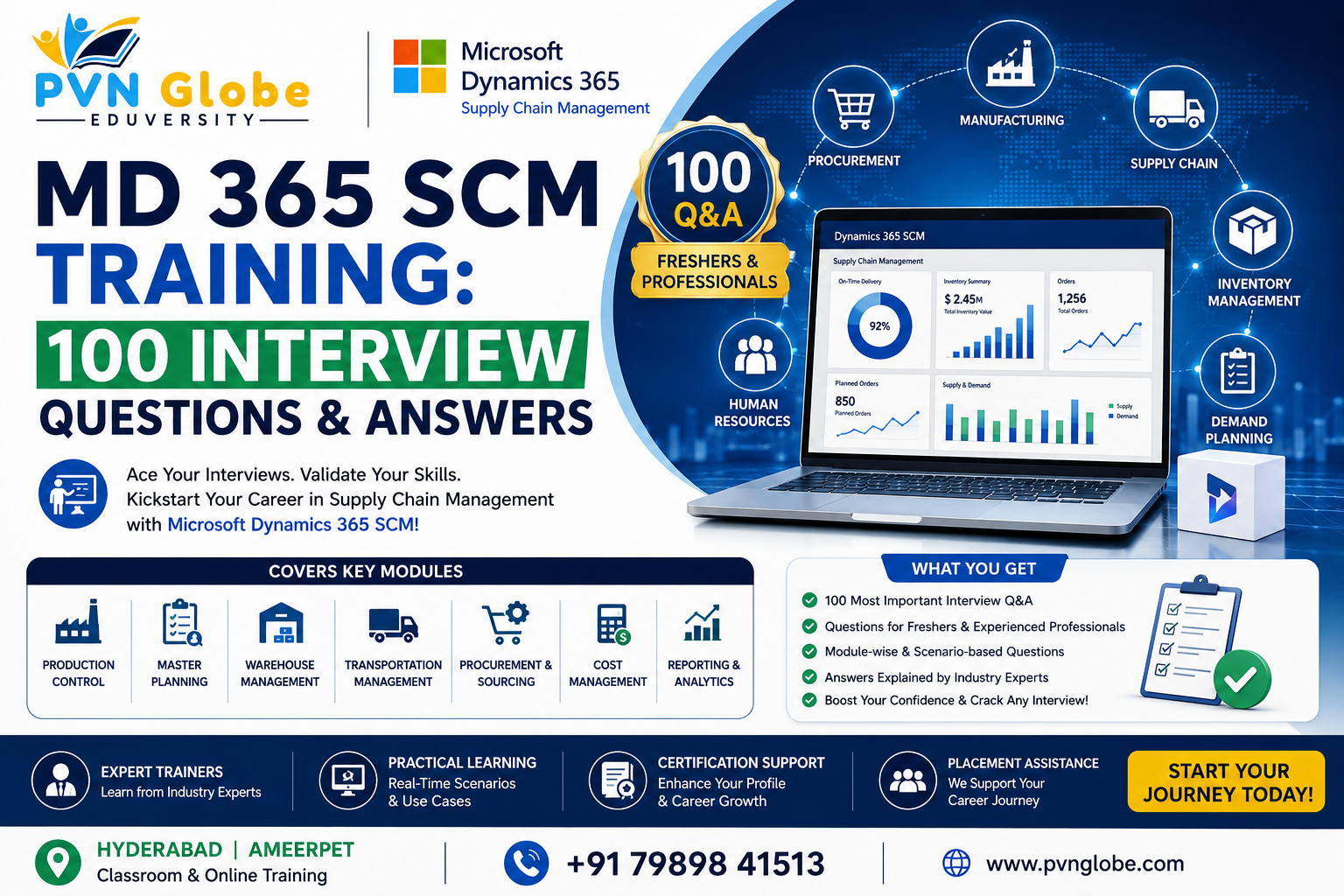
MD 365 SCM Training: 100 Interview Questions & Answers for Freshers and Professionals
50 MD 365 SCM Questions & Answers for Freshers
1. What is Microsoft Dynamics 365 SCM?
Answer:
Microsoft Dynamics 365 Supply Chain Management (SCM) is a cloud-based enterprise application that helps organizations manage supply-chain processes such as procurement, inventory, warehouse management, planning, manufacturing, transportation, and product information.
2. What does MD 365 SCM stand for?
Answer:
MD 365 SCM commonly refers to Microsoft Dynamics 365 Supply Chain Management.
3. Why should a fresher learn MD 365 SCM?
Answer:
A fresher can learn MD 365 SCM to build knowledge in ERP, supply-chain processes, procurement, inventory, warehousing, planning, and enterprise consulting. It can provide a foundation for careers such as Dynamics 365 SCM Functional Consultant and Business Analyst.
4. What is an ERP system?
Answer:
ERP stands for Enterprise Resource Planning. An ERP system integrates business processes such as finance, procurement, inventory, manufacturing, sales, and supply chain into a common enterprise platform.
5. What is Supply Chain Management?
Answer:
Supply Chain Management is the process of planning and managing the flow of products, materials, information, and related activities from suppliers through production and distribution to customers.
6. What are the major areas of Dynamics 365 SCM?
Answer:
Major areas include:
- Product Information Management
- Procurement and Sourcing
- Inventory Management
- Warehouse Management
- Master Planning
- Manufacturing
- Transportation Management
- Quality Management
- Asset Management
7. What is Product Information Management?
Answer:
Product Information Management is used to create and manage product-related information such as products, product masters, variants, categories, units, and product dimensions.
8. What is a product in Dynamics 365 SCM?
Answer:
A product represents an item or service that an organization buys, sells, manufactures, or manages. Product information can include identification, units, dimensions, categories, and other attributes.
9. What is a product master?
Answer:
A product master is a template for products that have variants based on product dimensions such as size, color, or configuration.
10. What is a product variant?
Answer:
A product variant is a specific version of a product master based on defined product dimensions.
For example:
T-Shirt → Product Master
Red + Large → Product Variant
11. What is procurement?
Answer:
Procurement is the process of acquiring materials, products, or services from suppliers.
A typical procurement process is:
Requirement → Purchase Requisition → Approval → Purchase Order → Receipt
12. What is a vendor?
Answer:
A vendor is an organization or individual that supplies products or services to a business.
13. What is a purchase order?
Answer:
A purchase order is a formal document issued to a vendor specifying the products or services being purchased, quantities, prices, delivery information, and other terms.
14. What is a purchase requisition?
Answer:
A purchase requisition is an internal request to purchase products or services. Depending on business rules, it can go through an approval process before a purchase order is created.
15. What is inventory management?
Answer:
Inventory management involves controlling and tracking products and materials throughout their lifecycle.
It includes:
- Stock tracking
- Inventory movements
- Counting
- Adjustments
- Batch tracking
- Serial tracking
16. What is a warehouse?
Answer:
A warehouse is a physical or logical location where inventory is received, stored, picked, packed, and shipped.
17. What is warehouse management?
Answer:
Warehouse management involves controlling warehouse operations such as receiving, put-away, picking, packing, movement, counting, and shipping.
18. What is a site in Dynamics 365 SCM?
Answer:
A site generally represents a physical or operational location where business activities such as inventory storage or manufacturing occur.
19. What is an inventory dimension?
Answer:
Inventory dimensions provide information used to identify and manage inventory, such as site, warehouse, location, batch, serial number, size, color, or configuration.
20. What is batch tracking?
Answer:
Batch tracking allows organizations to track inventory based on batch or lot numbers. It is particularly useful in industries where traceability is important.
21. What is serial number tracking?
Answer:
Serial number tracking identifies individual units using unique serial numbers. It helps organizations track the lifecycle and movement of specific products.
22. What is master planning?
Answer:
Master planning helps organizations determine future supply requirements by considering demand, inventory, supply, lead times, and planning parameters.
23. What is demand forecasting?
Answer:
Demand forecasting estimates future product demand using historical information and other planning inputs. It helps organizations make better purchasing, inventory, and production decisions.
24. What is a planned purchase order?
Answer:
A planned purchase order is a planning recommendation generated when the system determines that additional supply may be required.
25. What is manufacturing in Dynamics 365 SCM?
Answer:
Manufacturing involves converting raw materials into finished products. Dynamics 365 SCM supports manufacturing processes such as production orders, bills of materials, routes, resources, and production control.
26. What is a Bill of Materials?
Answer:
A Bill of Materials (BOM) is a structured list of components and quantities required to manufacture a product.
27. What is a production order?
Answer:
A production order is used to manage the manufacturing of a product. It can contain information about the product, quantity, materials, resources, operations, and production activities.
28. What is transportation management?
Answer:
Transportation management supports processes related to moving goods between locations, including loads, shipments, carriers, routes, freight, and transportation planning.
29. What is quality management?
Answer:
Quality management helps organizations inspect products and materials and manage processes related to quality control, testing, sampling, and nonconformance.
30. What is asset management?
Answer:
Asset management helps organizations manage operational assets and maintenance activities, including assets, maintenance plans, work orders, and preventive maintenance.
31. What is a functional consultant?
Answer:
A functional consultant understands business requirements and configures an enterprise application to support those requirements.
32. What does an MD 365 SCM functional consultant do?
Answer:
An MD 365 SCM Functional Consultant typically:
- Gathers requirements
- Analyzes business processes
- Configures SCM
- Prepares documentation
- Supports testing
- Helps resolve functional issues
- Trains users
33. Is coding required for an MD 365 SCM functional consultant?
Answer:
Advanced programming is generally not the primary requirement for a functional consultant. However, understanding technical concepts such as integrations, data entities, APIs, and data migration can be valuable.
34. What is configuration?
Answer:
Configuration means setting up application parameters and business rules so that Dynamics 365 SCM can support an organization’s requirements.
35. What is master data?
Answer:
Master data is relatively stable information used across business transactions.
Examples include:
- Products
- Vendors
- Customers
- Warehouses
- Sites
- Units
36. What is transactional data?
Answer:
Transactional data represents business activities that occur during operations.
Examples include:
- Purchase orders
- Sales orders
- Inventory movements
- Production orders
- Shipments
37. What is a business process?
Answer:
A business process is a sequence of activities performed to achieve a business outcome.
Examples include:
Procure-to-Pay
Plan-to-Produce
Order-to-Cash
38. What is Procure-to-Pay?
Answer:
Procure-to-Pay is the complete process from identifying a purchasing requirement through procurement, purchase order processing, receiving, and related financial processing.
39. What is Plan-to-Produce?
Answer:
Plan-to-Produce is the process of planning materials and production, creating production requirements, manufacturing products, and completing production activities.
40. What is real-time project training?
Answer:
Real-time project training uses realistic business scenarios to help learners understand requirements, configuration, transactions, testing, documentation, and implementation processes.
41. What is MB-330?
Answer:
MB-330 is the Microsoft exam associated with the Dynamics 365 Supply Chain Management Functional Consultant certification path.
42. What certification is available for Dynamics 365 SCM?
Answer:
Microsoft offers the Dynamics 365 Supply Chain Management Functional Consultant Associate certification. Candidates should check Microsoft’s current certification page for the latest requirements and exam information.
43. Can freshers learn MD 365 SCM?
Answer:
Yes. Freshers can begin with supply-chain fundamentals and gradually learn Dynamics 365 SCM modules, configuration, projects, and certification topics.
44. Can MBA students learn Dynamics 365 SCM?
Answer:
Yes. MBA students, especially those specializing in supply chain, operations, logistics, or related areas, can benefit from learning Dynamics 365 SCM.
45. Can non-IT students learn MD 365 SCM?
Answer:
Yes. Candidates from business, commerce, management, supply-chain, and logistics backgrounds can learn the functional aspects of Dynamics 365 SCM.
46. What skills should a fresher develop?
Answer:
A fresher should develop:
- Supply-chain fundamentals
- Procurement knowledge
- Inventory knowledge
- Warehouse concepts
- Master planning
- Dynamics 365 SCM concepts
- Business-process understanding
- Communication skills
- Problem-solving skills
47. What jobs can freshers target after MD 365 SCM Training?
Answer:
Depending on their skills and employer requirements, freshers can explore roles such as:
- Junior Dynamics 365 SCM Consultant
- SCM Business Analyst
- ERP Trainee
- Dynamics 365 Support Associate
- Junior Functional Consultant
48. Why choose PVN Globe for MD 365 SCM Training?
Answer:
PVN Globe can provide a career-oriented learning approach focused on Dynamics 365 SCM concepts, business scenarios, practical learning, projects, certification preparation, and interview readiness.
49. Where can I learn MD 365 SCM in Hyderabad?
Answer:
Candidates looking for MD 365 SCM Training in Hyderabad can explore PVN Globe for structured training focused on Dynamics 365 Supply Chain Management and career development.
50. How should a fresher start an MD 365 SCM career?
Answer:
A fresher can follow this roadmap:
Supply Chain Basics → ERP Fundamentals → Dynamics 365 SCM → Practical Training → Real-Time Project → Certification Preparation → Interview Preparation → Job Search
50 MD 365 SCM Questions & Answers for Professionals
1. What is the role of an MD 365 SCM Functional Consultant?
Answer:
An MD 365 SCM Functional Consultant analyzes business requirements, designs functional solutions, configures Dynamics 365 SCM, supports testing, documents processes, trains users, and assists with implementation or support activities.
2. What is requirement gathering?
Answer:
Requirement gathering is the process of understanding business needs, current processes, problems, desired outcomes, and system expectations from stakeholders.
3. How do you gather SCM requirements?
Answer:
A consultant can use:
- Stakeholder interviews
- Workshops
- Process walkthroughs
- Existing documentation
- System analysis
- Business-process mapping
- Gap analysis
4. What is a fit-gap analysis?
Answer:
Fit-gap analysis compares business requirements with standard system capabilities.
Fit: Standard Dynamics 365 functionality meets the requirement.
Gap: Additional configuration, customization, integration, or another solution may be required.
5. What is business-process mapping?
Answer:
Business-process mapping documents how activities move from one stage to another.
For example:
Purchase Requirement → Approval → Purchase Order → Receipt → Invoice
6. What is a legal entity?
Answer:
A legal entity represents an organization that has a separate legal identity and can have its own financial and operational requirements within Dynamics 365.
7. What is an organization hierarchy?
Answer:
An organization hierarchy represents organizational structures and relationships that can be used for business policies, reporting, workflows, and other organizational processes.
8. What is an item model group?
Answer:
An item model group controls inventory-related behaviors for products, including aspects of inventory accounting and physical inventory management.
9. What is an item group?
Answer:
An item group categorizes products and can be used to apply common settings or support inventory and financial processes.
10. What is a tracking dimension?
Answer:
Tracking dimensions help organizations track inventory at a detailed level, such as batch and serial numbers.
11. What is an inventory status?
Answer:
Inventory status can be used to indicate the availability or operational state of inventory, depending on the configured business process.
12. What is reservation in inventory management?
Answer:
Reservation associates available inventory with a specific demand or transaction so that the required quantity can be allocated according to configured rules.
13. What is available physical inventory?
Answer:
Available physical inventory generally represents physical stock that is available for relevant operational use after considering applicable inventory conditions and reservations.
14. What is cycle counting?
Answer:
Cycle counting is a method of regularly counting selected inventory items or locations instead of conducting a complete physical inventory count at one time.
15. What is warehouse work?
Answer:
Warehouse work represents operational tasks that warehouse workers need to perform, such as picking, put-away, movement, and counting.
16. What are work templates?
Answer:
Work templates define how warehouse work can be created and structured for different warehouse processes.
17. What are location directives?
Answer:
Location directives help determine where warehouse work should be performed, such as where inventory should be picked from or put away.
18. What is wave processing?
Answer:
Wave processing groups and processes warehouse demand to create warehouse work according to configured rules and operational requirements.
19. What is a mobile device process?
Answer:
Mobile device processes support warehouse workers performing operational tasks through a warehouse mobile interface.
20. What is master planning configuration?
Answer:
Master planning configuration determines how the system evaluates demand and supply and generates planning recommendations.
It can involve:
- Coverage
- Planning parameters
- Lead times
- Safety stock
- Demand
- Supply
21. What is safety stock?
Answer:
Safety stock is additional inventory maintained to protect against demand fluctuations, supply delays, or other uncertainties.
22. What is a coverage group?
Answer:
A coverage group defines planning behavior for products by determining how supply requirements should be calculated and replenished.
23. What is demand forecasting?
Answer:
Demand forecasting estimates future demand using historical information and other planning inputs to support inventory and supply decisions.
24. What is a planned production order?
Answer:
A planned production order is a planning recommendation indicating that production may be required to satisfy anticipated demand.
25. What is a planned transfer order?
Answer:
A planned transfer order can represent a recommendation to move inventory between locations to satisfy supply requirements.
26. How do you troubleshoot master-planning issues?
Answer:
A consultant should systematically review:
- Demand
- Supply
- Coverage settings
- Item setup
- Lead times
- Planning parameters
- Inventory availability
- Site and warehouse settings
- Planning run configuration
The consultant should then reproduce the issue and identify which configuration or data condition caused the unexpected result.
27. What is a BOM?
Answer:
A Bill of Materials defines the components required to manufacture a finished product.
28. What is a route?
Answer:
A route defines the sequence of operations or activities required to manufacture a product and can contain information about resources and production times.
29. What is production scheduling?
Answer:
Production scheduling determines when production activities should occur based on factors such as demand, capacity, resources, and operational constraints.
30. What is a production order lifecycle?
Answer:
A production order generally moves through various statuses from creation and estimation through scheduling, release, production, reporting, and completion, depending on the configured process.
31. What is procurement workflow?
Answer:
A procurement workflow automates approval or review processes associated with purchasing activities.
32. How do you configure a procurement process?
Answer:
A consultant analyzes the organization’s purchasing requirements and configures relevant procurement categories, vendors, policies, workflows, purchase processes, and approval rules.
33. What is vendor collaboration?
Answer:
Vendor collaboration provides mechanisms for suppliers to interact with relevant procurement information and processes according to configured business requirements.
34. What is a purchase agreement?
Answer:
A purchase agreement establishes agreed purchasing terms between an organization and a vendor for specified products, quantities, prices, or periods.
35. What is quality order management?
Answer:
Quality orders support inspection and quality-control processes for relevant inventory or business transactions.
36. How do you handle a functional production issue?
Answer:
A consultant should:
- Understand the reported problem.
- Reproduce the issue.
- Identify affected data.
- Review configuration.
- Check process history.
- Identify the root cause.
- Test the proposed solution.
- Document the resolution.
37. What is data migration?
Answer:
Data migration is the process of transferring required business data from an existing system into Dynamics 365.
Typical migration categories include:
- Master data
- Opening balances
- Inventory
- Products
- Vendors
- Customers
- Historical or operational data where required
38. What are data entities?
Answer:
Data entities provide a structured abstraction of business data that can be used for data management, integration, import, export, and migration scenarios.
39. What is integration?
Answer:
Integration connects Dynamics 365 SCM with other systems so that data and business processes can work across applications.
Examples can include:
- CRM
- E-commerce
- Warehouse systems
- Transportation systems
- Third-party applications
- Finance systems
40. What is UAT?
Answer:
UAT stands for User Acceptance Testing. Business users perform UAT to verify that the configured solution meets business requirements before production deployment.
41. What should a functional consultant include in test cases?
Answer:
A test case should generally include:
- Scenario
- Preconditions
- Test data
- Steps
- Expected result
- Actual result
- Pass/fail status
- Defect reference where applicable
42. What is a functional specification?
Answer:
A functional specification describes the business requirement and explains the expected system behavior or solution design so that technical teams can implement required development or integration work.
43. What is a customization?
Answer:
Customization is a modification or extension of standard application behavior to address a requirement that cannot be sufficiently handled through standard configuration.
A consultant should first evaluate standard functionality before recommending customization.
44. What is a business requirement document?
Answer:
A Business Requirement Document (BRD) records business requirements, objectives, processes, assumptions, and expected outcomes.
45. How should a consultant handle a client requirement that is not supported by standard functionality?
Answer:
The consultant should:
- Understand the requirement.
- Verify standard functionality.
- Identify alternative configurations.
- Perform fit-gap analysis.
- Evaluate customization or integration options.
- Assess impact and risks.
- Recommend the most appropriate solution.
46. What are common challenges in Dynamics 365 SCM implementations?
Answer:
Common challenges can include:
- Poor master data
- Unclear requirements
- Incorrect configuration
- Inadequate testing
- Integration problems
- Data migration issues
- User adoption
- Process inconsistencies
- Insufficient documentation
47. How can an SCM consultant improve client adoption?
Answer:
The consultant can support adoption through:
- User training
- Process documentation
- Demonstrations
- Business scenarios
- UAT involvement
- Change-management support
- Clear communication
48. How can SAP SCM professionals transition to Dynamics 365 SCM?
Answer:
SAP SCM professionals can leverage their existing knowledge of procurement, inventory, planning, manufacturing, and logistics while learning the Dynamics 365 architecture, terminology, configuration, and implementation methodology.
49. What should an experienced professional learn beyond basic MD 365 SCM?
Answer:
Experienced professionals should consider developing knowledge in:
- Advanced configuration
- Solution design
- Integrations
- Data migration
- Security
- Testing
- Performance considerations
- Implementation methodology
- Business analysis
- Microsoft certification
- Emerging AI capabilities
50. How can PVN Globe help professionals build an MD 365 SCM career?
Answer:
PVN Globe can provide a career-oriented learning environment focused on Microsoft Dynamics 365 SCM Training, practical business scenarios, functional configuration, real-time project exposure, certification preparation, interview preparation, and professional development.