
Introduction to
How to Become a Cloud Data Engineer
Cloud data engineering has become an important technology career path as organizations increasingly depend on cloud platforms, large-scale data processing, analytics and data-driven applications. Businesses generate information from applications, websites, customer systems, transactions, connected devices and enterprise platforms. Cloud data engineers help organizations collect, transform, organize and deliver this information for analytical and operational use.
In 2026, becoming a Cloud Data Engineer requires more than learning one cloud platform or one data tool. Professionals need a combination of SQL, Python, databases, data modeling, ETL and ELT concepts, cloud computing, data pipelines, data warehousing, data integration and practical project experience.
Learners can build cloud data engineering skills through platforms and technologies such as Microsoft Azure, Google Cloud, Snowflake and other modern data technologies. Each platform provides different services and career possibilities, but the underlying data engineering principles remain important.
For students, fresh graduates, working professionals and career switchers in Hyderabad, structured training can provide a pathway for learning these technologies. PVN Globe Academy Hyderabad offers training in areas including Snowflake, Azure Data Engineering, Azure Data Factory and GCP, giving learners opportunities to explore different aspects of cloud and data engineering.
This comprehensive guide explains how to become a Cloud Data Engineer in 2026, including the skills to learn, important tools, project ideas, certification pathways, career development and a practical learning roadmap.
What Is a Cloud Data Engineer?
A Cloud Data Engineer is a technology professional who designs, develops and manages systems that collect, process, transform, store and deliver data using cloud-based technologies.
Traditional data environments often required organizations to maintain physical servers and infrastructure. Cloud computing has changed this model by allowing businesses to use scalable computing, storage, database and analytics services through cloud platforms.
Cloud Data Engineers work at the intersection of data engineering and cloud computing. They may design data pipelines, integrate multiple data sources, manage data storage, transform datasets and prepare information for analytics.
A typical data environment may contain data from applications, databases, APIs, files and business systems. A Cloud Data Engineer helps move this information into appropriate cloud storage or analytical platforms.
The role also requires attention to reliability, security, scalability and performance.
A Cloud Data Engineer therefore needs to understand both the data itself and the technology infrastructure used to process it.
In 2026, professionals can build these skills through platforms such as Azure, GCP and specialized cloud data platforms such as Snowflake.
Why Cloud Data Engineering Is Important in 2026
Data has become an important business asset. Organizations use information to understand customers, analyze operations, identify trends, improve products and support decision-making.
At the same time, organizations are moving more applications and workloads to cloud environments. This creates a need for professionals who understand how data can be collected and processed within scalable cloud architectures.
Cloud Data Engineering connects these two areas.
A modern organization may have transactional databases, SaaS applications, APIs, log files, spreadsheets and external data sources. Bringing this information together requires data integration and engineering processes.
Cloud platforms provide services that can support these workflows. Engineers can use cloud storage, databases, data integration services, processing engines and analytical platforms to create complete data pipelines.
Artificial intelligence is also increasing the importance of well-managed data. AI systems depend on data for training, evaluation, retrieval and business applications.
As a result, Cloud Data Engineering can provide a foundation for professionals interested in analytics, machine learning, artificial intelligence and modern data platforms.
For learners beginning in 2026, developing strong data fundamentals alongside cloud knowledge can create a broader technical foundation.
Cloud Data Engineer vs Data Engineer vs Cloud Engineer
The terms Data Engineer, Cloud Data Engineer and Cloud Engineer are related but do not always describe the same responsibilities.
A Data Engineer generally focuses on building systems and pipelines that collect, transform, store and deliver data.
A Cloud Data Engineer performs similar data engineering activities while working primarily with cloud-based infrastructure and services.
A Cloud Engineer typically focuses more broadly on cloud infrastructure, computing, networking, deployment, security and operations.
There can be considerable overlap between these roles.
For example, a Cloud Data Engineer may need to understand cloud storage, identity management and networking because data pipelines operate within cloud environments.
Similarly, a Cloud Engineer may need to understand databases and data services when supporting data workloads.
The exact responsibilities depend on the organization and job description.
For learners, this means that developing overlapping skills can provide flexibility. SQL, Python, cloud fundamentals, databases and data pipeline knowledge can support multiple technology directions.
PVN Globe Academy Hyderabad provides learning opportunities across cloud and data technologies that can help learners develop this broader foundation.
The Core Skills Required to Become a Cloud Data Engineer
The Cloud Data Engineering field combines several technical skills.
SQL is one of the most important foundations because data engineers frequently work with relational databases, analytical systems and data transformations.
Python is another valuable skill because it can be used for scripting, automation, data processing and integration.
Database knowledge helps professionals understand how information is stored and accessed.
Data modeling provides a way to organize information for operational and analytical workloads.
ETL and ELT concepts explain how information moves between systems.
Cloud computing knowledge helps engineers understand storage, compute, networking, identity and security.
Data pipeline concepts are important for designing reliable workflows.
Data warehousing and data lake concepts help professionals understand different methods of storing and processing information.
Professionals can later add skills in orchestration, DevOps, infrastructure automation, data governance and cloud security.
The learning process should therefore be progressive rather than attempting to master every technology at once.
SQL Skills for Cloud Data Engineering
SQL is one of the most valuable skills for anyone planning to become a Cloud Data Engineer.
SQL allows professionals to interact with structured data and perform operations such as filtering, joining, aggregating and transforming datasets.
Beginners should first understand basic SQL syntax and gradually progress toward more advanced concepts.
Understanding SELECT statements, filtering, sorting and aggregation provides the initial foundation.
Joins are particularly important because real-world data is frequently distributed across multiple tables.
Subqueries, common table expressions and window functions can help professionals perform more advanced data transformations and analytical operations.
Understanding database concepts alongside SQL is equally important.
Learners should know how tables, schemas, indexes, relationships and constraints work.
SQL is relevant across many cloud data technologies. Professionals working with Snowflake, Azure data services or GCP data platforms may use SQL regularly.
PVN Globe Academy learners interested in Cloud Data Engineering can build SQL knowledge before moving into more advanced cloud data technologies.
Python Skills for Cloud Data Engineers
Python is widely used across data and cloud environments.
For a Cloud Data Engineer, Python can support automation, scripting, data processing and integration.
A beginner should first understand programming fundamentals such as variables, data types, conditions, loops, functions and error handling.
After learning these concepts, professionals can explore file processing, APIs and data manipulation.
Python can also be used to automate repetitive data engineering tasks.
Libraries and frameworks can support data processing, cloud integration and other engineering workflows.
Python becomes particularly useful when data workflows involve APIs, JSON files, custom processing or automation.
A Cloud Data Engineer does not necessarily need to become a specialist software developer, but strong programming fundamentals can make it easier to design and maintain data pipelines.
Combining Python with SQL is therefore an important part of a modern Cloud Data Engineering learning roadmap.
Databases, Data Warehouses and Data Lakes
Understanding data storage is essential for Cloud Data Engineers.
Traditional relational databases are commonly used for transactional applications. They are designed around structured data and operational workloads.
Data warehouses are generally designed for analytical workloads. They allow organizations to organize and analyze large volumes of information.
Data lakes provide a different approach by allowing organizations to store large amounts of data in various formats.
Modern architectures may combine databases, data lakes, data warehouses and specialized cloud data platforms.
Snowflake is an example of a cloud data platform used for data warehousing and analytical workloads.
Cloud platforms such as Azure and GCP provide services that can support different types of data storage and processing.
Understanding these concepts helps engineers choose appropriate technologies for different requirements.
A learner should therefore study data architecture rather than focusing only on individual tools.
ETL, ELT and Data Pipeline Concepts
ETL and ELT are fundamental concepts in data engineering.
ETL stands for Extract, Transform and Load. In this approach, data is extracted from source systems, transformed and then loaded into a target environment.
ELT stands for Extract, Load and Transform. Data is first loaded into the target platform and transformation is performed there.
Cloud data platforms have made ELT approaches increasingly common because cloud environments can provide scalable processing capabilities.
Data pipelines connect these processes.
A pipeline may collect data from a source database, move it into cloud storage, transform the information and make it available to an analytical platform.
Azure Data Factory is one technology that can be used for data integration and pipeline workflows.
Similar concepts can be implemented within GCP and other cloud environments.
Understanding the principles behind ETL and ELT is therefore more important than memorizing one particular tool.
Azure Data Engineering Skills
Microsoft Azure provides a broad collection of cloud services that can support data engineering.
Azure Data Engineering involves designing and implementing data solutions using Azure services and related technologies.
Learners can develop skills in SQL, Python, data integration, cloud storage, data processing and analytical systems.
Azure Data Factory is particularly relevant for understanding data pipeline and integration workflows.
A learner can study how information moves from source systems into target environments and how transformation activities can be incorporated into pipelines.
Azure knowledge can also include cloud fundamentals such as identity, security, networking and resource management.
Professionals can expand their Azure data engineering skills by exploring additional services as their understanding develops.
PVN Globe Academy Hyderabad provides Azure Data Engineering and Azure Data Factory-oriented training for learners interested in cloud data careers.
GCP Data Engineering Skills
Google Cloud provides a broad environment for cloud infrastructure, data analytics, data engineering and artificial intelligence.
A GCP-focused Cloud Data Engineer needs to understand general cloud concepts before progressing into specialized data technologies.
Core areas include computing, storage, networking, identity, security and resource management.
Data professionals can then explore cloud-based data storage, processing and analytics.
SQL and Python remain valuable because the underlying data engineering concepts are transferable across cloud platforms.
GCP also provides an environment for professionals interested in machine learning and AI.
This can be useful for learners who want to connect data engineering with AI workloads.
PVN Globe Academy Hyderabad offers GCP-oriented training for learners interested in cloud and data technology careers.
The learning process should focus on architecture and practical workflows rather than attempting to memorize every available cloud service.
Snowflake Skills for Cloud Data Engineers
Snowflake is an important technology for professionals interested in modern cloud data platforms.
It is commonly associated with cloud data warehousing, analytics and data workloads.
For a Cloud Data Engineer, Snowflake skills can include SQL, data loading, data transformation, data modeling and analytical workload management.
Understanding how Snowflake connects with source systems and data pipelines is also valuable.
Python can complement Snowflake skills when professionals need automation or programmatic data processing.
Cloud fundamentals are useful because Snowflake operates within cloud environments.
As professionals gain experience, they can explore additional concepts involving performance, security, governance and data sharing.
Snowflake can therefore form one component of a larger Cloud Data Engineering skill set.
PVN Globe Academy provides Snowflake training for learners in Hyderabad who want to develop modern cloud data platform knowledge.
Important Cloud Data Engineering Tools in 2026
Cloud Data Engineers work with a range of technologies rather than one universal toolset.
SQL remains a foundational technology for working with data.
Python supports programming, automation and data processing.
Cloud platforms such as Microsoft Azure and Google Cloud provide infrastructure and specialized data services.
Snowflake can support cloud data warehousing and analytics.
Azure Data Factory can support data integration and pipeline workflows.
Other tools may be used for orchestration, transformation, monitoring, version control and deployment.
The exact technology stack depends on the organization and project requirements.
A learner should therefore focus on transferable concepts first.
Once the fundamentals are strong, learning specific tools becomes easier because the learner understands why the tool is being used.
PVN Globe Academy’s cloud and data training ecosystem can help learners explore multiple technologies within this broader framework.
Cloud Data Engineering Projects for Beginners
Projects provide an important way to transform theoretical knowledge into practical understanding.
A beginner project can start with a simple dataset such as customer, sales or product information.
The learner can create a source dataset, load it into a database or cloud storage environment and use SQL to clean and transform the information.
A second project can introduce Python by reading files, processing information and generating structured outputs.
Another project can involve creating a basic ETL pipeline that moves data from a source into a target environment.
These projects help learners understand the complete flow of data.
The goal is not to create extremely complex systems at the beginning.
A well-designed beginner project should allow the learner to explain where data comes from, how it is transformed and where it is stored.
This understanding creates a foundation for larger cloud data engineering projects.
Intermediate and Advanced Cloud Data Engineering Projects
Once learners understand SQL, Python, databases and basic pipelines, they can move toward more advanced projects.
An intermediate project can involve multiple data sources such as CSV files, APIs and databases.
The learner can design a pipeline that collects information from each source and brings it into a cloud-based analytical environment.
A more advanced project can introduce scheduling, monitoring, error handling and incremental data processing.
Another project can involve designing a cloud data warehouse and creating analytical models for business reporting.
Professionals can also explore streaming data, real-time processing and large-scale workloads as their skills develop.
The most valuable projects are those that simulate realistic business requirements.
A learner should be able to explain architecture decisions, data transformations, security considerations and operational processes.
PVN Globe Academy Hyderabad can provide practical-oriented learning that helps learners connect technology concepts with project scenarios.
Cloud Data Engineering Certifications
Certifications can provide a structured learning framework and demonstrate knowledge of particular technologies.
Cloud providers offer certification programs across cloud infrastructure, data and related technology areas.
Microsoft provides Azure certification pathways, including certifications relevant to data and cloud professionals.
Google Cloud provides certification programs covering cloud and data-related skills.
Snowflake also provides certification options for professionals working with its platform.
The appropriate certification depends on the learner’s selected technology path.
Certification preparation should ideally be combined with practical learning.
Memorizing examination questions without understanding the underlying technology may not provide sufficient preparation for real-world engineering work.
Learners should therefore combine certification study with projects, SQL practice, cloud labs and data pipeline exercises.
PVN Globe Academy can help learners develop structured knowledge while preparing for technology-specific learning and certification goals.
Cloud Data Engineer Career Path for Freshers
Freshers can begin their Cloud Data Engineering journey by establishing strong fundamentals.
The first stage can involve learning SQL and database concepts.
Python can then be introduced to develop programming and automation skills.
The learner can study data engineering fundamentals such as ETL, ELT, data pipelines and data modeling.
Cloud fundamentals can follow, including storage, computing, networking, security and identity.
After understanding the basics, the learner can select a platform such as Azure or GCP and develop deeper skills.
Snowflake can also be introduced as a specialized cloud data platform.
Projects should be included throughout the learning process.
For freshers, the objective should be to develop enough practical knowledge to explain data workflows clearly and demonstrate technical skills through projects.
PVN Globe Academy Hyderabad provides training options that can support this type of structured learning journey.
Cloud Data Engineer Career Path for Working Professionals
Working professionals can approach Cloud Data Engineering by building upon their existing experience.
A SQL developer may move toward cloud data engineering by learning cloud platforms, data pipelines and modern data platforms.
A database administrator can expand into cloud databases, data architecture and data engineering.
A software developer can use Python and programming experience to move into data pipelines and cloud data processing.
A cloud professional can strengthen data engineering knowledge through SQL, databases and data architecture.
The key is to identify transferable skills.
Professionals do not necessarily need to learn every foundational concept again. Instead, they can identify their knowledge gaps and develop the technologies that complement their existing experience.
This targeted approach can make professional learning more practical.
PVN Globe Academy Hyderabad provides cloud and data technology training that can support professionals who want to expand their technical skill sets.
Cloud Data Engineering Jobs and Career Opportunities
Cloud Data Engineering skills can support several technology career directions.
Professionals may work toward Data Engineer, Cloud Data Engineer, Azure Data Engineer, GCP Data Engineer, Data Integration Engineer or related data platform roles.
Some professionals may move toward analytics engineering or data architecture as they gain experience.
Others may specialize in cloud platforms, data warehousing, data governance or data infrastructure.
Actual job requirements vary by organization.
Employers may evaluate SQL, Python, cloud platform knowledge, data pipeline experience, database knowledge and project experience.
Communication and problem-solving skills can also be important because data engineers often work with developers, analysts, business teams and cloud professionals.
Completing a course does not automatically guarantee employment. Career development depends on the learner’s skills, practical experience, qualifications, interview preparation and the requirements of individual employers.
How to Build a Cloud Data Engineering Portfolio
A portfolio can help learners demonstrate what they have learned.
A strong Cloud Data Engineering portfolio should explain complete projects rather than simply listing technologies.
For example, a learner can document a project involving a source database, data extraction, transformation, cloud storage and analytical queries.
The portfolio can explain the architecture, technologies used and reason for each component.
SQL scripts and Python programs can demonstrate programming and data transformation skills.
Pipeline diagrams can help communicate how information moves through the system.
Projects can also demonstrate error handling, data quality and monitoring concepts.
Freshers can start with smaller projects and gradually build more sophisticated solutions.
Working professionals can create projects that reflect realistic enterprise scenarios.
The goal of a portfolio is to demonstrate understanding, problem-solving and practical implementation.
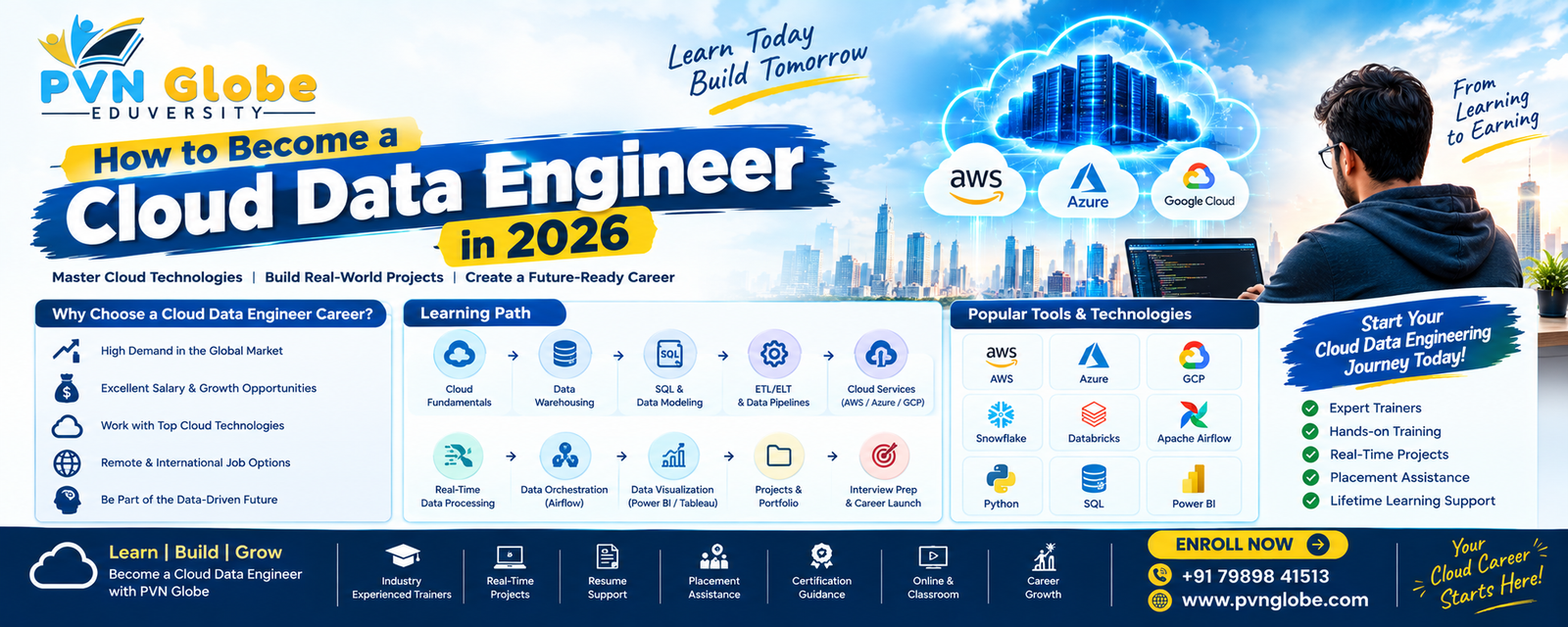
Complete Cloud Data Engineer Learning Roadmap for 2026
A structured learning roadmap can make the Cloud Data Engineering journey easier to manage.
The first stage should focus on SQL and database fundamentals.
The second stage can introduce Python programming and automation.
The third stage should cover data engineering concepts such as ETL, ELT, data pipelines, data modeling, data warehouses and data lakes.
The fourth stage can introduce cloud computing fundamentals, including storage, compute, networking, identity and security.
The fifth stage should involve selecting a primary cloud or data platform.
Learners interested in Microsoft’s ecosystem can explore Azure Data Engineering and Azure Data Factory.
Learners interested in Google’s ecosystem can explore GCP and its data services.
Learners interested in cloud data warehousing can explore Snowflake.
The next stage should involve practical projects.
After developing practical skills, learners can prepare for relevant certifications.
The final stage should focus on continuous improvement, advanced projects and specialization.
Cloud Data Engineering is not a technology career that ends after completing one course. Cloud platforms, data architectures and engineering practices continue to evolve.
Professionals should therefore continue learning new tools and concepts throughout their careers.
Conclusion: Become a Cloud Data Engineer in 2026 with PVN Globe Academy
Becoming a Cloud Data Engineer in 2026 requires a combination of data engineering fundamentals, programming knowledge, cloud skills and practical experience.
SQL and databases provide the foundation. Python adds programming and automation capabilities. ETL, ELT, data modeling and data pipeline concepts help professionals understand how information moves through modern data architectures.
Cloud platforms such as Azure and GCP provide infrastructure and data services, while specialized platforms such as Snowflake provide capabilities for modern cloud data workloads.
Projects are an important part of the learning journey because they allow learners to connect theoretical concepts with practical data workflows.
Certifications can provide structured learning milestones, but practical knowledge remains an important part of professional development.
PVN Globe Academy Hyderabad provides training opportunities in Snowflake, Azure Data Engineering, Azure Data Factory and GCP, helping students, freshers and working professionals explore modern cloud and data technologies.
For learners searching for Cloud Data Engineering Training in Hyderabad, building a strong foundation and following a structured roadmap can provide a clear direction for developing relevant technology skills in 2026.