
Introduction
Snowflake vs Azure Data Engineering vs GCP
Cloud computing and data engineering have become important areas of the modern technology industry. Organizations are generating increasing volumes of data and are using cloud platforms and specialized data technologies to store, process, transform and analyze that information.
For students, freshers and working professionals planning a career in data and cloud technologies, choosing a suitable learning path can be challenging. Snowflake, Azure Data Engineering and Google Cloud Platform represent different but interconnected technology areas that can lead toward data engineering, cloud engineering, analytics and related career paths.
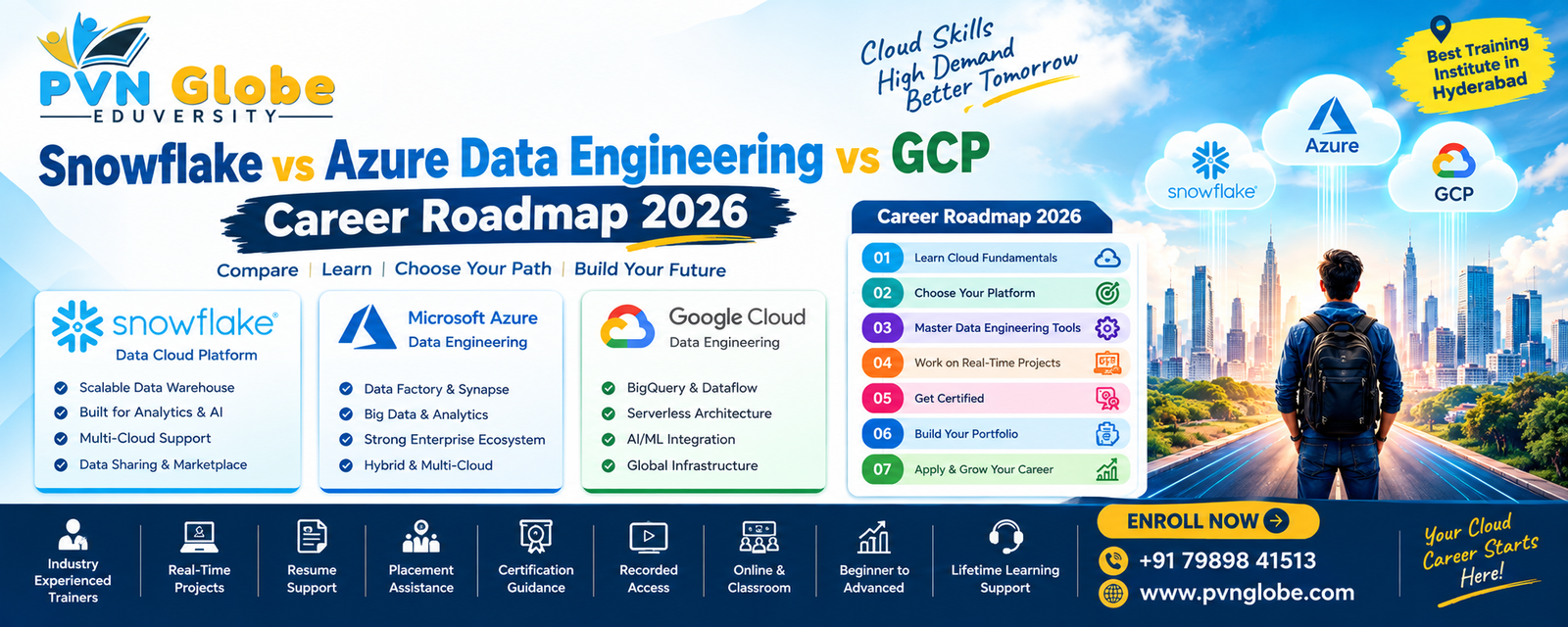
Snowflake is a cloud data platform focused strongly on data warehousing, analytics and modern data workloads. Azure Data Engineering combines data engineering concepts with Microsoft’s Azure ecosystem and services such as Azure Data Factory and other data platforms. GCP provides a broad cloud ecosystem covering infrastructure, data, analytics, artificial intelligence and application development.
Rather than considering these technologies as direct substitutes in every situation, it is more useful to understand their roles within the larger cloud and data ecosystem.
For learners in Hyderabad, these technologies represent several possible directions for building modern IT skills. PVN Globe Academy Hyderabad provides training opportunities in Snowflake, Azure Data Engineering, Azure Data Factory and GCP, allowing learners to explore different aspects of cloud and data engineering.
This comprehensive guide compares Snowflake, Azure Data Engineering and GCP, explains their skill requirements and career directions, and presents a practical learning roadmap for 2026.
The Growth of Cloud and Data Engineering in 2026
Data has become a central component of modern businesses. Organizations use data to understand customers, monitor operations, improve products, manage finances and support decision-making.
The growth of cloud computing has changed how organizations build data environments. Instead of maintaining every component within traditional data centers, organizations can use cloud services for storage, computing, databases, analytics, security and data processing.
This has created demand for professionals who understand how data moves through modern technology environments.
Data engineering is particularly important because analytical systems depend on reliable and well-managed data pipelines. Data engineers work with processes that collect information from different sources, transform it and make it available for analytics or other applications.
Snowflake, Azure and GCP can all participate in modern data architectures, although they serve different purposes and provide different technology ecosystems.
For a learner, understanding these distinctions is more valuable than simply memorizing product names. A strong career foundation comes from understanding databases, SQL, cloud concepts, data pipelines, programming and data architecture.
PVN Globe Academy Hyderabad provides learning paths that can help students and professionals explore these technologies as part of their broader technology development.
Understanding Snowflake
Snowflake is a cloud-based data platform designed to support data storage, processing, analytics and modern data workloads.
One of the reasons Snowflake attracts attention among data professionals is its focus on cloud data warehousing and analytics. It provides capabilities that allow organizations to work with structured and other forms of data while using cloud-based infrastructure.
For learners, Snowflake training generally involves understanding SQL, databases, data loading, data transformation, data warehousing concepts and cloud data architecture.
Snowflake can be particularly relevant to professionals who want to move toward data engineering, analytics engineering, cloud data warehousing or data platform roles.
However, learning Snowflake should not be treated as learning only a single software product. A successful data professional also needs to understand the fundamentals behind the platform.
SQL is especially important because it is widely used for querying and transforming data. Understanding databases, tables, schemas, data types and data modeling can make Snowflake concepts easier to understand.
Python can also complement Snowflake knowledge, particularly for professionals working with automation, data processing and advanced data workflows.
Understanding Azure Data Engineering
Azure Data Engineering refers to building and managing data solutions using Microsoft Azure and related data technologies.
Azure provides a broad cloud ecosystem that includes services for computing, storage, databases, data integration, analytics, security and artificial intelligence.
A data engineer working within Azure may interact with multiple services rather than using one platform for every task.
Azure Data Factory is an important component of the Azure data ecosystem. It supports data integration and pipeline-oriented workflows that move and transform information between different sources.
Azure data engineering can therefore provide a broader cloud-based learning path for professionals who want to understand both data engineering and cloud services.
Learners may study SQL, Python, data integration, ETL and ELT concepts, cloud storage, data pipelines, data processing and analytics.
The Microsoft ecosystem can also be useful for professionals working in organizations that already use Microsoft technologies across their IT environments.
PVN Globe Academy Hyderabad provides Azure Data Engineering and Azure Data Factory training for learners interested in developing these skills.
Understanding Google Cloud Platform
Google Cloud Platform, commonly known as GCP, is a broad cloud computing ecosystem that provides infrastructure, storage, databases, data analytics, machine learning and application development services.
GCP can support multiple career directions. A learner may use GCP knowledge to develop toward cloud engineering, data engineering, data analytics, machine learning or application development.
The data ecosystem within GCP includes technologies designed for large-scale analytics and data processing.
For beginners, GCP learning should start with cloud fundamentals. Understanding computing, networking, storage, identity, security and resource management provides a foundation before moving into specialized data services.
For data professionals, GCP can then be connected with data storage, processing, analytics and machine learning.
The broad nature of GCP makes it different from learning a specialized cloud data platform. A learner can develop knowledge across multiple aspects of cloud technology.
PVN Globe Academy Hyderabad provides GCP-oriented training for students and professionals who want to explore cloud and data careers.
Snowflake vs Azure Data Engineering vs GCP
Snowflake, Azure Data Engineering and GCP should be understood according to their roles in a technology architecture.
Snowflake is primarily associated with cloud data workloads, particularly data warehousing and analytics. It can be an attractive learning direction for someone who wants to specialize in modern data platforms.
Azure Data Engineering combines data engineering with the broader Microsoft Azure cloud ecosystem. It can therefore provide exposure to data integration, pipelines, cloud storage and other Azure services.
GCP is a broader cloud platform. It can support infrastructure, application development, data engineering, analytics and artificial intelligence.
The technologies can also work together in real-world environments. Organizations may use one cloud platform for infrastructure while using specialized data technologies for analytics and warehousing.
Therefore, learning one technology does not necessarily prevent a professional from learning another later.
A strong data engineering professional can eventually develop multi-cloud knowledge while maintaining deeper specialization in one or two core technologies.
Skills Required for Snowflake Careers
A Snowflake-oriented career path starts with strong data fundamentals.
SQL is one of the most important skills because professionals frequently work with queries, data transformation and analytical workloads.
Database concepts are also important. Learners should understand schemas, tables, views, relationships, data types and data modeling.
Cloud fundamentals can help professionals understand how Snowflake operates within cloud environments.
Data loading and transformation concepts are also important because data must often be moved from operational systems into analytical environments.
Python can provide additional value for professionals working with automation and advanced data workflows.
As professionals progress, they can explore areas such as Snowflake architecture, performance considerations, data sharing, security, governance and advanced data workloads.
PVN Globe Academy’s Snowflake training can provide a structured environment for learners who want to develop these skills.
Skills Required for Azure Data Engineering
Azure Data Engineering requires a combination of data, programming and cloud knowledge.
SQL is an essential foundation because data engineers frequently query and transform information.
Python can support automation and data processing tasks.
Learners should understand ETL and ELT concepts, data pipelines, data integration and data transformation.
Azure fundamentals are also important. Professionals need to understand concepts related to cloud storage, compute resources, identity, networking and security.
Azure Data Factory is particularly relevant for understanding data pipeline workflows.
As learners progress, they can explore additional Azure data services and analytics technologies.
A successful Azure data engineer generally needs more than knowledge of individual Azure services. Understanding how different services fit into a complete data architecture is an important part of professional development.
Skills Required for GCP Careers
GCP learning starts with general cloud computing knowledge.
Learners should understand concepts such as compute, storage, networking, identity and access management, security and cloud resource management.
For data engineering, additional knowledge of SQL, Python, databases, data pipelines and analytical systems can be useful.
Professionals interested in machine learning can build upon these foundations by studying data processing, model development and AI-related services.
GCP professionals may eventually specialize in cloud infrastructure, data engineering, analytics, machine learning or application development.
The broad nature of GCP means learners should create a clear specialization rather than attempting to learn every service simultaneously.
PVN Globe Academy’s GCP training can provide a structured starting point for learners exploring the Google Cloud ecosystem.
SQL as the Foundation of Data Engineering
SQL remains one of the most important skills for people entering data-related careers.
Whether a learner chooses Snowflake, Azure Data Engineering or GCP, understanding SQL can make the learning journey significantly easier.
SQL allows professionals to retrieve, filter, join, aggregate and transform information stored in databases and data platforms.
A beginner should first understand basic queries and gradually progress toward joins, subqueries, common table expressions, window functions, aggregations and more advanced analytical queries.
Understanding SQL also helps learners think about data logically.
For example, a data engineer needs to understand how tables relate to each other and how transformations affect datasets.
A learner planning to study Snowflake, Azure Data Engineering or GCP should therefore consider SQL a core part of the learning roadmap.
PVN Globe Academy can help learners connect SQL knowledge with broader data engineering technologies.
Python and Programming for Data Engineering
Python is another valuable skill for modern data professionals.
While SQL is highly important for querying and transforming data, Python can support automation, data processing, scripting and integration tasks.
A beginner does not necessarily need to become an advanced software developer before starting data engineering. However, understanding programming fundamentals can make it easier to work with data pipelines and automation.
Learners can gradually develop knowledge of variables, functions, collections, modules, error handling and file processing.
Python libraries can then be introduced for data manipulation and analysis.
Python can complement Snowflake, Azure and GCP learning because modern cloud data environments often involve programming and automation.
A learner who combines SQL, Python and cloud fundamentals can build a stronger foundation for progressing into data engineering.
Data Pipelines, ETL and ELT
Data pipelines are central to data engineering.
Organizations typically collect data from multiple sources. This information may need to be extracted, transformed and loaded into a data warehouse, data lake or analytical platform.
ETL refers to extracting data, transforming it and loading it into a target environment.
ELT changes the order by loading data first and performing transformations within the target data platform.
Understanding these concepts helps learners understand why tools such as Azure Data Factory and cloud data platforms are important.
Snowflake can be used as part of modern data architectures, while Azure provides services for building data integration workflows. GCP also provides services for data processing and analytics.
Learning data pipelines helps professionals think beyond individual tools.
Instead of asking only how a particular platform works, learners begin to understand how data moves through an organization’s technology environment.
Snowflake Career Paths
Snowflake knowledge can support several data-oriented career directions.
A learner may develop toward data engineering, cloud data warehousing, analytics engineering or data platform roles depending on their broader skills and experience.
Data engineers working with Snowflake may be involved in data ingestion, transformation, modeling, warehouse development and data platform management.
Analytics-focused professionals may use Snowflake for analytical workloads and reporting environments.
Professionals can also expand their skills into data governance, security, performance optimization and cloud architecture.
Career progression depends on experience and the ability to work with real data environments.
Training provides a foundation, but professionals generally develop deeper expertise through practical projects and workplace exposure.
For learners in Hyderabad, Snowflake training can be one possible pathway into the broader cloud data engineering ecosystem.
Azure Data Engineering Career Paths
Azure Data Engineering can lead toward roles focused on data pipelines, data integration, cloud data platforms and analytics infrastructure.
A data engineer may work with data ingestion, transformation, storage and processing.
Azure professionals can also develop toward broader cloud roles as their knowledge expands.
Understanding Azure Data Factory can provide practical exposure to pipeline design and data integration.
Professionals may also combine Azure knowledge with SQL, Python, data modeling and analytics technologies.
The Microsoft ecosystem provides opportunities to develop both specialized and broader cloud skills.
For learners already familiar with Microsoft technologies, Azure can provide a natural extension into cloud data engineering.
PVN Globe Academy Hyderabad provides Azure Data Engineering training for learners interested in developing this combination of cloud and data skills.
GCP Career Paths
GCP can support career development across cloud engineering, data engineering, analytics, machine learning and application development.
A learner interested in data can specialize in cloud-based data processing and analytics.
Someone interested in infrastructure can explore cloud engineering and platform operations.
Professionals with programming backgrounds can combine GCP with application development and cloud-native technologies.
Learners interested in artificial intelligence can explore how GCP supports machine learning and AI workloads.
Because GCP is a broad cloud platform, career specialization becomes increasingly important as the learner progresses.
Building a strong foundation and then selecting a specific area can make the learning process more manageable.
PVN Globe Academy’s GCP training can provide learners with a structured starting point before they progress toward more advanced specialization.
Learning Roadmap for Beginners
A beginner should generally start with fundamental concepts before attempting advanced cloud data technologies.
The first stage can involve understanding basic computer concepts, databases and SQL.
The next stage can introduce Python and programming fundamentals.
After that, learners can study data engineering concepts such as ETL, ELT, data pipelines, data warehouses and data lakes.
Cloud fundamentals should then be introduced, including storage, computing, networking, identity and security.
Once these foundations are established, the learner can choose a specialization.
A Snowflake learner can progress toward cloud data warehousing and analytics.
An Azure learner can move into Azure Data Engineering and Azure Data Factory.
A GCP learner can specialize in cloud data engineering, analytics, infrastructure or AI.
This staged approach helps learners understand the concepts behind the tools rather than simply memorizing platform-specific features.
Learning Roadmap for Working Professionals
Working professionals may already have valuable experience that can be connected with cloud and data technologies.
A database professional may already possess strong SQL knowledge and can progress toward Snowflake or cloud data engineering.
A Microsoft technology professional may find Azure Data Engineering relevant to existing skills.
A developer can combine Python and programming knowledge with cloud and data engineering.
An infrastructure professional can build upon cloud fundamentals and progress toward GCP or Azure.
Professionals should identify their existing strengths before selecting a learning path.
The goal should be to add complementary skills rather than unnecessarily starting from the beginning.
For example, a SQL professional does not need to spend excessive time repeating database fundamentals. Instead, the learner can strengthen cloud concepts, pipelines and data architecture.
This approach can make professional learning more focused and practical.
Projects and Practical Data Engineering Experience
Practical projects can help learners understand how cloud and data technologies work together.
A beginner Snowflake project might involve loading datasets, creating tables, writing SQL transformations and developing analytical queries.
An Azure Data Engineering project could involve building a pipeline that extracts information from a source, transforms the data and stores it in a cloud-based analytical environment.
A GCP project could involve designing a cloud data workflow using appropriate storage, processing and analytics services.
The purpose of a project is not simply to create a portfolio item. It is to understand the complete technology workflow.
Learners should be able to explain where data originates, how it moves, how it is transformed and where it is ultimately consumed.
PVN Globe Academy Hyderabad emphasizes practical-oriented technology learning, which can help learners connect theoretical concepts with realistic technology scenarios.
Snowflake, Azure and GCP Certifications
Certifications can provide a structured way to validate knowledge of particular technologies, although certification alone does not replace practical experience.
Snowflake offers certification pathways associated with its platform.
Microsoft provides certification paths for Azure and data-related technologies.
Google Cloud provides certifications covering cloud and data-related professional skills.
Certification preparation can encourage learners to study platform architecture, terminology, services and practical concepts systematically.
However, learners should focus on understanding the technology rather than preparing only to pass an examination.
Combining certification preparation with hands-on projects can provide a broader learning experience.
PVN Globe Academy learners can use structured training to prepare for technology learning milestones while continuing to develop practical skills.
Comparing the Learning Experience and Career Direction
Snowflake, Azure Data Engineering and GCP represent different learning experiences.
Snowflake places greater emphasis on cloud data warehousing, SQL, analytics and modern data platform concepts.
Azure Data Engineering combines data engineering with Microsoft’s broader cloud ecosystem. Learners can work with data integration, pipelines and Azure services.
GCP provides a broad cloud platform that extends across infrastructure, data, analytics, machine learning and application development.
The right learning direction depends on the learner’s existing background and career goals.
A database-oriented learner may naturally be interested in Snowflake. Someone interested in Microsoft cloud technologies may explore Azure Data Engineering. A learner seeking broader cloud exposure may explore GCP.
Professionals can also eventually learn multiple platforms.
In modern technology environments, multi-cloud and cross-platform knowledge can be useful, but learners should first establish strong fundamentals and meaningful expertise in at least one area.
Building a Long-Term Cloud Data Engineering Career
A long-term technology career requires continuous skill development.
The cloud and data ecosystem continues to evolve, and professionals need to keep learning new services, architectures, security practices and engineering approaches.
A strong career foundation can begin with SQL, Python, databases and data engineering concepts.
The learner can then specialize in Snowflake, Azure or GCP according to professional objectives.
Over time, additional skills such as cloud architecture, data governance, security, DevOps, artificial intelligence and automation can be added.
The most important objective is not simply to collect technology names. It is to develop the ability to design, understand, troubleshoot and improve technology solutions.
PVN Globe Academy Hyderabad provides learners with training opportunities across Snowflake, Azure Data Engineering and GCP, allowing students and professionals to explore modern cloud and data technologies.
Conclusion: Snowflake vs Azure Data Engineering vs GCP
Snowflake, Azure Data Engineering and GCP each provide valuable opportunities for professionals interested in modern cloud and data careers, but they represent different technology directions.
Snowflake is strongly associated with cloud data warehousing, analytics and modern data platform workloads. Azure Data Engineering combines data engineering with the Microsoft Azure ecosystem and data integration services. GCP provides a broad cloud environment covering infrastructure, data, analytics, machine learning and application development.
For beginners, the strongest starting point is usually a foundation in SQL, Python, databases, cloud computing and data engineering concepts. Once these foundations are established, learners can select a specialization based on their interests and professional background.
For working professionals, existing experience can help determine the most relevant path. Database professionals may explore Snowflake, Microsoft-oriented professionals may explore Azure Data Engineering, and cloud-focused learners may explore GCP.
PVN Globe Academy Hyderabad provides training opportunities across these technology areas, helping learners explore modern cloud and data engineering skills in a structured learning environment.
As the technology industry continues to evolve in 2026, professionals who combine strong fundamentals with practical skills, cloud knowledge and continuous learning can build a more adaptable technology skill set.