
Introduction
Data has become one of the most important assets for modern organizations. Companies across banking, healthcare, retail, manufacturing, e-commerce, telecom, logistics, and technology generate enormous amounts of information every day.
But collecting data is only the beginning.
Organizations need professionals who can ingest, transform, store, secure, process, govern, and optimize data.
This is where Data Engineers come in.
In 2026, three technology paths receive significant attention from learners and professionals:
- Azure Data Engineer
- AWS Data Engineer
- Snowflake Data Engineer
Although these roles have similar objectives, their technology ecosystems are different.
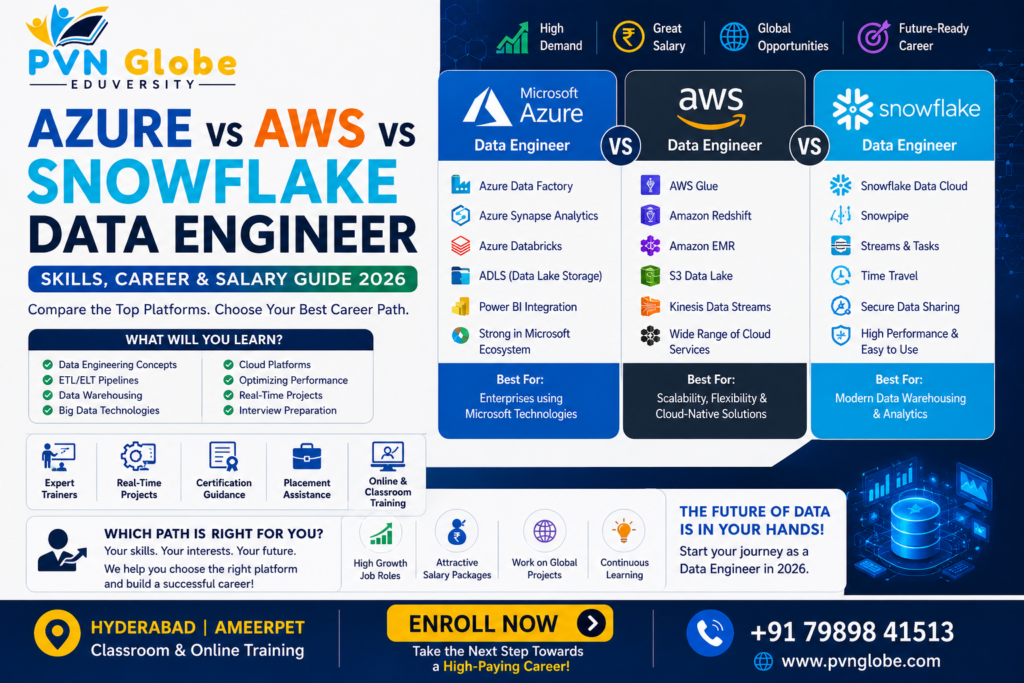
An Azure-focused engineer may work with services such as Azure Data Factory, Azure Data Lake Storage, Azure Databricks, Synapse and Microsoft Fabric.
An AWS-focused engineer may work with Amazon S3, AWS Glue, Amazon Redshift, Amazon Athena, EMR and related AWS services.
A Snowflake-focused engineer works heavily with Snowflake’s cloud data platform, SQL, Snowpark, Snowpipe, Dynamic Tables and modern data-engineering capabilities. Snowflake’s current data-engineering ecosystem also includes Snowpipe Streaming, OpenFlow, Snowpark and Iceberg interoperability.
So which career path should you choose?
Azure vs AWS vs Snowflake?
The answer depends on your career goals, existing skills, preferred technology ecosystem, target companies, and the type of data-engineering work you want to perform.
This comprehensive guide from PVN Globe Academy explains the differences.
What Is a Data Engineer?
Before comparing the three career paths, it is important to understand the role itself.
A Data Engineer designs and maintains systems that collect, process, store, and deliver data.
A typical data-engineering lifecycle looks like:
Data Sources → Ingestion → Storage → Transformation → Data Warehouse/Lakehouse → Analytics → Business Decisions
Common Data Engineer Responsibilities
A Data Engineer may be responsible for:
- Building data pipelines
- Developing ETL/ELT workflows
- Integrating databases
- Processing large datasets
- Designing data warehouses
- Managing data lakes
- Creating data models
- Ensuring data quality
- Monitoring pipelines
- Optimizing performance
- Managing cloud resources
- Implementing data security
- Supporting analytics teams
- Working with data scientists
- Automating data workflows
The fundamental skills remain similar across platforms.
The difference is the technology stack used to implement those responsibilities.
Azure Data Engineer in 2026
An Azure Data Engineer works primarily with Microsoft’s cloud ecosystem.
Azure is widely used by organizations that already have Microsoft technologies across their enterprise environments.
Major Azure Data Technologies
A learner may encounter:
- Azure Data Factory
- Azure Data Lake Storage
- Azure Blob Storage
- Azure Databricks
- Azure Synapse Analytics
- Microsoft Fabric
- Azure SQL
- Power BI
- Microsoft Purview
- Azure Key Vault
Microsoft’s current Fabric Data Engineer Associate certification describes the data-engineer role around data loading patterns, data architectures, orchestration, ingestion and transformation, security, monitoring, and optimization, with SQL, PySpark and KQL among the stated skills.
Azure Data Engineering Architecture
A simplified architecture can look like:
- SQL Server / APIs / Applications
- Azure Data Factory
- Azure Data Lake Storage
- Azure Databricks / Fabric
- Transformation
- Warehouse / Lakehouse
- Power BI
- Business Users
AWS Data Engineer in 2026
An AWS Data Engineer works with Amazon Web Services to build and operate cloud data platforms.
AWS has a broad collection of services covering storage, ingestion, processing, analytics, databases, security, governance, and monitoring.
Important AWS Data Engineering Services
Common technologies include:
- Amazon S3
- AWS Glue
- Amazon Redshift
- Amazon Athena
- Amazon EMR
- Amazon Kinesis
- AWS Lambda
- AWS Lake Formation
- AWS Step Functions
- AWS IAM
- Amazon CloudWatch
AWS’s current Data Engineer – Associate certification is organized around four major areas:
- Data ingestion and transformation
- Data store management
- Data operations and support
- Data security and governance
Example AWS Architecture
- Applications / Databases / APIs
- AWS Glue / Kinesis
- Amazon S3
- Glue / EMR / Spark
- Amazon Redshift / Athena
- BI / Analytics
- Snowflake Data Engineer in 2026
Snowflake is different from Azure and AWS because it is primarily a cloud data platform, rather than a broad hyperscale cloud provider.
A Snowflake-focused Data Engineer works heavily with:
- Snowflake SQL
- Data Warehousing
- Data Lakes
- Data Sharing
- Snowpark
- Snowpipe
- Snowpipe Streaming
- Dynamic Tables
- Streams
- Tasks
- Stored Procedures
- Python
- dbt
- Apache Iceberg
Snowflake’s current data-engineering material highlights capabilities including Dynamic Tables, OpenFlow, Snowpipe Streaming, Snowpark and Iceberg interoperability.
Example Snowflake Architecture
- Source Systems
- Ingestion
- Cloud Storage / Snowpipe
- Snowflake
- Transformation
- Curated Data
- BI / Analytics / AI
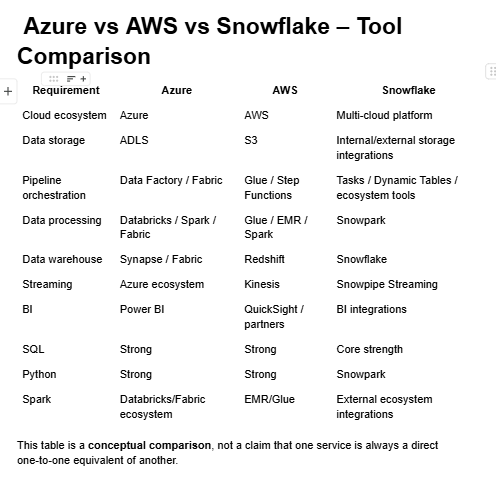
- Azure vs AWS vs Snowflake – Core Difference
The simplest way to understand the difference is:
Platform | Primary Focus |
Azure | Broad Microsoft cloud ecosystem + data engineering |
AWS | Broad Amazon cloud ecosystem + data engineering |
Snowflake | Cloud-native data platform and analytics |
Azure
Best suited for professionals interested in the Microsoft ecosystem and enterprise cloud environments.
AWS
Strong option for professionals wanting broad AWS cloud expertise combined with data engineering.
Snowflake
Excellent choice for professionals focusing on cloud data warehousing, analytics, modern data platforms, and data engineering.
Skills Comparison
Although the platforms differ, several fundamental skills are common.
Common Skills
SQL
SQL is essential for all three paths.
Python
Python is useful for:
- Automation
- APIs
- Data transformation
- Data processing
- Spark
- Snowpark
Data Warehousing
Understand:
- Fact tables
- Dimensions
- Star schema
- Slowly Changing Dimensions
- Data marts
ETL/ELT
Understand how data moves from source systems to analytical platforms.
Data Modeling
Learn how to organize data for reporting and analytics.
Cloud Fundamentals
Understand:
- Storage
- Compute
- Networking
- Identity
- Security
- Monitoring
Azure Data Engineer Skills
A strong Azure Data Engineer should understand:
Core
- SQL
- Python
- Data engineering
- ETL/ELT
- Data modeling
Azure
- Azure Data Factory
- ADLS
- Azure Databricks
- PySpark
- Synapse
- Microsoft Fabric
- Power BI
- Purview
Advanced
- Incremental loading
- CDC
- SCD
- Pipeline orchestration
- Data quality
- Security
- Monitoring
- CI/CD
- Cost optimization
Career Advantage
Azure can be particularly attractive to professionals already working with:
- Microsoft SQL Server
- Power BI
- Microsoft 365
- Dynamics
- .NET
- Enterprise Microsoft environments
AWS Data Engineer Skills
AWS Data Engineers need strong cloud and data-processing knowledge.
Core Skills
- SQL
- Python
- Data modeling
- ETL/ELT
- Data pipelines
AWS Skills
- Amazon S3
- AWS Glue
- Redshift
- Athena
- EMR
- Kinesis
- Lambda
- IAM
- Lake Formation
Advanced Skills
- Spark
- Streaming
- Data governance
- Security
- Cost optimization
- Monitoring
- Infrastructure automation
AWS’s official Data Engineer Associate scope includes tasks around choosing data stores, cataloging data, lifecycle management, schema evolution, automation, analytics, pipeline monitoring, and data quality.
Snowflake Data Engineer Skills
Snowflake Data Engineers need strong data-platform skills.
Core Skills
- SQL
- Python
- Data warehousing
- Data modeling
- ETL/ELT
Snowflake Skills
- Snowflake architecture
- Virtual warehouses
- Databases
- Schemas
- Tables
- Views
- Stages
- File formats
- Streams
- Tasks
- Snowpipe
Advanced Skills
- Snowpark
- Dynamic Tables
- Snowpipe Streaming
- Data sharing
- Performance optimization
- Cost optimization
- Governance
- Iceberg
- dbt integration
Snowflake’s current data-engineering resources specifically highlight Dynamic Tables, Snowpipe Streaming, Snowpark and Iceberg interoperability as modern capabilities.
Career Opportunities in 2026
All three paths can lead to multiple career roles.
Azure Career Roles
- Azure Data Engineer
- Cloud Data Engineer
- Data Engineer
- Azure Analytics Engineer
- Data Platform Engineer
- Fabric Data Engineer
- BI/Data Engineer
AWS Career Roles
- AWS Data Engineer
- Cloud Data Engineer
- Data Engineer
- AWS Analytics Engineer
- Big Data Engineer
- Data Platform Engineer
Snowflake Career Roles
- Snowflake Data Engineer
- Data Engineer
- Analytics Engineer
- Snowflake Developer
- Cloud Data Engineer
- Data Warehouse Engineer
- Data Platform Engineer
Salary Guide in 2026
Salary should be treated carefully because there is no single universal salary for any of these roles.
Compensation varies based on:
- Country
- City
- Experience
- Employer
- Technical specialization
- Industry
- Certification
- Project experience
- Interview performance
- Cloud architecture skills
For India, especially Hyderabad, Bengaluru, Pune, Chennai, Mumbai and NCR, compensation can vary substantially between companies and experience levels.
Typical Career Progression
- Fresher / Junior
- Data Engineer
- Senior Data Engineer
- Lead Data Engineer
- Data Architect / Cloud Data Architect
- The platform itself does not guarantee a particular salary.
A professional with strong SQL + Python + cloud + architecture + project experience may have a stronger profile than someone who only holds a platform certification.
Certification Comparison in 2026
Certification strategies have changed, especially on the Microsoft side.
Microsoft
The previous Azure Data Engineer Associate / DP-203 exam was retired on March 31, 2025. Microsoft currently lists Fabric Data Engineer Associate with exam DP-700 as its current data-engineering credential.
AWS
AWS currently provides AWS Certified Data Engineer – Associate (DEA-C01). Its official exam scope covers ingestion/transformation, data stores, operations/support, and security/governance.
Snowflake
Snowflake provides certification and training pathways around its data platform and data-engineering ecosystem. Snowflake also emphasizes certification as a way to validate data-engineering skills.
Important Advice
Don’t choose a course only because it promises a certification.
Choose a learning path that combines:
Skills + Projects + Certification + Interview Preparation
Which Is Easier to Learn?
There is no universal answer.
Azure
Beginners familiar with Microsoft technologies may find Azure easier to understand.
AWS
AWS has a broad service ecosystem, so beginners may need more time to understand how the different services fit together.
Snowflake
Snowflake can feel more focused for learners who primarily want data warehousing and cloud analytics.
For Freshers
A practical approach is:
SQL → Python → Data Engineering → One Cloud/Data Platform → Projects
Don’t try to master Azure, AWS, and Snowflake simultaneously.
Which Data Engineer Career Should You Choose?
Choose Azure if:
You want to work with:
- Microsoft technologies
- Azure cloud
- Data Factory
- Databricks
- Synapse/Fabric
- Power BI
- Enterprise Microsoft environments
Choose AWS if:
You want to work with:
- AWS cloud
- S3
- Glue
- Redshift
- EMR
- Kinesis
- Large AWS environments
Choose Snowflake if:
You want to specialize in:
- Cloud data warehousing
- Analytics
- Modern data platforms
- Snowflake SQL
- Snowpark
- Data sharing
- ELT
- Cloud-native analytics
The Best Choice?
The “best” platform depends on your target role and the companies you want to work for.
Why Choose PVN Globe Academy?
PVN Globe Academy provides career-focused technology training for learners who want to develop practical skills in cloud, data, analytics, and enterprise technologies.
For students interested in comparing Azure Data Engineer vs AWS Data Engineer vs Snowflake Data Engineer, PVN Globe can help learners understand the skills and technology ecosystems involved in each career path.
PVN Globe Data Engineering Learning Areas
Azure
- Azure Data Factory
- Azure Data Lake
- Databricks
- PySpark
- Synapse
- Microsoft Fabric
AWS
- Amazon S3
- AWS Glue
- Redshift
- Athena
- EMR
- Kinesis
Snowflake
- Snowflake SQL
- Snowpipe
- Snowpark
- Dynamic Tables
- Streams & Tasks
- Data Warehousing
Common Foundation
PVN Globe learners can focus on:
SQL + Python + Data Engineering + Cloud + ETL/ELT + Data Modeling + Projects + Interview Preparation
Azure vs AWS vs Snowflake – Final Verdict
There is no single winner between Azure Data Engineer, AWS Data Engineer, and Snowflake Data Engineer.
Each career path has its own strengths.
Azure Data Engineer
Best for: Microsoft-oriented enterprise environments and professionals interested in Azure’s data and analytics ecosystem.
AWS Data Engineer
Best for: Professionals seeking broad AWS cloud and data-engineering experience.
Snowflake Data Engineer
Best for: Professionals focusing on cloud data warehousing, analytics, ELT, and modern data platforms.
The Most Important Skills
Regardless of platform, develop:
- SQL
- Python
- Data Engineering
- ETL/ELT
- Data Modeling
- Cloud/Data Platform
- Projects
- Interview Preparation
The strongest Data Engineers don’t simply know how to use one service.
They understand why a technology is selected, how it fits into an architecture, how to make it secure and scalable, and how to solve real business problems with data.