
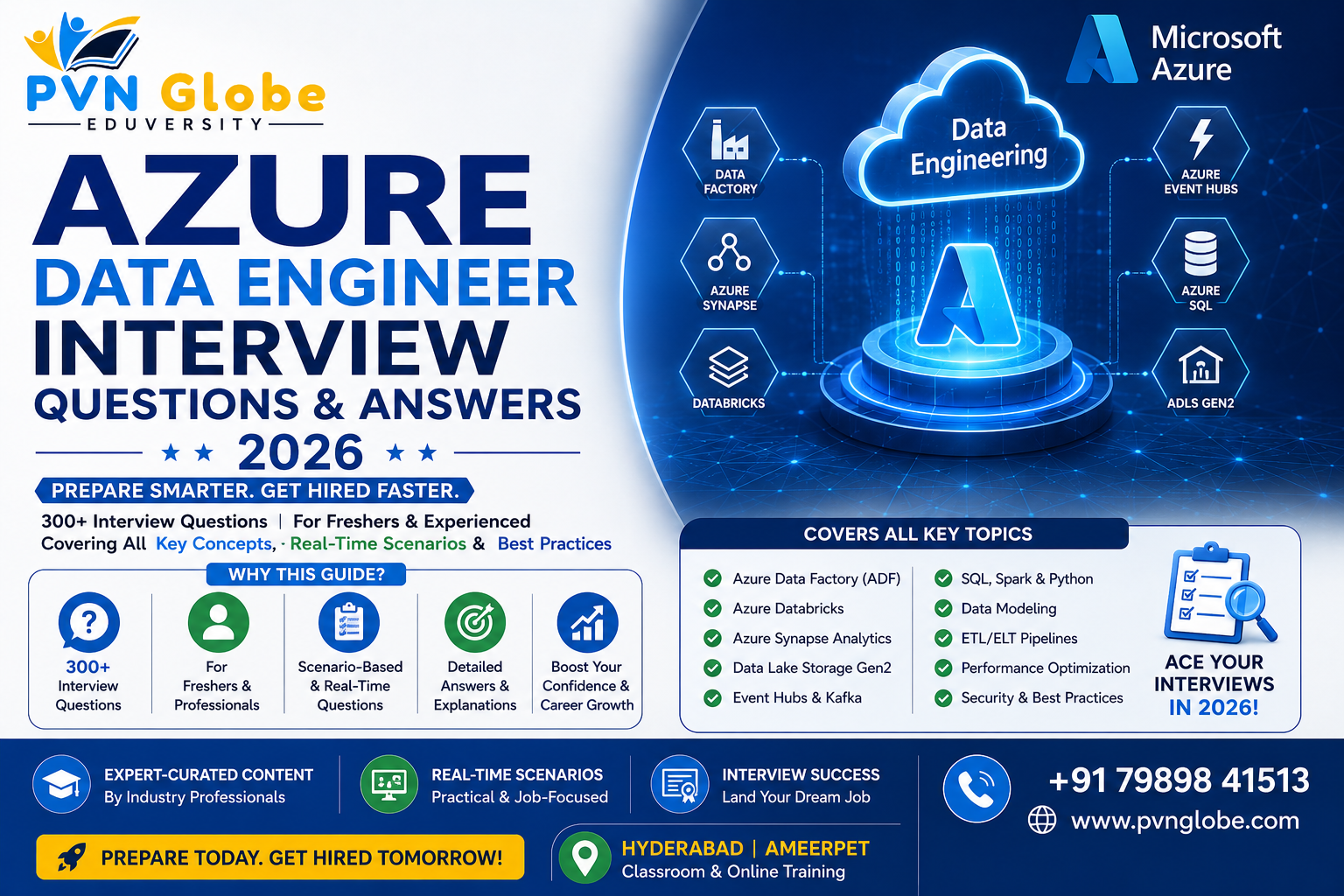
PVN Globe Academy – Azure Data Engineer Training & Career Services
Master Azure Data Engineering with PVN Globe Academy
PVN Globe Academy offers career-focused Azure Data Engineer Training designed for freshers, working professionals, and IT professionals who want to build practical skills in modern cloud data engineering.
Our training approach focuses on the complete Azure Data Engineering lifecycle—from SQL and Python fundamentals to Azure Data Factory, Azure Data Lake Storage, Azure Databricks, PySpark, Azure Synapse Analytics, data warehousing, ETL/ELT, data pipelines, and real-world project scenarios
Azure Data Engineer Interview Questions & Answers for Freshers
1. What is Azure Data Engineering?
Answer: Azure Data Engineering is the process of collecting, storing, transforming, processing, and managing data using Microsoft Azure cloud services. Azure Data Engineers build data pipelines and platforms that make data available for analytics and reporting.
2. Who is an Azure Data Engineer?
Answer: An Azure Data Engineer is a professional who designs, develops, and maintains data solutions using Azure services such as Azure Data Factory, Azure Data Lake Storage, Azure Databricks, and Azure Synapse Analytics.
3. What are the main responsibilities of an Azure Data Engineer?
Answer: Responsibilities include data ingestion, pipeline development, data transformation, data storage, data modeling, data quality, monitoring, security, performance optimization, and supporting analytics teams.
4. What is Microsoft Azure?
Answer: Microsoft Azure is a cloud computing platform that provides services for computing, storage, networking, databases, analytics, AI, security, and application development.
5. Why is SQL important for a Data Engineer?
Answer: SQL is essential for querying databases, joining tables, filtering data, aggregating information, transforming datasets, and analyzing data stored in relational systems.
6. What is a database?
Answer: A database is an organized collection of data that allows applications and users to store, retrieve, update, and manage information.
7. What is ETL?
Answer: ETL stands for Extract, Transform, Load. Data is extracted from source systems, transformed according to business requirements, and loaded into a target system.
8. What is ELT?
Answer: ELT means Extract, Load, Transform. Data is first loaded into the target platform and transformation happens there.
9. What is a data pipeline?
Answer: A data pipeline is a sequence of processes that moves data from one or more sources to a destination while performing required transformations.
10. What is Azure Data Factory?
Answer: Azure Data Factory is a cloud-based data integration service used to create, schedule, orchestrate, and monitor data pipelines.
11. What is a pipeline in Azure Data Factory?
Answer: An ADF pipeline is a logical grouping of activities that performs a data integration workflow.
12. What is an activity in ADF?
Answer: An activity represents an individual operation in a pipeline. Examples include Copy Activity, Lookup, Get Metadata, ForEach, and stored procedure execution.
13. What is a dataset in ADF?
Answer: A dataset represents the structure or location of data that an activity works with, such as a SQL table, CSV file, or JSON file.
14. What is a linked service?
Answer: A linked service stores connection information used by Azure Data Factory to connect to external data stores or compute services.
15. What is Integration Runtime?
Answer: Integration Runtime, or IR, provides the computing infrastructure used by Azure Data Factory to perform data movement and certain transformation activities.
16. What is Azure Data Lake Storage?
Answer: Azure Data Lake Storage is a scalable cloud storage service designed for large-scale analytics workloads and can store structured, semi-structured, and unstructured data.
17. What is a data lake?
Answer: A data lake is a centralized storage environment that can store large volumes of raw and processed data in different formats.
18. What is Azure Blob Storage?
Answer: Azure Blob Storage is Microsoft’s object storage service for storing unstructured data such as documents, images, logs, videos, and data files.
19. What is Azure Databricks?
Answer: Azure Databricks is a cloud-based analytics platform built around Apache Spark. It is commonly used for data engineering, large-scale data processing, analytics, and AI workloads.
20. What is Apache Spark?
Answer: Apache Spark is a distributed processing engine designed to process large datasets across multiple machines.
21. What is PySpark?
Answer: PySpark is the Python API for Apache Spark. It allows developers to use Python for distributed data processing.
22. What is a DataFrame?
Answer: A DataFrame is a distributed collection of data organized into named columns. It is commonly used in Spark for data transformation and analysis.
23. What is Azure Synapse Analytics?
Answer: Azure Synapse Analytics is an analytics service that provides capabilities for data warehousing, SQL analytics, data integration, and large-scale analytical workloads.
24. What is a data warehouse?
Answer: A data warehouse is a centralized system designed to store structured historical data for reporting, analytics, and business intelligence.
25. What is a fact table?
Answer: A fact table stores measurable business events, such as sales amount, quantity, order count, or revenue.
26. What is a dimension table?
Answer: A dimension table contains descriptive information related to business entities such as customers, products, employees, and locations.
27. What is a star schema?
Answer: A star schema consists of a central fact table connected to multiple dimension tables. It is commonly used in analytical data warehouses.
28. What is a primary key?
Answer: A primary key uniquely identifies each record in a table and should contain unique, non-null values.
29. What is a foreign key?
Answer: A foreign key is a column or group of columns that establishes a relationship between tables by referencing a key in another table.
30. What is a JOIN in SQL?
Answer: A JOIN combines rows from two or more tables based on a related column.
Common joins include:
- INNER JOIN
- LEFT JOIN
- RIGHT JOIN
- FULL OUTER JOIN
31. What is a stored procedure?
Answer: A stored procedure is a precompiled collection of SQL statements that can be executed to perform a specific database operation.
32. What is a view?
Answer: A view is a virtual table based on a SQL query. It can simplify complex queries and provide controlled access to data.
33. What is data transformation?
Answer: Data transformation is the process of changing data into a required format or structure. Examples include filtering, joining, aggregating, cleansing, and standardizing data.
34. What is data cleansing?
Answer: Data cleansing identifies and corrects problems such as duplicate records, missing values, invalid formats, and inconsistent data.
35. What is batch processing?
Answer: Batch processing processes data in groups at scheduled or defined intervals rather than processing every record immediately.
36. What is real-time data processing?
Answer: Real-time processing handles data as it arrives, allowing organizations to analyze or respond to information with low latency.
37. What is a trigger in Azure Data Factory?
Answer: A trigger starts an ADF pipeline based on a specific condition or schedule.
Examples include:
- Schedule triggers
- Tumbling window triggers
- Event-based triggers
38. What is parameterization in ADF?
Answer: Parameterization allows values such as file paths, table names, or dates to be passed dynamically into pipelines, making them reusable.
39. What is a Lookup activity?
Answer: Lookup activity retrieves data from a data source and can be used to drive decisions or dynamic processing within a pipeline.
40. What is ForEach activity?
Answer: ForEach activity iterates over a collection of items and executes one or more activities for each item.
41. What is Git?
Answer: Git is a distributed version-control system used to track changes in code, configuration, notebooks, and other project files.
42. Why is Python useful for Data Engineering?
Answer: Python is useful for automation, data transformation, API integration, file processing, scripting, and frameworks such as PySpark.
43. What is Pandas?
Answer: Pandas is a Python library used for data manipulation and analysis, especially for tabular datasets.
44. What is JSON?
Answer: JSON stands for JavaScript Object Notation. It is a lightweight data format commonly used for APIs and data exchange.
45. What is CSV?
Answer: CSV stands for Comma-Separated Values. It is a simple tabular file format commonly used to exchange data between systems.
46. What is Parquet?
Answer: Parquet is a columnar storage file format designed for efficient analytical processing and commonly used in data engineering platforms.
47. What is data partitioning?
Answer: Partitioning divides data into smaller logical sections based on a column such as date, region, or customer category. It can improve query and processing efficiency.
48. What is data quality?
Answer: Data quality refers to the accuracy, completeness, consistency, validity, uniqueness, and reliability of data.
49. What project can a fresher build?
Answer: A fresher can build a retail sales data pipeline using SQL, Azure Data Factory, Azure Data Lake, Databricks, PySpark, and Synapse. The project can demonstrate ingestion, transformation, storage, and reporting.
50. How can I become an Azure Data Engineer?
Answer: Start with SQL and Python, learn data engineering fundamentals, understand Azure services, practice Azure Data Factory, Data Lake, Databricks, PySpark, and Synapse, build projects, prepare for certification, and practice interviews.
Azure Data Engineer Interview Questions & Answers for Professionals
1. How would you design an enterprise Azure data pipeline?
Answer: I would first identify the source systems, data volume, frequency, latency requirements, security requirements, and business SLAs. Then I would design ingestion using ADF or appropriate streaming tools, store raw data in ADLS, transform it using Databricks/Spark, publish curated data to the analytical layer, and implement monitoring, security, data quality, and cost optimization.
2. How would you design a metadata-driven pipeline?
Answer: I would maintain configuration metadata containing source information, destination details, table names, load types, watermark columns, and transformation rules. A generic pipeline would read this metadata and dynamically execute ingestion and transformation processes.
3. What is incremental loading?
Answer: Incremental loading processes only new or changed records instead of reprocessing the entire dataset.
Common approaches include:
- Watermark columns
- Change tracking
- CDC
- Timestamp-based loading
- Source-system change indicators
4. What is CDC?
Answer: CDC stands for Change Data Capture. It identifies inserts, updates, and deletes occurring in source systems so that downstream systems can process only the changed records.
5. Full load vs incremental load?
Answer: A full load processes the entire dataset, while an incremental load processes only new or modified records.
Full loads are simpler but can be expensive for large datasets. Incremental loads reduce processing time and cost but require additional design considerations.
6. How would you handle duplicate records?
Answer: I would identify the business key, use ranking or deduplication logic, validate source behavior, and implement appropriate uniqueness rules. In Spark, functions such as dropDuplicates() or window functions can be used depending on the requirement.
7. How would you handle late-arriving data?
Answer: I would design the pipeline to support late-arriving records using event timestamps, watermarking, reprocessing windows, or correction mechanisms. The solution depends on business requirements and the latency tolerance.
8. How do you implement Slowly Changing Dimensions?
Answer: The implementation depends on the SCD type.
For example, Type 1 overwrites the existing value, while Type 2 maintains historical versions using fields such as effective date, expiry date, and current-record indicators.
9. What is SCD Type 2?
Answer: SCD Type 2 preserves historical changes by creating a new record when a dimension attribute changes rather than overwriting the previous record.
10. How do you optimize Spark jobs?
Answer: I analyze the execution plan and consider:
- Partitioning
- Predicate pushdown
- Appropriate joins
- Broadcast joins where suitable
- Avoiding unnecessary shuffles
- Caching only when beneficial
- Efficient file formats
- Reducing data movement
- Optimizing transformations
11. What is data skew?
Answer: Data skew occurs when data is unevenly distributed across partitions, causing some Spark tasks to process significantly more data than others.
12. How do you resolve data skew?
Answer: Depending on the scenario, I may use salting, broadcast joins, repartitioning, skew-aware join strategies, filtering, or redesign the data distribution.
13. What is a broadcast join?
Answer: A broadcast join distributes a relatively small dataset to worker nodes so that Spark can perform joins without requiring a large shuffle of the smaller dataset.
14. What is a shuffle in Spark?
Answer: A shuffle occurs when Spark redistributes data across partitions, often during operations such as joins, aggregations, and repartitioning.
Shuffles can be expensive because they involve network and disk I/O.
15. What is Delta Lake?
Answer: Delta Lake is a storage layer that provides capabilities such as ACID transactions, schema enforcement, schema evolution, and reliable data management on data lakes.
16. What is schema evolution?
Answer: Schema evolution allows a dataset’s structure to change over time, such as adding columns, while maintaining compatibility with existing data and processing logic.
17. How do you handle schema drift?
Answer: I first identify which schema changes are expected and which are unexpected. I then use schema validation, metadata-driven processing, controlled schema evolution, alerts, and quarantine mechanisms where appropriate.
18. How would you troubleshoot a failed ADF pipeline?
Answer: I would check the pipeline run history, identify the failed activity, inspect error messages and input/output details, validate linked services and authentication, check source availability, verify parameters, and review integration runtime behavior.
19. How do you monitor production pipelines?
Answer: I use pipeline monitoring, logs, alerts, metrics, failure notifications, execution duration tracking, and operational dashboards. Critical pipelines should have defined SLAs and alerting thresholds.
20. How would you implement retry logic?
Answer: I would configure retries for transient failures while avoiding repeated execution for permanent failures. Retry count, retry interval, and error classification should be aligned with the source system and SLA.
21. How would you secure an Azure data platform?
Answer: I would use least-privilege access, managed identities, RBAC, network controls, encryption, secret management, private connectivity where required, auditing, and appropriate data-access policies.
22. What is Azure RBAC?
Answer: Azure Role-Based Access Control manages permissions by assigning roles to users, groups, service principals, or managed identities at appropriate scopes.
23. What is a managed identity?
Answer: A managed identity allows an Azure resource to authenticate to supported services without storing credentials directly in application code or configuration.
24. How do you manage secrets?
Answer: Secrets should be stored in a secure secret-management service such as Azure Key Vault rather than hard-coded in scripts, notebooks, or pipeline definitions.
25. How would you optimize Azure data engineering costs?
Answer: I would optimize storage formats, compute sizing, cluster configuration, pipeline frequency, partitioning, data retention, unnecessary data movement, and idle resources. Monitoring actual workload usage is important before making cost decisions.
26. How do you design a scalable data pipeline?
Answer: I would design for parallel processing, partitioned data, reusable components, scalable storage, parameterization, distributed compute, fault tolerance, monitoring, and controlled resource utilization.
27. How would you process billions of records?
Answer: I would avoid single-node processing and use distributed processing. I would select efficient columnar formats, partition the data appropriately, minimize shuffles, process incrementally where possible, and optimize compute resources according to workload characteristics.
28. How would you design a medallion architecture?
Answer: I would generally organize data into:
Bronze → Silver → Gold
Bronze contains raw data, Silver contains cleaned and standardized data, and Gold contains curated business-ready datasets.
29. How do you implement data validation?
Answer: I define validation rules for record counts, null values, duplicates, data types, business constraints, referential integrity, and expected ranges. Invalid data can be quarantined while alerts are generated.
30. How would you handle pipeline dependencies?
Answer: I would model dependencies explicitly using orchestration activities, control tables, triggers, pipeline parameters, and status tracking. The objective is to ensure downstream processing starts only when required upstream processes succeed.
31. What is idempotency in data pipelines?
Answer: An idempotent pipeline produces the same intended result when the same input is processed multiple times. It helps prevent duplicate data during retries or reruns.
32. How do you implement incremental processing in Databricks?
Answer: Depending on the architecture, I can use timestamps, watermarks, CDC, Delta-based processing, or other source-specific change indicators to process only new or modified data.
33. How would you troubleshoot a slow Spark job?
Answer: I would inspect the Spark UI and execution plan to identify stages with high execution time, large shuffles, skewed partitions, excessive data scans, or inefficient joins. I would then optimize the relevant transformations and data layout.
34. What is predicate pushdown?
Answer: Predicate pushdown means filtering data as close to the data source as possible so that unnecessary records are not read or transferred.
35. Why is Parquet preferred for analytics?
Answer: Parquet is columnar, supports compression, and allows analytical engines to read only the columns required by a query, which can improve performance and reduce I/O.
36. How do you manage schema changes in production?
Answer: I use schema validation, versioning, controlled schema evolution, automated testing, alerts, and backward-compatibility checks where required.
37. What is a data warehouse star schema?
Answer: A star schema contains a central fact table surrounded by related dimension tables. It is designed to simplify analytical queries and reporting.
38. What is a surrogate key?
Answer: A surrogate key is an artificial identifier assigned to a record, often used in dimension tables to uniquely identify historical versions independently of the source-system business key.
39. What is partition pruning?
Answer: Partition pruning allows an analytical engine to read only relevant partitions instead of scanning the entire dataset, improving query performance.
40. How do you handle failed records?
Answer: I separate valid and invalid records, capture error information, store failed records in a quarantine or error location, generate alerts, and provide a mechanism for investigation and reprocessing.
41. How would you migrate an on-premises data warehouse to Azure?
Answer: I would assess the existing architecture, workloads, dependencies, data volumes, security requirements, and performance requirements. Then I would define the target Azure architecture, migrate data incrementally, validate results, optimize workloads, perform testing, and execute the final cutover.
42. How would you migrate an on-premises SQL Server database to Azure?
Answer: The approach depends on the target architecture. I would assess compatibility and dependencies, choose an appropriate Azure database or storage target, perform schema and data migration, validate data, test applications and pipelines, and plan the production cutover.
43. How do you ensure data lineage?
Answer: Data lineage can be maintained through metadata, pipeline documentation, cataloging systems, source-to-target mappings, naming standards, and monitoring tools that track how data moves through the platform.
44. What is a data catalog?
Answer: A data catalog organizes metadata about datasets, including definitions, ownership, lineage, classifications, and discovery information.
45. How do you implement CI/CD for data pipelines?
Answer: I use source control, development branches, pull requests, automated validation, deployment pipelines, environment-specific configurations, and controlled promotion across development, testing, and production environments.
46. How do you test data pipelines?
Answer: Testing can include:
- Unit testing
- Integration testing
- Data-quality testing
- Schema validation
- Reconciliation
- Performance testing
- Failure testing
- End-to-end testing
47. How would you design a near-real-time data pipeline?
Answer: I would select an appropriate event or streaming ingestion mechanism, process incoming events using a streaming engine, apply validation and transformations, store results in an analytical destination, and implement monitoring and fault tolerance.
48. How do you handle sensitive data?
Answer: I identify sensitive fields, apply appropriate access controls, encryption, masking or tokenization where required, secure data transfer, auditing, retention policies, and least-privilege access.
49. What makes a production-ready data pipeline?
Answer: A production-ready pipeline should be:
- Reliable
- Scalable
- Secure
- Observable
- Maintainable
- Testable
- Recoverable
- Cost-aware
It should also have appropriate documentation, alerting, SLAs, and operational procedures.
50. How would you explain your Azure Data Engineering project in an interview?
Answer: I would explain the project using a structured approach:
Business Problem → Data Sources → Architecture → Ingestion → Storage → Transformation → Data Model → Security → Monitoring → Performance → Challenges → Solution → Business Result
This demonstrates not only technical knowledge but also the ability to connect engineering decisions to business requirements.