
Introduction
The demand for cloud-based data professionals continues to grow as organizations move their analytics, reporting, data warehousing, and AI workloads to the cloud. Among the most valuable career paths in this ecosystem is Azure Data Engineering. If you are planning to become an Azure Data Engineer in 2026, this is an excellent time to build your skills. An Azure Data Engineer designs, develops, integrates, transforms, and manages data solutions using Microsoft Azure services. The role combines SQL, Python, cloud computing, data integration, data warehousing, big data, analytics, and automation.
For freshers, choosing the right learning path is important. You do not need to master every Azure service before starting. Instead, focus on the technologies that are commonly used in real-world data engineering projects.
PVN Globe helps learners build practical technology skills through structured training, hands-on exercises, projects, and career-focused learning.
What You Will Learn in This Guide
This comprehensive guide explains:
- What an Azure Data Engineer does
- Why Azure Data Engineering is important in 2026
- Azure Data Engineer skills
- Azure Data Engineer roadmap
- Azure Data Factory
- Azure Synapse Analytics
- Azure Databricks
- Microsoft Fabric and related data technologies
- SQL and Python
- Data warehousing
- ETL and ELT
- Azure certification options
- Real-time projects
- Azure Data Engineer career opportunities
- Interview preparation
- Career roadmap for freshers
- Learning path for professionals
- How PVN Globe can help you start your journey
What Is an Azure Data Engineer?
An Azure Data Engineer is a technology professional who works with data using Microsoft Azure cloud services.
The primary responsibility of a data engineer is to make data available, reliable, scalable, secure, and usable for analytics and business intelligence.
Imagine an organization receiving millions of records every day from:
- Websites
- Mobile applications
- CRM systems
- ERP systems
- Databases
- APIs
- IoT devices
- Business applications
- Transaction systems
Someone needs to collect this data, clean it, transform it, store it, and make it available for analysts and business users.
That is where the Azure Data Engineer plays an important role.
Simple Definition
An Azure Data Engineer builds and manages cloud-based data pipelines and data platforms using Microsoft Azure technologies.
Typical Azure Data Engineer Responsibilities
An Azure Data Engineer may:
- Collect data from different sources.
- Build data ingestion pipelines.
- Transform raw data.
- Clean inconsistent records.
- Design data warehouses.
- Manage data lakes.
- Optimize queries.
- Implement data security.
- Monitor pipelines.
- Automate data workflows.
- Support analytics teams.
- Work with data scientists and BI developers.
Why Become an Azure Data Engineer in 2026?
Cloud computing has become an important foundation for modern data platforms.
Organizations are generating more data than ever before, and they need professionals who understand how to build scalable data solutions.
Major Reasons to Choose Azure Data Engineering
1. Growing Cloud Adoption
Companies are increasingly adopting cloud platforms for data storage, processing, analytics, and AI workloads.
2. Data-Driven Business Decisions
Organizations depend on data for:
- Sales forecasting
- Customer analytics
- Financial reporting
- Marketing analytics
- Supply chain management
- Fraud detection
- Business intelligence
3. AI Requires High-Quality Data
Artificial intelligence and machine learning systems depend heavily on clean, structured, and accessible data.
This creates strong demand for professionals who understand data pipelines and cloud data platforms.
4. Multiple Career Opportunities
Azure Data Engineering skills can lead to roles such as:
- Azure Data Engineer
- Cloud Data Engineer
- Data Engineer
- ETL Developer
- Azure Developer
- Data Platform Engineer
- Big Data Engineer
- Analytics Engineer
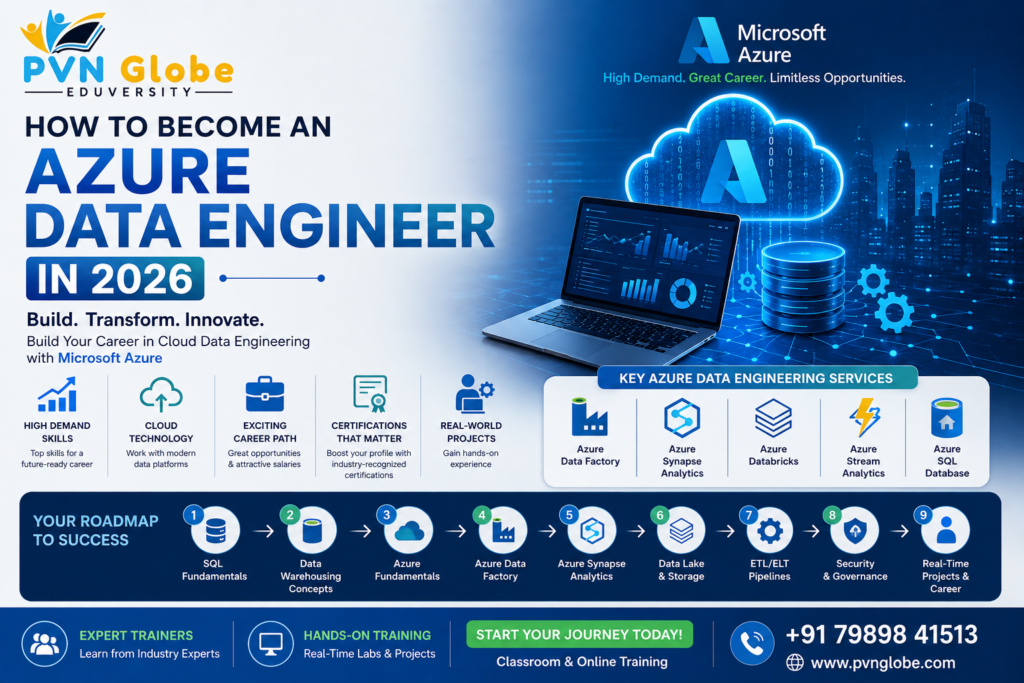
Azure Data Engineer Roadmap 2026
If you are a beginner, follow a structured roadmap instead of learning random technologies.
Azure Data Engineer Roadmap
Step 1: Learn SQL
Start with:
- SELECT
- WHERE
- GROUP BY
- ORDER BY
- JOIN
- Subqueries
- CTEs
- Window functions
- Stored procedures
- Views
- Indexing
- Query optimization
SQL is one of the most important skills for data engineering.
Step 2: Learn Python
Focus on:
- Variables
- Data types
- Conditions
- Loops
- Functions
- Lists
- Dictionaries
- File handling
- Exception handling
- Pandas
- NumPy
Step 3: Learn Data Engineering Concepts
Understand:
- ETL
- ELT
- Data pipelines
- Batch processing
- Streaming
- Data lakes
- Data warehouses
- Data marts
- Data modeling
Step 4: Learn Azure Fundamentals
Understand:
- Azure Portal
- Resource Groups
- Storage
- Identity
- Networking basics
- Security
- Monitoring
Step 5: Learn Azure Data Factory
ADF is an important Azure data integration service.
Step 6: Learn Azure Storage
Understand:
- Blob Storage
- Data Lake Storage
- Containers
- Files
- Access control
Step 7: Learn Azure Databricks
Learn:
- Spark
- PySpark
- DataFrames
- Transformations
- Actions
- Delta Lake
Step 8: Learn Azure Synapse Analytics
Understand:
- Dedicated SQL pools
- Serverless SQL
- Data integration
- Analytics workloads
Step 9: Build Projects
Projects are critical for demonstrating practical skills.
Step 10: Prepare for Certification and Interviews
Combine certification preparation with hands-on learning.
Essential Skills for an Azure Data Engineer
A successful Azure Data Engineer needs a combination of technical and professional skills.
1. SQL
SQL is foundational.
You should understand how to:
- Query databases
- Join tables
- Aggregate data
- Analyze datasets
- Optimize queries
- Create views
- Write complex queries
2. Python
Python is widely used for:
- Data transformation
- Automation
- ETL
- API integration
- Data analysis
- Spark programming
3. Azure
Learn the Azure ecosystem relevant to data engineering.
4. ETL/ELT
Understand how data moves from source systems into analytical platforms.
5. Data Modeling
Learn:
- Fact tables
- Dimension tables
- Star schema
- Snowflake schema
- Slowly Changing Dimensions
6. Big Data
Understand distributed data processing concepts.
7. Apache Spark
Spark is particularly important when working with large datasets.
8. Git
Learn basic version control.
9. Data Security
Understand:
- Authentication
- Authorization
- Role-based access
- Encryption
- Secrets management
10. Problem-Solving
Technical skills alone are not enough. Data engineers must be able to identify problems and design reliable solutions.
Azure Data Factory
Azure Data Factory, commonly known as ADF, is a cloud-based data integration service.
It allows organizations to create data pipelines that move and transform data between different systems.
Why Learn Azure Data Factory?
ADF can be used for:
- Data ingestion
- ETL pipelines
- ELT workflows
- Data movement
- Pipeline orchestration
- Scheduling
- Monitoring
Important ADF Components
You should understand:
- Pipelines
- Activities
- Datasets
- Linked Services
- Integration Runtime
- Triggers
- Parameters
- Variables
- Copy Activity
- Mapping Data Flows
Example
Suppose an organization stores sales data in SQL Server.
An ADF pipeline can:
SQL Server → Azure Data Factory → Azure Data Lake → Databricks → Synapse → Power BI
This represents a simplified modern data engineering workflow.
Azure Data Lake Storage
Modern data platforms often need scalable storage for structured, semi-structured, and unstructured data.
Azure Data Lake Storage provides cloud-based storage capabilities for large-scale data workloads.
What Can You Store?
Examples include:
- CSV
- JSON
- Parquet
- Avro
- Logs
- Images
- Application data
- Transaction data
Data Lake Architecture
A common approach is to organize data into layers.
Bronze Layer
Raw data.
Silver Layer
Cleaned and transformed data.
Gold Layer
Business-ready data.
This architecture can make data pipelines easier to manage and maintain.
Azure Databricks and Apache Spark
Azure Databricks provides a collaborative environment for data engineering, analytics, and AI workloads.
It is built around Apache Spark and is commonly used for large-scale data processing.
What Should Beginners Learn?
Start with:
- Spark architecture
- DataFrames
- RDD basics
- Transformations
- Actions
- Spark SQL
- PySpark
- Delta Lake
- Partitioning
- Optimization
Example PySpark Workflow
A typical data engineering workflow could involve:
Read → Clean → Transform → Validate → Write
For example:
Raw CSV
↓
Azure Data Lake
↓
Databricks
↓
PySpark Transformation
↓
Delta Table
↓
Analytics
Learning Azure Databricks Training alongside Azure Data Factory can give learners a stronger understanding of modern cloud data pipelines.
Azure Synapse Analytics
Azure Synapse Analytics combines data integration, data warehousing, and analytics capabilities.
For an Azure Data Engineer, understanding Synapse can help with designing analytical data solutions.
Important Concepts
Learn:
- SQL
- Data warehousing
- Dedicated SQL pools
- Serverless SQL
- Data integration
- External tables
- Performance optimization
Azure Data Engineering Architecture
A simplified architecture could look like:
Business Applications
↓
Data Sources
↓
Azure Data Factory
↓
Azure Data Lake
↓
Azure Databricks
↓
Azure Synapse
↓
Power BI
↓
Business Users
This architecture demonstrates how different Azure services can work together.
Data Warehousing Concepts
A data engineer must understand data warehouse fundamentals.
What Is a Data Warehouse?
A data warehouse is a system designed to store and analyze structured business data.
It typically supports:
- Reporting
- Business intelligence
- Analytics
- Historical analysis
- Decision-making
Fact Tables
Fact tables generally contain measurable business events.
Examples:
- Sales amount
- Quantity
- Revenue
- Order count
Dimension Tables
Dimension tables provide descriptive information.
Examples:
- Customer
- Product
- Employee
- Location
- Date
Star Schema
A common analytical model consists of:
Fact Table + Dimension Tables
Understanding these concepts is essential for Azure Data Engineer interviews.
ETL vs ELT
One of the most common questions for beginners is:
What is ETL?
ETL means:
Extract → Transform → Load
Data is extracted from a source, transformed, and then loaded into the target system.
What is ELT?
ELT means:
Extract → Load → Transform
Data is first loaded into the target platform and transformed there.
Why Is ELT Popular in Cloud Data Engineering?
Cloud platforms provide scalable storage and compute resources.
This makes it possible to load large datasets into cloud platforms and transform them using scalable processing engines.
Interview Tip
Do not simply memorize ETL and ELT definitions.
Understand:
- When to use them
- Where transformation occurs
- How cloud architectures affect the design
- How cost and performance influence decisions
Real-World Azure Data Engineer Project
Projects are one of the best ways to demonstrate practical knowledge.
Project: Retail Sales Data Engineering Pipeline
Imagine a retail company receives sales information from multiple stores.
Data Sources
- SQL Server
- CSV files
- REST API
- Application database
Step 1: Ingestion
Use Azure Data Factory to ingest data.
Step 2: Storage
Store raw data in Azure Data Lake Storage.
Step 3: Transformation
Use Azure Databricks and PySpark to:
- Remove duplicates
- Handle missing values
- Standardize columns
- Join datasets
- Create calculated fields
Step 4: Data Warehouse
Load curated data into an analytical platform.
Step 5: Reporting
Create dashboards using Power BI.
Skills Demonstrated
This single project can demonstrate:
- SQL
- Python
- Azure
- ADF
- Data Lake
- Databricks
- PySpark
- Data warehousing
- Data modeling
- BI integration
Azure Data Engineer Certification
Certification can help demonstrate your knowledge of Microsoft Azure technologies.
A widely recognized certification path is the Microsoft Certified: Azure Data Engineer Associate, associated with the DP-203 exam.
However, Microsoft certification exams and learning paths can change, so candidates should always verify the current Microsoft certification catalog and exam requirements before planning their preparation.
Should Freshers Get Certified?
Certification can be useful, but it should not replace practical skills.
A stronger profile combines:
Certification + Projects + SQL + Python + Azure Skills + Interview Preparation
Certification Preparation Strategy
- Learn Azure fundamentals.
- Understand data engineering concepts.
- Practice Azure services.
- Build projects.
- Study exam objectives.
- Practice scenario-based questions.
- Review weak areas.
- Take mock assessments.
Azure Data Engineer Jobs in 2026
After developing the required skills, learners can explore multiple career paths.
Possible Job Roles
Azure Data Engineer
Designs and manages Azure-based data solutions.
Cloud Data Engineer
Works with cloud data platforms and pipelines.
Data Engineer
Builds data processing and analytical systems.
ETL Developer
Develops data extraction and transformation workflows.
Big Data Engineer
Works with large-scale data processing technologies.
Data Platform Engineer
Builds and maintains enterprise data platforms.
Analytics Engineer
Transforms data into analytics-ready datasets.
Azure Data Engineer Salary
Salary varies significantly depending on:
- Experience
- Location
- Technical skills
- Employer
- Industry
- Certification
- Project experience
- Interview performance
Instead of focusing only on salary, beginners should focus on building skills that increase their long-term career value.
Career Progression
A possible career path is:
Fresher
↓
Junior Data Engineer
↓
Azure Data Engineer
↓
Senior Data Engineer
↓
Lead Data Engineer
↓
Data Architect / Cloud Architect
Your actual progression will depend on your skills, experience, organization, and specialization.
Azure Data Engineer Interview Preparation
Preparing for interviews requires more than memorizing definitions.
Common Interview Areas
SQL
Expect questions around:
- Joins
- CTEs
- Window functions
- Aggregations
- Subqueries
- Performance
Azure Data Factory
Prepare for:
- Pipelines
- Triggers
- Activities
- Integration Runtime
- Parameters
- Monitoring
Databricks
Study:
- Spark
- PySpark
- DataFrames
- Transformations
- Partitioning
- Delta Lake
Data Warehousing
Know:
- Fact tables
- Dimensions
- Star schema
- Slowly Changing Dimensions
Scenario-Based Questions
Interviewers may ask:
How would you design a pipeline to process millions of records every day?
A strong answer should discuss:
- Data sources
- Ingestion
- Storage
- Transformation
- Data quality
- Security
- Monitoring
- Performance
- Cost optimization
Azure Data Engineer Learning Path for Freshers
If you are completely new to data engineering, avoid trying to learn everything simultaneously.
6-Month Learning Roadmap
Month 1 — SQL
Learn:
- SQL fundamentals
- Joins
- Aggregations
- Subqueries
- CTEs
- Window functions
Month 2 — Python
Learn:
- Python fundamentals
- Pandas
- Data manipulation
- File processing
- APIs
Month 3 — Azure Fundamentals
Learn:
- Azure basics
- Storage
- Resource groups
- Identity
- Security
Month 4 — Data Engineering
Learn:
- Azure Data Factory
- Data Lake
- ETL
- ELT
- Data pipelines
Month 5 — Databricks & Synapse
Learn:
- Apache Spark
- PySpark
- Delta Lake
- Azure Databricks
- Synapse Analytics
Month 6 — Projects & Interviews
Build:
- End-to-end pipeline
- Data warehouse
- Real-time or batch project
- Portfolio
- Resume
Then prepare for interviews and relevant certification.
Why Choose PVN Globe for Azure Data Engineer Training?
Choosing the right training approach can make a major difference when learning a technical career path.
PVN Globe focuses on career-oriented technology training designed to help learners understand concepts and apply them through practical learning.
PVN Globe Azure Data Engineer Training Can Help Learners Build Skills In:
- SQL
- Python
- Azure Fundamentals
- Azure Data Factory
- Azure Data Lake
- Azure Databricks
- PySpark
- Azure Synapse Analytics
- Data Warehousing
- ETL/ELT
- Data Pipelines
- Real-Time Project Concepts
- Interview Preparation
- Certification Preparation
Why Practical Learning Matters
A learner may understand what Azure Data Factory is, but an employer may ask:
“Can you build a production-style data pipeline?”
That is why practical project experience matters.
At PVN Globe, learners can focus on understanding how technologies work together rather than learning individual services in isolation.