
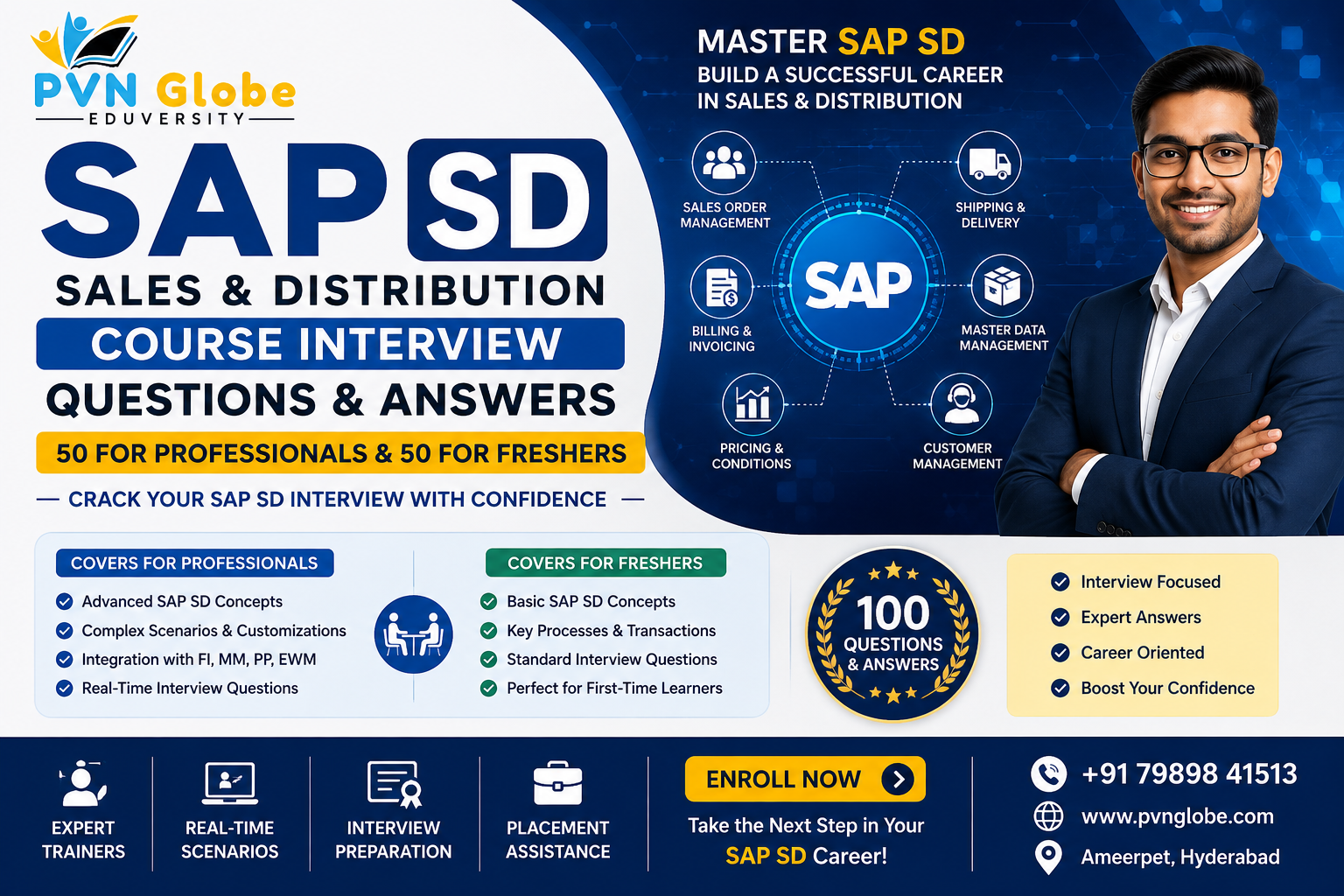
Preparing for an SAP SD interview requires more than memorizing definitions. Candidates should understand sales processes, order management, pricing, delivery, billing, shipping, and integration with other SAP modules.
Whether you are a fresher starting your SAP career or an experienced professional looking to advance your career, these SAP SD Course Interview Questions and Answers can help you prepare with confidence.
At PVN Globe, learners can build practical SAP SD knowledge through structured training and real-time-oriented learning.
What Is SAP SD?
SAP SD stands for Sales and Distribution. It is one of the major SAP modules used to manage business processes related to sales, customer orders, deliveries, shipping, and billing.
The SAP SD module covers important areas such as:
- Enterprise structure
- Customer master data
- Material master data
- Sales order processing
- Pricing
- Availability checks
- Delivery processing
- Shipping
- Picking and packing
- Billing
- Credit management
- Output determination
- Account determination
- Integration with SAP MM and SAP FI
50 SAP SD Interview Questions and Answers for Freshers
1. What is SAP SD?
SAP SD is the Sales and Distribution module used to manage sales-related business processes from customer inquiry through billing.
2. What is the purpose of SAP SD?
SAP SD helps organizations manage customer sales, order processing, delivery, shipping, and billing processes.
3. What is a sales order?
A sales order is a document created in SAP to record a customer’s request for products or services.
4. What is a customer master?
Customer master contains important customer-related information such as address, sales area, shipping, billing, and payment information.
5. What is a material master?
Material master stores information about materials used in different business processes.
6. What is a sales area?
A sales area consists of Sales Organization, Distribution Channel, and Division.
7. What is a sales organization?
A sales organization represents an organizational unit responsible for selling products or services.
8. What is a distribution channel?
Distribution channel defines how products or services are sold to customers.
9. What is a division?
Division represents a grouping of products or services within an organization.
10. What is an inquiry?
An inquiry is a customer request for information about products, prices, or availability.
11. What is a quotation?
A quotation is a formal offer provided to a customer based on requested products or services.
12. What is a sales document?
A sales document records business transactions related to sales activities.
13. What is pricing in SAP SD?
Pricing determines the price, discounts, taxes, freight, and other conditions applicable to a sales transaction.
14. What is a condition type?
A condition type represents a pricing element such as price, discount, freight, or tax.
15. What is a condition record?
A condition record stores values used by SAP during pricing determination.
16. What is a delivery document?
A delivery document controls the process of delivering products to customers.
17. What is a billing document?
A billing document represents the customer billing transaction.
18. What is shipping?
Shipping includes activities such as delivery processing, picking, packing, and goods issue.
19. What is PGI?
PGI means Post Goods Issue. It confirms that goods have been issued from inventory for delivery.
20. What is ATP?
ATP means Available-to-Promise. It checks whether the required quantity can be confirmed for a customer.
21. What is a sales document type?
Sales document type controls the behavior and processing of different sales transactions.
22. What is an item category?
Item category controls how individual items in a sales document are processed.
23. What is schedule line category?
Schedule line category controls delivery-related information such as requirements, availability checks, and movement types.
24. What is partner determination?
Partner determination determines business partners involved in a sales transaction.
25. What are common partner functions?
Common partner functions include Sold-to Party, Ship-to Party, Bill-to Party, and Payer.
26. What is a shipping point?
A shipping point is an organizational unit responsible for processing deliveries.
27. What is route determination?
Route determination identifies the appropriate transportation route for delivering goods.
28. What is output determination?
Output determination determines which messages or documents should be generated for a business transaction.
29. What is text determination?
Text determination controls how predefined and manually entered texts are determined in SAP documents.
30. What is credit management?
Credit management helps organizations control customer credit exposure during sales processing.
31. What is a sales order cycle?
A typical sales cycle is Inquiry → Quotation → Sales Order → Delivery → PGI → Billing → Accounting.
32. What is a return order?
A return order is used when a customer sends products back to the organization.
33. What is a credit memo?
A credit memo reduces the amount payable by a customer.
34. What is a debit memo?
A debit memo increases the amount payable by a customer.
35. What is a cash sale?
Cash sale is a sales process where payment is generally expected immediately.
36. What is a rush order?
A rush order is used for sales transactions requiring immediate delivery processing.
37. What is consignment sales?
Consignment sales involve placing stock at a customer’s location while ownership remains with the company until consumption or sale.
38. What is third-party sales?
In third-party processing, goods are supplied directly from a vendor to the customer.
39. What is make-to-order?
Make-to-order means products are produced or procured based on a specific customer requirement.
40. What is account determination?
Account determination determines the appropriate G/L accounts for financial postings generated from sales transactions.
41. What is copy control?
Copy control defines how data is transferred from one SAP document to another.
42. What is incompletion log?
The incompletion log identifies required information missing from a sales document.
43. What is a billing type?
Billing type controls the processing and behavior of different billing documents.
44. What is a billing due list?
A billing due list contains documents that are ready for billing.
45. What is a sales office?
A sales office represents a location or organizational unit responsible for sales activities.
46. What is a sales group?
A sales group represents a group of sales employees or sales representatives.
47. What is material determination?
Material determination allows SAP to automatically substitute one material with another based on predefined rules.
48. What is product hierarchy?
Product hierarchy provides a structured classification of products.
49. How does SAP SD integrate with SAP MM?
SAP SD integrates with SAP MM for material availability, inventory, delivery, and goods movement processes.
50. How does SAP SD integrate with SAP FI?
SAP SD integrates with SAP FI when billing documents generate accounting-related postings.
50 SAP SD Interview Questions and Answers for Professionals
1. Explain the complete SAP SD order-to-cash cycle.
The order-to-cash cycle generally includes sales order creation, availability check, delivery, picking, packing, PGI, billing, and accounting integration.
2. Explain sales document configuration.
Sales document configuration involves defining document types, number ranges, item categories, schedule line categories, and relevant determination procedures.
3. What is item category determination?
Item category determination determines the appropriate item category based on factors such as sales document type, item category group, item usage, and higher-level item.
4. What is schedule line category determination?
Schedule line category determination determines how an item behaves concerning availability checks, requirements, and goods movements.
5. Explain pricing procedure determination.
Pricing procedure determination identifies the pricing procedure using relevant organizational and customer/material factors.
6. What is a pricing procedure?
A pricing procedure defines the sequence and behavior of condition types used to calculate prices in a sales transaction.
7. What is condition exclusion?
Condition exclusion allows SAP to prevent certain pricing conditions from being applied together according to predefined rules.
8. What is a condition technique?
Condition technique is the mechanism used by SAP to determine appropriate records based on defined access sequences and condition tables.
9. What is an access sequence?
An access sequence defines the search strategy SAP uses to find a valid condition record.
10. What is a condition table?
A condition table defines combinations of fields used for maintaining condition records.
11. What is the difference between header and item conditions?
Header conditions apply to the overall sales document, while item conditions apply to individual items.
12. Explain delivery processing.
Delivery processing involves creating the delivery, picking, packing when applicable, and posting goods issue.
13. What factors determine a shipping point?
Shipping point determination can depend on the delivering plant, shipping conditions, and loading group.
14. What is delivery split?
A delivery split occurs when items that could otherwise be delivered together require separate deliveries because of differing relevant criteria.
15. What is a collective delivery?
A collective delivery combines eligible sales order items into a single delivery document.
16. What is picking?
Picking is the process of removing the required quantity of materials from storage for delivery.
17. What is packing?
Packing involves assigning products to handling units such as cartons or pallets.
18. What is PGI’s impact?
Posting goods issue reduces relevant inventory and records the goods movement associated with the delivery.
19. What is billing relevance?
Billing relevance determines when and how a sales document item becomes eligible for billing.
20. What is an invoice?
An invoice is a billing document issued to a customer for products or services supplied.
21. Explain billing cancellation.
Billing cancellation reverses the financial impact of an incorrectly created billing document according to configured processes.
22. What is invoice correction?
Invoice correction is used to correct billing-related differences between the original billing and the required customer transaction.
23. What is a pro forma invoice?
A pro forma invoice is a non-accounting billing document commonly used for informational or logistics purposes.
24. What is revenue account determination?
Revenue account determination identifies the appropriate G/L account for revenue-related postings.
25. What is the role of VKOA?
VKOA is commonly used to configure revenue account determination in SAP SD.
26. What is a sales area determination?
Sales area determination identifies the relevant sales organization, distribution channel, and division for a transaction.
27. Explain customer account groups.
Customer account groups control characteristics such as number ranges and field status for customer master records.
28. What is a material account assignment group?
It is used as one of the factors in determining appropriate revenue accounts.
29. What is customer account assignment group?
It can be used in revenue account determination to differentiate accounting treatment for customers.
30. Explain free goods processing.
Free goods processing allows certain products or quantities to be provided without charging the customer according to configured business rules.
31. What is rebate processing?
Rebate processing supports agreements where customers may receive benefits based on predefined sales conditions.
32. What is consignment fill-up?
Consignment fill-up transfers stock to a customer’s location while ownership remains with the company.
33. What is consignment issue?
Consignment issue occurs when the customer consumes or sells consignment stock, resulting in relevant sales processing.
34. What is consignment return?
Consignment return handles the return of previously supplied consignment stock.
35. Explain third-party order processing.
In third-party processing, the company receives a customer order while an external vendor supplies the goods directly to the customer.
36. Explain individual purchase order processing.
Individual purchase order processing can trigger procurement for a specific customer requirement rather than using existing inventory.
37. What is a material listing?
Material listing controls which materials are permitted for particular customers.
38. What is material exclusion?
Material exclusion prevents specified materials from being sold to particular customers based on configured rules.
39. What is customer-material information?
Customer-material information stores customer-specific information about materials, such as customer material numbers and relevant sales data.
40. What is output management in SAP SD?
Output management controls the generation and transmission of business documents such as order confirmations, delivery documents, and invoices.
41. How do you troubleshoot pricing issues?
Check pricing procedure determination, condition records, access sequences, condition types, validity dates, scales, and analysis within the sales document.
42. How do you troubleshoot an incomplete sales order?
Review the incompletion log and identify the missing mandatory data required for further processing.
43. How do you troubleshoot a delivery not being created?
Check delivery blocks, confirmed quantities, shipping point determination, delivery dates, route, item status, and relevant configuration.
44. How do you troubleshoot billing not being created?
Check billing blocks, billing relevance, document status, copy control, billing dates, and billing due-list eligibility.
45. What is copy control in sales?
Copy control determines how information is copied between preceding and subsequent sales documents.
46. What is the difference between order-related and delivery-related billing?
Order-related billing is based on the sales order, while delivery-related billing is based on the delivery document.
47. How does SAP SD integrate with SAP FI?
Billing creates accounting-relevant information, which can result in postings to customer and revenue accounts.
48. How does SAP SD integrate with SAP MM?
The integration supports material availability, inventory movements, procurement, and goods issue processes.
49. How does SAP SD integrate with SAP CO?
SD-related revenue and cost information can contribute to controlling processes depending on the organization’s configuration.
50. What skills should an experienced SAP SD consultant have?
A strong consultant should understand end-to-end sales processes, configuration, pricing, shipping, billing, integration, troubleshooting, testing, and business requirements.
Why Learn SAP SD at PVN Globe?
Learning SAP SD with practical business scenarios can help candidates understand how sales processes work in real-world SAP environments.
At PVN Globe, SAP SD learners can focus on:
- SAP SD fundamentals
- Sales order processing
- Pricing configuration
- Delivery and shipping
- Billing processes
- Customer and material master data
- SAP SD integration
- Real-time business scenarios
- Interview preparation
- Practical learning
Who Can Learn SAP SD?
SAP SD can be suitable for:
- Fresh graduates
- Working professionals
- Sales and distribution professionals
- ERP aspirants
- SAP beginners
- Professionals looking to transition into SAP
- Experienced SAP professionals looking to strengthen their SD knowledge
Final Thoughts
Preparing with the right SAP SD Course Interview Questions and Answers can help you build stronger conceptual and practical knowledge before attending interviews.
Freshers should focus on SAP SD fundamentals and business-process understanding, while experienced professionals should prepare for configuration, integration, troubleshooting, and scenario-based questions.
If you are planning to build a career in SAP Sales and Distribution, PVN Globe can help you strengthen your SAP SD knowledge through structured training and practical learning.
Start your SAP SD learning journey with PVN Globe and prepare for your next SAP SD career opportunity.