
Introduction
development, CDS, OData, RAP, and real-time business scenarios.
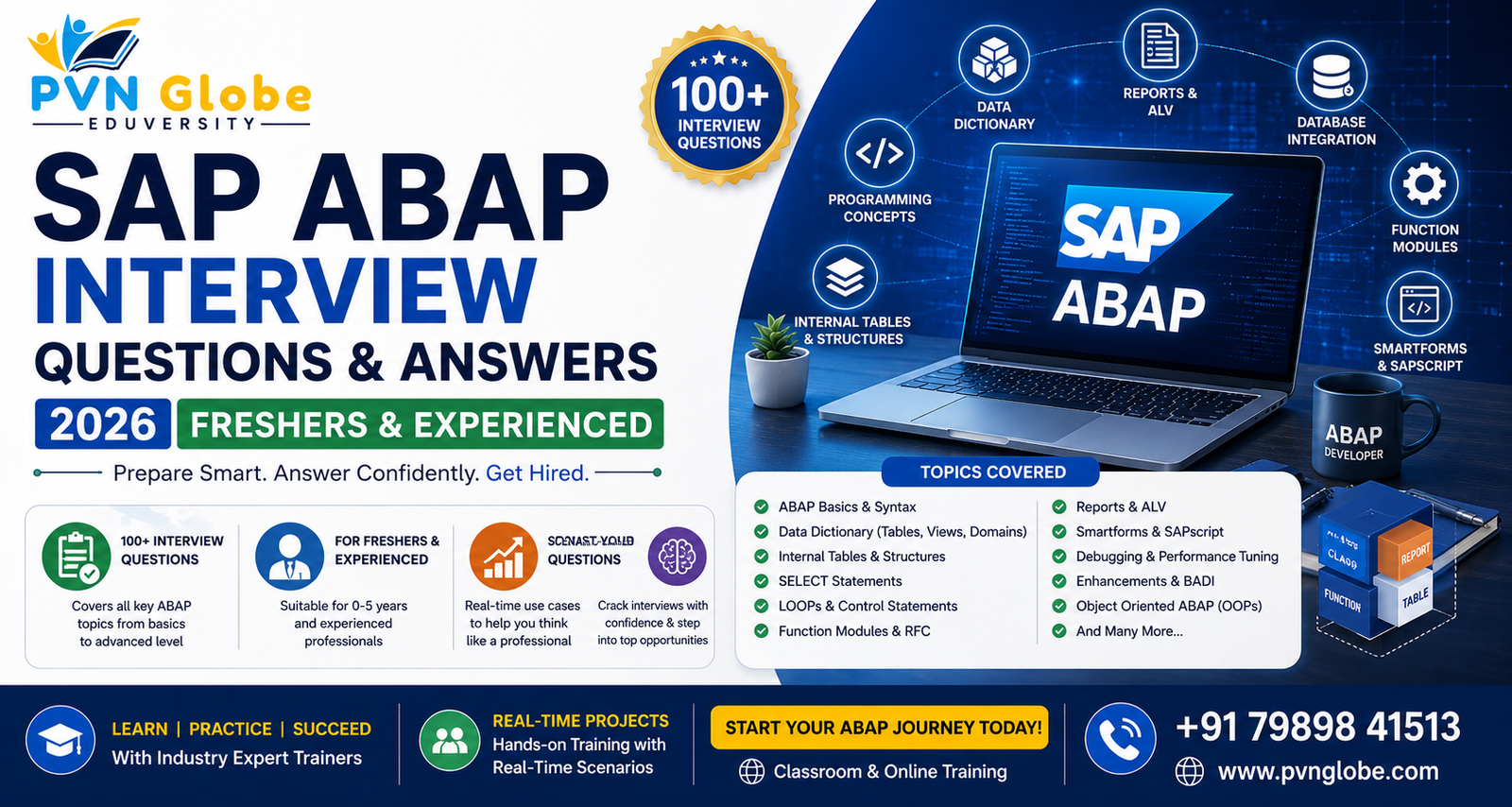
This comprehensive SAP ABAP Interview Questions and Answers guide from PVN GLOBE contains 100 questions and answers:
- 50 SAP ABAP interview questions for freshers
- 50 SAP ABAP interview questions for experienced professionals
- Core ABAP concepts
- Advanced ABAP concepts
- Object-oriented ABAP
- SAP HANA and S/4HANA
- CDS Views
- OData
- RAP
- Performance optimization
- Enhancements
- Real-time development scenarios
Whether you are looking for SAP ABAP Training in Hyderabad, preparing for an SAP ABAP Course, or getting ready for your first SAP developer interview, this guide can be used as a structured preparation resource.
PART 1: 50 SAP ABAP Interview Questions and Answers for Freshers
1. What is SAP ABAP?
Answer:
SAP ABAP stands for Advanced Business Application Programming. It is SAP’s programming language used to develop reports, applications, interfaces, enhancements, forms, and other business functionality within SAP environments.
ABAP is widely used in SAP ERP and SAP S/4HANA development.
2. What is an SAP ABAP Developer?
Answer:
An SAP ABAP Developer develops and maintains SAP applications using ABAP. Responsibilities can include reports, interfaces, enhancements, forms, database programming, debugging, APIs, and modern S/4HANA development.
3. What are the basic components of ABAP?
Answer:
Important ABAP programming components include:
- Variables
- Data types
- Internal tables
- Structures
- Work areas
- Operators
- Conditions
- Loops
- Modularization
- Database statements
4. What is an internal table?
Answer:
An internal table is a temporary runtime data structure used to store and process multiple records in an ABAP program.
Common types include:
- Standard table
- Sorted table
- Hashed table
5. What is a work area?
Answer:
A work area is a memory area used to hold a single record while processing data.
It is commonly used when reading or modifying individual records.
6. What is the difference between an internal table and a work area?
Answer:
An internal table can contain multiple records, while a work area generally represents one record.
For example:
Internal Table → Multiple employee records
Work Area → One employee record
7. What is Open SQL?
Answer:
Open SQL is the SQL interface provided by ABAP for accessing database tables.
It allows developers to retrieve, insert, modify, and delete application data while remaining relatively independent of the underlying database.
8. What is the Data Dictionary in SAP?
Answer:
The ABAP Dictionary, commonly called DDIC, is used to define and manage data structures such as:
- Tables
- Views
- Data elements
- Domains
- Structures
- Search helps
- Lock objects
9. What is a domain?
Answer:
A domain defines the technical characteristics of a field, such as:
- Data type
- Field length
- Decimal places
- Possible value restrictions
10. What is a data element?
Answer:
A data element defines the semantic meaning of a field and references a domain for its technical properties.
It can also contain field labels and documentation.
11. What is a transparent table?
Answer:
A transparent table is an SAP Dictionary table that has a corresponding physical database table.
It stores application data directly in the database.
12. What is a structure?
Answer:
A structure is a collection of fields that does not normally store database records by itself.
Structures are frequently used for:
- Work areas
- Interfaces
- Function modules
- Data processing
13. What is a database view?
Answer:
A database view provides a logical representation of data from one or more database tables.
It can be used to access related data through a predefined view definition.
14. What is a selection screen?
Answer:
A selection screen allows users to enter input parameters before executing a report.
It can contain:
- Parameters
- Select-options
- Checkboxes
- Radio buttons
15. What is a report program?
Answer:
An ABAP report is an executable program designed to process data and produce output based on business requirements.
Reports can display information using formats such as ALV.
16. What is ALV?
Answer:
ALV stands for ABAP List Viewer.
It provides a structured way to display business data in a table format and commonly supports functions such as:
- Sorting
- Filtering
- Subtotals
- Exporting
- Layout management
17. What is a function module?
Answer:
A function module is a reusable procedure defined in the SAP function library.
It can be called from different ABAP programs and can contain importing, exporting, changing, and table parameters.
18. What is a function group?
Answer:
A function group is a container used to organize related function modules.
Function modules belonging to the same function group can share global data and supporting declarations.
19. What is a transaction code?
Answer:
A transaction code is a shortcut used to access a specific SAP application, transaction, or development function.
Examples include development and dictionary transactions.
20. What is debugging in SAP ABAP?
Answer:
Debugging is the process of analyzing ABAP program execution to identify and fix errors.
Developers can use:
- Breakpoints
- Watchpoints
- Variable inspection
- Step execution
- Call stack analysis
21. What is a breakpoint?
Answer:
A breakpoint pauses program execution at a specific location so the developer can inspect the program’s state.
Breakpoints are useful for troubleshooting logic and data-related problems.
22. What is a loop in ABAP?
Answer:
A loop repeatedly executes a block of statements.
Common ABAP looping constructs include:
- LOOP AT
- DO
- WHILE
LOOP AT is commonly used for processing internal table records.
23. What is modularization?
Answer:
Modularization means dividing a large program into smaller reusable components.
Examples include:
- Subroutines
- Function modules
- Methods
- Classes
Modularization improves readability and maintainability.
24. What is a subroutine?
Answer:
A subroutine is a reusable block of code defined using FORM and ENDFORM.
It can be called using PERFORM.
Modern ABAP development generally favors object-oriented approaches where appropriate.
25. What is a parameter?
Answer:
A parameter allows users or programs to provide input values to an ABAP program.
For example, a report may ask for a company code or date range.
26. What is SELECT-OPTIONS?
Answer:
SELECT-OPTIONS allows users to enter single values, ranges, multiple values, and exclusion criteria.
It is commonly used in ABAP report selection screens.
27. What is a primary key?
Answer:
A primary key uniquely identifies a record in a database table.
A table can contain one primary key composed of one or more fields.
28. What is a foreign key?
Answer:
A foreign key establishes a relationship between fields in related tables.
It helps define relationships and can provide consistency checks within SAP Dictionary definitions.
29. What is a join?
Answer:
A join combines data from multiple database tables based on related fields.
Common SQL joins include:
- Inner join
- Left outer join
Joins can reduce the need for multiple database accesses.
30. What is an index?
Answer:
A database index helps the database locate records more efficiently.
Appropriate indexes can improve read performance, although unnecessary indexes can also have maintenance and write-performance costs.
31. What is an enhancement?
Answer:
An enhancement allows developers to add or modify functionality without directly changing the original SAP standard code.
Examples include:
- Enhancement spots
- BAdIs
- Customer exits
32. What is a BAdI?
Answer:
BAdI stands for Business Add-In.
It is an enhancement technique based on object-oriented concepts that allows additional customer-specific functionality to be implemented at predefined points.
33. What is a user exit?
Answer:
A user exit is a predefined enhancement point provided by SAP where customers can add custom functionality.
34. What is an RFC?
Answer:
RFC stands for Remote Function Call.
It allows a function module to be called remotely between SAP systems or between SAP and compatible external systems.
35. What is an IDoc?
Answer:
An IDoc, or Intermediate Document, is a structured SAP data format used for exchanging business information between systems.
IDocs are commonly used in integration scenarios.
36. What is a batch input?
Answer:
Batch input is a technique for transferring large volumes of data into SAP through simulated transaction processing.
It can be useful for certain data migration or mass-processing scenarios.
37. What is a background job?
Answer:
A background job allows an ABAP program or business process to execute without requiring continuous user interaction.
Background processing is commonly used for:
- Large reports
- Scheduled processing
- Periodic data operations
38. What is SAP HANA?
Answer:
SAP HANA is SAP’s in-memory database platform designed for high-performance transaction processing and analytics.
Modern ABAP development often takes advantage of HANA’s capabilities.
39. What is CDS?
Answer:
Core Data Services (CDS) provides a framework for defining semantically rich data models.
CDS is an important technology in modern SAP S/4HANA development.
40. What is OData?
Answer:
OData is a standardized protocol used to expose and consume data through web services.
In SAP environments, OData services can connect backend SAP data and business logic with applications and user interfaces.
41. What is SAP S/4HANA?
Answer:
SAP S/4HANA is SAP’s modern ERP suite built to run on the SAP HANA database.
ABAP development in S/4HANA involves modern technologies such as CDS, APIs, OData, and RAP.
42. What is object-oriented programming?
Answer:
Object-oriented programming organizes software around objects and classes.
Important concepts include:
- Encapsulation
- Inheritance
- Polymorphism
- Abstraction
ABAP supports object-oriented programming through ABAP Objects.
43. What is a class?
Answer:
A class is a blueprint that defines attributes and methods.
Objects can be created from classes during program execution.
44. What is an object?
Answer:
An object is an instance of a class.
It contains data and behavior defined by the class.
45. What is inheritance?
Answer:
Inheritance allows one class to derive functionality from another class.
The derived class can reuse and extend functionality from the superclass.
46. What is polymorphism?
Answer:
Polymorphism allows different object types to respond to the same interface or method call according to their implementation.
It is an important concept in object-oriented ABAP.
47. What is exception handling?
Answer:
Exception handling provides a structured way to manage runtime errors.
In object-oriented ABAP, exception classes and TRY…CATCH blocks can be used to handle exceptions.
48. What is performance optimization in ABAP?
Answer:
Performance optimization involves improving program efficiency.
Common approaches include:
- Reducing unnecessary database calls
- Selecting only required fields
- Using suitable internal table types
- Optimizing SQL
- Avoiding unnecessary nested loops
- Analyzing runtime behavior
49. Why is SAP ABAP important for S/4HANA?
Answer:
ABAP remains an important development technology in SAP environments, while modern S/4HANA development uses approaches such as CDS, RAP, APIs, and HANA-optimized development.
Therefore, modern ABAP knowledge can be valuable for S/4HANA technical professionals.
50. How can a fresher prepare for an SAP ABAP interview?
Answer:
A fresher should focus on:
- ABAP fundamentals
- SQL
- Internal tables
- Data Dictionary
- Debugging
- ABAP Objects
- Enhancements
- CDS basics
- S/4HANA fundamentals
- Real-time projects
Practical coding and project explanation are especially important.
PART 2: 50 SAP ABAP Interview Questions and Answers for Experienced Professionals
1. How do you optimize an ABAP program with poor performance?
Answer:
Start by identifying the bottleneck using appropriate analysis tools and traces.
Then examine:
- Database access
- SQL statements
- Internal table operations
- Nested loops
- Data volume
- Memory consumption
Optimization should be based on measured bottlenecks rather than assumptions.
2. How can you reduce database access in ABAP?
Answer:
Use efficient SQL and avoid unnecessary repeated database queries.
Possible approaches include:
- Selecting only required fields
- Using appropriate joins
- Processing data efficiently
- Avoiding SELECT statements inside loops where possible
- Using suitable database-oriented techniques
3. Why should SELECT statements inside loops generally be avoided?
Answer:
A database operation inside a large loop can generate many database requests and significantly affect performance.
Instead, developers should look for ways to retrieve required data efficiently in fewer database operations.
4. What is the difference between FOR ALL ENTRIES and JOIN?
Answer:
Both can retrieve related data, but they work differently.
A JOIN combines related database tables directly.
FOR ALL ENTRIES uses values from an internal table to restrict the database selection.
The correct choice depends on data relationships, volume, database behavior, and the specific business requirement.
5. What is a hashed internal table?
Answer:
A hashed table uses a unique key and is optimized for key-based access.
It is useful when records need to be accessed frequently using a unique key.
6. What is the difference between sorted and hashed internal tables?
Answer:
Sorted table:
Maintains data according to its sort key and supports efficient key access and ordered processing.
Hashed table:
Uses a hash algorithm for efficient unique-key access and does not maintain conventional sorted order.
7. What is a secondary index?
Answer:
A secondary index is an additional database index created to improve access to data based on fields other than the primary key.
Indexes should be designed carefully because they can affect database storage and write performance.
8. What is ST05?
Answer:
ST05 is a performance analysis tool commonly used to trace activities such as database SQL operations.
It can help developers understand how an ABAP program interacts with the database.
9. What is SAT?
Answer:
SAT is an ABAP runtime analysis tool.
It can help analyze:
- Execution time
- Processing hotspots
- Method calls
- Program flow
- Runtime behavior
10. How do you troubleshoot a production ABAP issue?
Answer:
A structured approach includes:
- Understand the business problem.
- Reproduce the issue if possible.
- Analyze logs and relevant dumps.
- Check program logic.
- Debug safely where appropriate.
- Identify the root cause.
- Test the correction.
- Document the solution.
Production debugging should always follow the organization’s authorization and change-management procedures.
11. What is a short dump?
Answer:
A short dump is a runtime error generated when an ABAP program terminates unexpectedly.
Developers can analyze dumps using the appropriate SAP runtime-error analysis transaction.
12. What is ATC?
Answer:
ABAP Test Cockpit (ATC) is used to identify code quality, syntax, performance, security, and other development issues according to configured checks.
It is an important quality-management tool in modern ABAP development.
13. What is Code Inspector?
Answer:
Code Inspector is used to analyze ABAP development objects against various quality and performance checks.
Organizations may use ATC as the broader quality framework in modern environments.
14. What is a BAdI implementation?
Answer:
A BAdI implementation provides customer-specific logic at a predefined enhancement point.
It allows developers to extend standard SAP functionality while reducing the need for modifications to SAP standard code.
15. What is the difference between a BAdI and a user exit?
Answer:
A BAdI is based on object-oriented enhancement concepts and generally offers a more structured enhancement mechanism.
User exits are older enhancement techniques provided at predefined points in SAP applications.
The appropriate mechanism depends on the application and available enhancement framework.
16. What is a customer exit?
Answer:
Customer exits are predefined enhancement points provided by SAP that allow customers to add custom functionality.
They can include function exits, screen exits, and menu exits depending on the scenario.
17. What is the difference between enhancement and modification?
Answer:
Enhancement:
Adds functionality at an SAP-provided extension point.
Modification:
Directly changes SAP standard objects.
Enhancements are generally preferred because they can reduce upgrade and maintenance complications.
18. What is dynamic programming in ABAP?
Answer:
Dynamic programming allows certain program elements, such as data references or field access, to be determined dynamically during runtime.
It should be used carefully because excessive dynamic programming can reduce readability and maintainability.
19. What is field symbol?
Answer:
A field symbol is a dynamically assigned reference to an existing memory area.
It can be useful for efficient processing of internal table records and dynamic data access.
20. What is a data reference?
Answer:
A data reference points to dynamically allocated data objects.
It is useful when developing flexible and dynamic ABAP applications.
21. What is the difference between field symbols and data references?
Answer:
A field symbol acts like an alias to a memory area, while a data reference is a reference variable pointing to a data object.
Both support dynamic programming but are used differently.
22. What is ABAP Managed Database Procedure?
Answer:
AMDP allows certain database procedures to be implemented and managed through ABAP development, particularly for SAP HANA scenarios.
It can be used when database-side processing is appropriate.
23. What is code pushdown?
Answer:
Code pushdown means moving suitable data-intensive processing closer to the database rather than processing everything in the application server.
In SAP HANA environments, this can improve performance when designed correctly.
24. What are CDS Views?
Answer:
CDS Views are semantic data models that define reusable data structures and relationships.
They support modern SAP development and can be used for transactional, analytical, and service-oriented scenarios depending on the design.
25. What are CDS annotations?
Answer:
Annotations provide metadata about CDS entities.
They can influence aspects such as:
- Semantics
- UI behavior
- Analytics
- Authorization
- Consumption
The exact behavior depends on the annotation used and the relevant framework.
26. What is an association in CDS?
Answer:
An association defines a relationship between CDS entities.
Associations support reusable semantic modeling and can help represent relationships between business objects.
27. What is RAP?
Answer:
RESTful Application Programming Model (RAP) is a modern SAP development model for building transactional applications and services using ABAP.
It supports concepts such as:
- Business objects
- Behavior definitions
- Service definitions
- Service bindings
28. What is the difference between managed and unmanaged RAP?
Answer:
In a managed implementation, the RAP framework handles much of the transactional behavior.
In an unmanaged implementation, the developer has greater control over implementation logic and existing business logic can be integrated where appropriate.
29. What is OData in SAP S/4HANA?
Answer:
OData can expose SAP business data and functionality as services that can be consumed by applications and user interfaces.
It plays an important role in many SAP Fiori and integration scenarios.
30. What is SAP Gateway?
Answer:
SAP Gateway provides technologies for connecting SAP business data and processes with external applications through service-based interfaces, including OData in relevant scenarios.
31. What is the difference between REST and OData?
Answer:
REST is an architectural style for designing web services.
OData is a standardized protocol built around REST principles and provides conventions for querying and manipulating structured resources.
32. How does ABAP integrate with external systems?
Answer:
ABAP can participate in integration scenarios using technologies such as:
- APIs
- OData
- REST
- SOAP
- RFC
- IDocs
- Events
- Middleware platforms
The appropriate method depends on the system architecture and business requirement.
33. How do you handle errors in an interface?
Answer:
A robust interface should include:
- Input validation
- Exception handling
- Error logging
- Monitoring
- Retry strategies where appropriate
- Clear error messages
- Reconciliation mechanisms
34. How do you design a scalable ABAP report?
Answer:
A scalable report should:
- Minimize database calls
- Retrieve only required data
- Handle large datasets carefully
- Avoid unnecessary nested loops
- Use suitable internal tables
- Support background execution when appropriate
- Include meaningful error handling
35. How do you handle large-volume data processing?
Answer:
Consider:
- Efficient SQL
- Package-based processing
- Background jobs
- Appropriate internal table structures
- Memory management
- Database-side processing where appropriate
The design should be tested with realistic data volumes.
36. How do you approach an ABAP code review?
Answer:
Review:
- Functional correctness
- Readability
- Naming conventions
- Performance
- Security
- Exception handling
- Database access
- Maintainability
- Testability
- Compliance with development standards
37. What is clean-core development?
Answer:
Clean-core development aims to minimize modifications and inappropriate customizations of the SAP core.
Developers should prefer supported extension mechanisms, APIs, and appropriate in-app or side-by-side extensibility approaches.
38. How is ABAP changing with cloud development?
Answer:
ABAP development is increasingly aligned with cloud-oriented development models and extensibility approaches.
Professionals should understand:
- ABAP Cloud concepts
- RAP
- APIs
- CDS
- Cloud-ready development
- Clean-core principles
39. What is ABAP Cloud?
Answer:
ABAP Cloud is SAP’s cloud-ready ABAP development model focused on modern, upgrade-stable development using released APIs and development artifacts.
It is an important area for developers preparing for modern SAP landscapes.
40. How can an ABAP developer prepare for SAP BTP?
Answer:
An ABAP developer can expand into:
- Cloud fundamentals
- SAP BTP
- APIs
- Integration
- RAP
- Side-by-side extensibility
- Event-driven architecture
- Cloud application development
This combination can broaden an SAP technical career.
41. How would you design an ABAP-based application extension?
Answer:
First understand the business requirement and identify whether standard functionality already supports it.
Then evaluate:
- In-app extensibility
- Released APIs
- Enhancement points
- RAP
- Side-by-side extension
- Integration requirements
The solution should align with clean-core and upgradeability principles.
42. How do you troubleshoot a slow SQL statement?
Answer:
Analyze the SQL execution using appropriate tracing and runtime-analysis tools.
Check:
- Selected fields
- WHERE conditions
- Joins
- Index usage
- Data volume
- Execution plan
- Frequency of execution
Then optimize based on measured evidence.
43. What is authorization in ABAP?
Answer:
Authorization controls whether a user is permitted to perform certain actions or access specific business data.
ABAP programs may perform authorization checks using SAP’s authorization framework.
44. Why is security important in ABAP development?
Answer:
ABAP applications can process sensitive enterprise data.
Developers should therefore consider:
- Authorization
- Input validation
- Secure coding
- Data access controls
- API security
- Protection against unauthorized data exposure
45. How do you test an ABAP application?
Answer:
Testing can include:
- Unit testing
- Functional testing
- Integration testing
- Regression testing
- Performance testing
- User acceptance testing
Developers should test both normal and exception scenarios.
46. What is ABAP Unit?
Answer:
ABAP Unit is SAP’s unit-testing framework for ABAP.
It allows developers to write automated tests for classes and methods and helps improve code reliability.
47. How do you explain an SAP ABAP project in an interview?
Answer:
Use a structured format:
Business Requirement → Your Role → Technical Solution → Technologies Used → Challenges → Testing → Result
Explain what you personally developed rather than describing only the overall project.
48. What should an experienced ABAP developer learn in 2026?
Answer:
A modern skill set can include:
- Advanced ABAP
- S/4HANA
- CDS
- RAP
- ABAP Cloud
- APIs
- OData
- SAP BTP
- Integration
- Clean-core principles
- Performance optimization
- Secure development
49. How can an ABAP developer move toward an SAP Technical Architect role?
Answer:
Develop beyond programming by learning:
- SAP architecture
- S/4HANA
- Integration
- APIs
- BTP
- Security
- Performance
- Cloud architecture
- Business processes
- Solution design
Architects need to understand how multiple technologies work together rather than focusing only on individual programs.
50. What is the best SAP ABAP career strategy for 2026?
Answer:
A strong strategy is to build a combination of:
ABAP + S/4HANA + CDS + RAP + APIs + Integration + Cloud
Then strengthen the profile through:
- Real-time projects
- Certification where useful
- Continuous practice
- Technical interviews
- Architecture knowledge
This creates a broader modern SAP technical profile.
PVN GLOBE
🌐 www.pvnglobe.com
📞 +91 79898 41513
Learn SAP ABAP. Practice Real-Time Scenarios. Build Modern SAP Development Skills.