
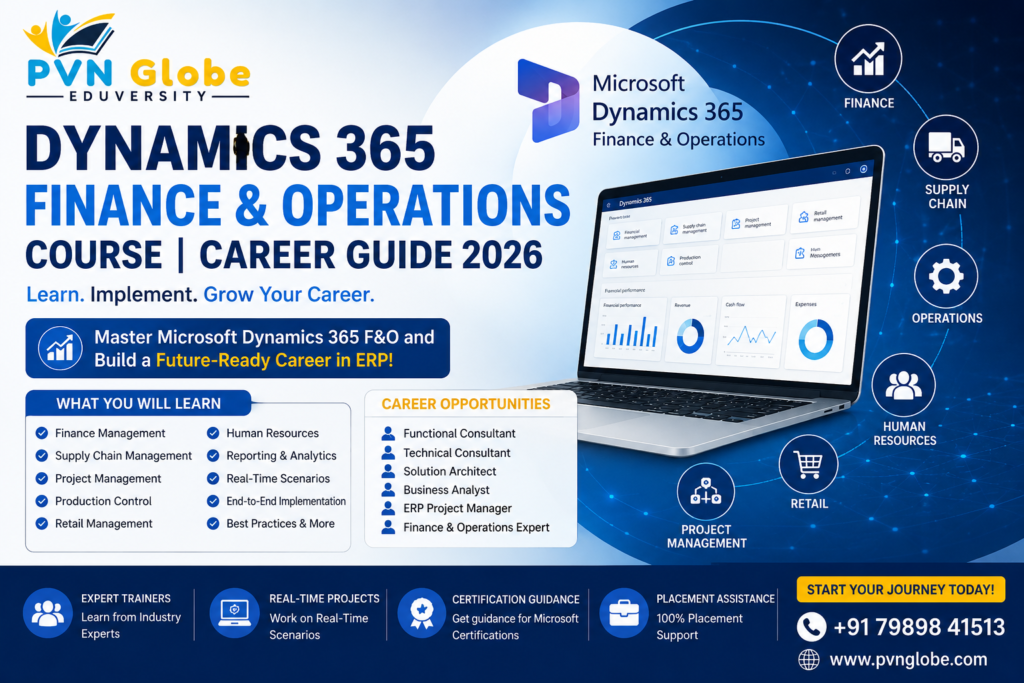
What Is Microsoft Dynamics 365 Finance & Operations?
Microsoft Dynamics 365 Finance & Operations, commonly referred to as D365 F&O, is a cloud-based enterprise business application environment designed to help organizations manage financial and operational processes.
The platform brings together business processes that may otherwise be handled through multiple disconnected applications.
Depending on organizational requirements, Dynamics 365 Finance and Operations capabilities can support areas such as:
- Financial management
- General ledger
- Accounts payable
- Accounts receivable
- Budgeting
- Procurement
- Inventory management
- Warehouse operations
- Supply chain planning
- Sales processes
- Manufacturing
- Product information management
- Asset management
- Reporting and analytics
- Data management
- Workflow-based approvals
Microsoft’s learning resources position Finance and Operations apps as a starting point for people working with business processes, functional consulting, administration, finance, accounting, supply chain, and related areas.
Why Is D365 F&O Important?
Modern organizations need more than basic accounting software. They require integrated systems that can connect financial transactions with operational activities.
For example, a procurement transaction can affect inventory, vendor accounts, purchase orders, receiving, invoicing, and financial postings.
This interconnected nature is one of the key reasons ERP professionals need to understand both business processes and technology.
Who Uses Dynamics 365 F&O?
D365 F&O can be relevant to:
- Manufacturing organizations
- Retail businesses
- Distribution companies
- Professional services organizations
- Global enterprises
- Supply-chain businesses
- Finance departments
- Procurement teams
- Warehouse operations
- ERP consulting organizations
For learners, this creates opportunities to specialize in functional, technical, reporting, implementation, support, or consulting roles.
Why Learn Microsoft Dynamics 365 F&O in 2026?
Enterprise applications continue to evolve as organizations move toward cloud-based business systems, integrated analytics, automation, and AI-enabled workflows.
Microsoft’s current Dynamics 365 roadmap continues to invest in areas such as supply-chain planning, procurement, warehouse operations, manufacturing, analytics, and AI-enabled capabilities.
For someone planning a career in ERP, this makes D365 F&O an interesting platform to study.
1. Cloud ERP Skills
Organizations increasingly require professionals who understand cloud-based enterprise applications.
Learning D365 F&O introduces learners to modern ERP concepts, business processes, data, configuration, security, workflows, reporting, and implementation.
2. Multiple Career Paths
D365 F&O knowledge can support different career directions.
A learner can explore:
- Functional consulting
- Technical consulting
- Finance consulting
- Supply-chain consulting
- Application support
- ERP implementation
- D365 development
- Data migration
- Reporting
- Business analysis
3. Business + Technology Combination
One major advantage of ERP careers is the combination of business knowledge and technology.
A successful consultant doesn’t simply know software screens.
They should understand:
Business requirement → Process → Configuration → Testing → Data → Reporting → Deployment → Support
4. Growing Enterprise Ecosystem
Microsoft Dynamics 365 is part of a wider Microsoft ecosystem involving technologies such as Power Platform, Azure, Power BI, Dataverse, and Microsoft cloud services.
This allows professionals to gradually expand their skill set beyond the core ERP platform.
Major Modules in Dynamics 365 Finance & Operations
Understanding the modules is one of the first steps toward becoming a D365 F&O professional.
Dynamics 365 Finance
Finance functionality can include:
- General ledger
- Accounts payable
- Accounts receivable
- Cash and bank management
- Fixed assets
- Budgeting
- Financial dimensions
- Tax configuration
- Period close
- Financial reporting
Microsoft provides dedicated documentation and learning resources for Dynamics 365 Finance, including implementation, deployment, administration, development, and financial operations.
Supply Chain Management
Supply Chain Management covers major operational processes.
Microsoft’s current documentation includes:
- Product information management
- Procurement
- Inventory
- Demand planning
- Master planning
- Warehouse management
- Manufacturing
- Sales fulfillment
- Transportation
- Asset management
Procurement and Sourcing
Learners can understand:
- Purchase requisitions
- Purchase orders
- Vendors
- RFQs
- Procurement categories
- Purchase workflows
- Vendor invoices
- Vendor collaboration
Inventory Management
Inventory processes include:
- Item management
- Inventory dimensions
- Inventory transactions
- Stock movement
- Counting
- Inventory journals
- Cost management
Warehouse Management
Warehouse operations may include:
- Inbound processes
- Outbound processes
- Warehouse work
- Picking
- Packing
- Mobile warehouse processes
- Location management
Dynamics 365 Finance Functional Consultant Career Path
One of the most popular career directions is the D365 Finance Functional Consultant.
A functional consultant acts as a bridge between business users and the technical implementation team.
What Does a Functional Consultant Do?
A functional consultant may:
- Understand business requirements
- Analyze current processes
- Identify system requirements
- Prepare functional documentation
- Configure the application
- Support testing
- Coordinate with developers
- Support data migration
- Train users
- Assist during implementation and go-live
Example
Imagine a company wants to improve its purchase-to-pay process.
The consultant needs to understand:
Requirement → Vendor → Purchase Requisition → Approval → Purchase Order → Product Receipt → Invoice → Payment → Financial Posting
The consultant then maps the business process to Dynamics 365 functionality.
Important Functional Skills
A learner should develop knowledge of:
- ERP fundamentals
- Finance processes
- Supply chain processes
- Procurement
- Inventory
- Business requirements
- Configuration
- Testing
- Documentation
- Data migration
- Reporting
- Security concepts
Why Business Knowledge Matters
ERP consultants are expected to solve business problems, not just navigate software.
Therefore, candidates who combine business process knowledge + D365 F&O knowledge can create a stronger professional profile.
Dynamics 365 Supply Chain Management
Supply Chain Management is one of the major areas of D365 F&O.
Microsoft describes Dynamics 365 Supply Chain Management as supporting end-to-end processes covering planning, procurement, manufacturing, warehousing, transportation, inventory, and fulfillment.
Major SCM Areas
Product Information Management
Learners can understand:
- Products
- Product masters
- Product variants
- Released products
- Product dimensions
- Units of measure
Procurement
The procurement cycle typically involves:
Requirement → Vendor Selection → Purchase Order → Receipt → Invoice → Payment
Microsoft’s business-process guidance describes procurement as part of the source-to-pay process, including acquiring goods or services and managing related inventory and costs.
Inventory
Important concepts include:
- Inventory dimensions
- On-hand inventory
- Inventory journals
- Transfers
- Counting
- Inventory closing
- Cost management
Warehouse Management
Warehouse functionality helps organizations manage:
- Receiving
- Put-away
- Picking
- Packing
- Shipping
- Warehouse locations
- Warehouse work
Master Planning
Planning helps organizations understand demand and supply requirements.
Modern supply-chain environments increasingly depend on forecasting, planning, automation, and analytics.
Microsoft’s 2026 release information highlights improvements around demand planning, supply planning, procurement, warehouse operations, and manufacturing.
D365 F&O Technical Skills
D365 F&O is not limited to functional consulting.
Professionals interested in development and technical consulting can explore technical areas such as:
- X++
- Visual Studio
- Extensions
- Data entities
- Integrations
- APIs
- Reporting
- Security
- Development environments
- Application lifecycle management
- Testing
- Data migration
X++ Development
X++ is an important development technology associated with Dynamics 365 Finance and Operations.
Technical professionals can use it to develop custom functionality and extensions.
Extension-Based Development
Modern D365 development emphasizes upgrade-friendly extension approaches rather than modifying standard application objects directly.
Data Entities
Data entities are important for:
- Data migration
- Integration
- Import
- Export
- Data management
Integrations
Enterprise applications rarely operate alone.
D365 F&O may need to communicate with:
- Banking systems
- CRM applications
- E-commerce platforms
- Warehouse systems
- Power Platform
- External APIs
- Data platforms
Therefore, integration knowledge can be valuable for technical consultants.
D365 F&O Course Syllabus
A comprehensive Microsoft Dynamics 365 F&O course syllabus should cover both fundamental concepts and practical business scenarios.
Module 1: ERP Fundamentals
- ERP introduction
- Enterprise business processes
- Cloud ERP concepts
- Microsoft Dynamics 365 overview
- Finance and Operations overview
Module 2: Finance
- General Ledger
- Chart of Accounts
- Financial Dimensions
- Accounts Payable
- Accounts Receivable
- Cash and Bank
- Fixed Assets
- Budgeting
- Tax
- Financial Period Close
Module 3: Procurement
- Vendors
- Procurement categories
- Purchase requisitions
- RFQs
- Purchase orders
- Product receipts
- Vendor invoices
- Procurement workflows
Module 4: Inventory
- Products
- Released products
- Inventory dimensions
- Inventory journals
- Transfers
- Counting
- On-hand inventory
- Cost management
Module 5: Warehouse
- Warehouse setup
- Locations
- Receiving
- Put-away
- Picking
- Packing
- Shipping
Module 6: Supply Chain
- Demand planning
- Supply planning
- Master planning
- Procurement
- Inventory
- Logistics
Module 7: Reporting
- Financial reporting
- Operational reports
- Analytics
- Power BI concepts
- Data analysis
Module 8: Data Management
- Data entities
- Import
- Export
- Data migration
- Data validation
Module 9: Implementation
- Requirement gathering
- Fit-gap analysis
- Configuration
- Testing
- UAT
- Deployment
- Go-live
- Support
Real-Time Project Training in D365 F&O
Learning concepts is important, but practical implementation knowledge is equally valuable.
A project-based Dynamics 365 F&O training program should allow learners to understand how a real business requirement moves through the ERP implementation lifecycle.
Example Project
Consider a fictional company:
Global Manufacturing & Distribution Pvt. Ltd.
The company needs a centralized ERP system for:
- Finance
- Procurement
- Inventory
- Warehouse
- Sales
- Supply chain
Project Lifecycle
Phase 1: Requirement Gathering
Consultants interact with business users to identify:
- Current problems
- Business processes
- Required reports
- Approval workflows
- Integration requirements
Phase 2: Business Process Mapping
The consultant maps:
Current Process → Required Process → D365 F&O Solution
Phase 3: Configuration
The application is configured according to approved requirements.
Phase 4: Data Migration
Master data and transactional data are prepared and validated.
Phase 5: Testing
Testing may include:
- Unit testing
- Functional testing
- Integration testing
- User acceptance testing
Phase 6: Training
End users are trained on their business processes.
Phase 7: Go-Live
The configured system moves into production.
Phase 8: Support
Consultants monitor issues, troubleshoot problems, and support business users.
This project approach helps learners understand that ERP consulting is a complete business transformation process rather than simply learning application menus.
Skills Required to Become a D365 F&O Consultant
A strong D365 F&O professional needs a combination of technical, business, analytical, and communication skills.
Technical Skills
Depending on the chosen career path:
- Dynamics 365 F&O
- X++
- SQL fundamentals
- Data management
- Integrations
- Reporting
- Power BI
- Power Platform
- Azure concepts
Functional Skills
For functional consultants:
- Finance
- Accounting
- Procurement
- Inventory
- Supply chain
- Manufacturing
- Business processes
- Requirement gathering
Analytical Skills
Consultants frequently analyze:
- Business requirements
- Process gaps
- Transaction issues
- Data problems
- System behavior
- Reports
Communication Skills
A consultant communicates with:
- Business users
- Managers
- Developers
- Testers
- Project managers
- Technical architects
Therefore, communication and documentation are important career skills.
D365 F&O Certification and Learning Roadmap
Certification can be useful, but learners should avoid treating certification as a replacement for practical experience.
Microsoft maintains official learning paths for Finance and Operations apps and Supply Chain Management. Its learning content includes beginner-level paths for understanding finance and operations applications and dedicated Supply Chain Management training.
Recommended Learning Roadmap
Step 1: Learn ERP Fundamentals
Understand:
- ERP
- Business processes
- Cloud applications
- Enterprise systems
Step 2: Select Your Specialization
Choose:
- Finance
- Supply Chain
- Functional Consulting
- Technical Development
Step 3: Learn D365 F&O Fundamentals
Understand navigation, legal entities, organizations, master data, transactions, and business processes.
Step 4: Build Module Knowledge
Choose relevant modules based on your career direction.
Step 5: Practice Business Scenarios
Don’t only memorize features.
Practice complete business flows.
Step 6: Learn Data and Reporting
Understand data entities, reporting, analytics, and data validation.
Step 7: Work on Projects
Build implementation-style project experience.
Step 8: Prepare for Relevant Microsoft Credentials
Check Microsoft’s current certification and exam information before registering because Microsoft certification portfolios and exam requirements can change.
D365 F&O Jobs and Career Opportunities
After developing relevant skills, candidates can explore several job roles.
1. Dynamics 365 Finance Functional Consultant
Focus:
- Finance
- Accounting
- Configuration
- Business processes
2. Dynamics 365 Supply Chain Functional Consultant
Focus:
- Procurement
- Inventory
- Warehouse
- Planning
- Supply chain
3. D365 F&O Technical Consultant
Focus:
- Development
- Integrations
- Data
- X++
- Technical architecture
4. D365 F&O Developer
Focus:
- X++
- Extensions
- APIs
- Data entities
- Integrations
5. ERP Business Analyst
Focus:
- Requirements
- Process analysis
- Documentation
- Business transformation
6. D365 Application Support Consultant
Focus:
- Troubleshooting
- User support
- Incident resolution
- Functional analysis
7. D365 Implementation Consultant
Focus:
- Implementation lifecycle
- Configuration
- Testing
- Data migration
- Go-live
8. ERP Project Consultant
Experienced professionals can progress toward project management, solution architecture, or specialized consulting roles.
Is D365 F&O Good for Freshers?
Yes, beginners can start learning D365 F&O, but they should approach it with realistic expectations.
A fresher does not need to know every Dynamics 365 module on day one.
Instead, the learner can build knowledge progressively.
Beginner Roadmap
Start with:
- ERP fundamentals
- Microsoft Dynamics 365 overview
- Finance and Operations basics
- One functional specialization
- Business process flows
- Configuration concepts
- Data management
- Testing
- Project scenarios
- Interview preparation
For Finance Graduates
Commerce, finance, accounting, and business graduates may find Finance-related functional concepts easier to connect with their academic background.
For IT Graduates
Computer science and IT graduates can explore:
- Functional consulting
- Technical consulting
- D365 development
- Data
- Integration
- Reporting
For Experienced Professionals
Professionals from:
- SAP
- Oracle
- ERP
- Finance
- Supply chain
- Business analysis
- Software development
may be able to transfer existing business or technology knowledge into a D365 F&O specialization.
The key is to identify transferable skills and then build platform-specific knowledge.
D365 F&O Interview Preparation
Preparing for a D365 F&O interview requires more than memorizing definitions.
Interviewers may want candidates to explain business processes and demonstrate problem-solving ability.
Sample Functional Interview Questions
- What is Dynamics 365 Finance and Operations?
Explain the platform, its purpose, and the business processes it supports.
- What is a legal entity?
Explain how organizations structure companies and business operations within the ERP.
- What is a chart of accounts?
Explain its role in financial accounting.
- What are financial dimensions?
Explain how dimensions help organizations classify and analyze financial transactions.
- Explain the procure-to-pay process.
Example:
Purchase Requisition → Purchase Order → Product Receipt → Vendor Invoice → Payment
- What is inventory management?
Explain how an organization tracks products, quantities, movements, and costs.
- What is master data?
Examples include:
- Customers
- Vendors
- Products
- Employees
- Warehouses
- What is data migration?
Explain how data is moved from legacy systems into D365.
Scenario-Based Questions
You may also be asked:
A purchase order was created, but the invoice cannot be posted. How would you investigate?
A strong answer should demonstrate:
- Requirement understanding
- Process knowledge
- Transaction analysis
- Configuration checking
- Error investigation
- Resolution
- Testing
D365 F&O, Power BI, Power Platform and Microsoft Ecosystem
One important advantage of learning Dynamics 365 is understanding its relationship with the wider Microsoft ecosystem.
Professionals may eventually work with technologies such as:
- Power BI
- Power Automate
- Power Apps
- Dataverse
- Azure
- Microsoft Excel
- Microsoft Teams
Power BI
Power BI can be used to create dashboards and analytical views from business data.
For example:
A finance dashboard may show:
- Revenue
- Expenses
- Receivables
- Payables
- Cash flow
A supply-chain dashboard may show:
- Inventory
- Purchase orders
- Sales orders
- Warehouse performance
- Product movement
Power Automate
Automation can support workflow-based business processes.
Power Apps
Organizations can build business applications around their Microsoft environment.
Azure
Azure skills can be useful for professionals working with enterprise integrations, cloud architecture, data, and Microsoft technologies.
This creates an opportunity for D365 professionals to gradually become broader Microsoft business application specialists.
Why Practical D365 F&O Training Matters
There is a major difference between:
Learning software concepts
and
Learning how to solve business problems using the software.
A practical training approach should focus on business scenarios.
Practical Learning Should Include
- Business requirements
- Configuration
- Transaction processing
- Data
- Testing
- Reporting
- Troubleshooting
- Documentation
- Project scenarios
- Interview preparation
PVN Globe Approach
For learners searching for PVN Globe MD 365 F&O Course or Microsoft Dynamics 365 F&O Training in Hyderabad, the goal should be to develop practical understanding that connects learning with real-world enterprise processes.
A strong learning experience should help students understand:
Concept → Configuration → Transaction → Testing → Reporting → Business Result
Why Project-Based Learning Helps
Suppose a learner understands the definition of procurement.
That is useful.
But being able to explain:
How does a company purchase a product, receive it, record the vendor invoice, and complete the financial transaction?
demonstrates deeper understanding.
That is the kind of thinking expected in enterprise ERP environments.
Why Choose PVN Globe for MD 365 F&O Training?
If you are searching for MD 365 F&O Training in Hyderabad, choosing a course should involve more than comparing course duration or fees.
Consider the learning experience and practical coverage.
What Learners Should Look For
Industry-Oriented Curriculum
The curriculum should cover business processes rather than only theoretical concepts.
Real-Time Project Exposure
Projects can help learners understand implementation scenarios.
Functional + Business Understanding
Students should understand why a configuration or transaction is required.
Interview Preparation
Training should help learners communicate their knowledge confidently during interviews.
Career Guidance
Learners should understand possible career paths and specialization options.
PVN Globe MD 365 F&O Course
The PVN Globe MD 365 F&O Course can be positioned for learners who want to build knowledge of Microsoft Dynamics 365 Finance and Operations and develop skills relevant to ERP consulting and enterprise business applications.
Potential learner groups include:
- Fresh graduates
- IT professionals
- Finance professionals
- Commerce graduates
- ERP professionals
- Supply-chain professionals
- Business analysts
- Working professionals
- Career switchers
The ideal learner should focus on consistent practice, business-process understanding, project exposure, and continuous learning.
How to Start Your D365 F&O Career in 2026
If your goal is to become a Microsoft Dynamics 365 F&O professional, follow a structured roadmap.
Month 1: Fundamentals
Learn:
- ERP
- Microsoft Dynamics 365
- Finance and Operations
- Cloud concepts
- Business processes
Month 2: Core Modules
Choose a specialization.
For Finance:
- General Ledger
- AP
- AR
- Fixed Assets
- Budgeting
For Supply Chain:
- Procurement
- Inventory
- Warehouse
- Product Management
- Planning
Month 3: Practical Work
Practice:
- Business scenarios
- Configuration
- Transactions
- Workflows
- Data
- Reports
Month 4: Project
Complete an implementation-style project.
Understand:
Requirement → Design → Configuration → Data → Testing → UAT → Go-Live
Month 5: Interview Preparation
Prepare:
- Technical questions
- Functional questions
- Scenario questions
- Project explanation
- Resume
- Communication
Month 6: Career Development
Apply for suitable roles and continue building skills.
The Long-Term Career Path
A possible career progression can look like:
Trainee → Junior Consultant → Functional/Technical Consultant → Senior Consultant → Lead Consultant → Solution Architect / Project Lead
Career progression varies by organization, experience, specialization, and project exposure.
Frequently Asked Questions About MD 365 F&O
What is MD 365 F&O?
MD 365 F&O commonly refers to Microsoft Dynamics 365 Finance & Operations, Microsoft’s enterprise business application environment for financial and operational processes.
Is Dynamics 365 F&O difficult to learn?
The difficulty depends on your background and specialization. Beginners should start with ERP fundamentals and gradually move into Finance, Supply Chain, technical development, or another specialization.
Can freshers learn D365 F&O?
Yes. Freshers can begin with ERP fundamentals, D365 F&O concepts, business processes, practical exercises, and project-based learning.
What is the best D365 F&O career path?
There is no single best path. Common directions include Finance Functional Consultant, Supply Chain Functional Consultant, Technical Consultant, Developer, Business Analyst, Application Support Consultant, and Implementation Consultant.
Is D365 F&O only for finance professionals?
No. Finance professionals can specialize in Finance, while IT graduates and developers can explore technical, integration, data, and development areas. Supply-chain professionals can specialize in Supply Chain Management.
What should I learn before D365 F&O?
Basic ERP and business-process knowledge is useful. Depending on your specialization, accounting, supply chain, programming, databases, reporting, or cloud knowledge can also help.
Is certification necessary?
Certification can validate knowledge, but practical skills, business-process understanding, project experience, and interview preparation are also important.
Always check Microsoft’s current certification pages for the latest exam names, requirements, and availability.
Does D365 F&O include Supply Chain Management?
Dynamics 365 Finance and Operations learning commonly involves Finance and Supply Chain Management concepts. Microsoft’s current learning resources separately cover Finance and Supply Chain Management capabilities within the broader Finance and Operations ecosystem.
What is a D365 F&O functional consultant?
A functional consultant analyzes business requirements and helps configure and implement Dynamics 365 functionality to support business processes.
What is a D365 F&O technical consultant?
A technical consultant focuses more on development, integrations, data, extensions, technical solutions, and related implementation activities.
Is D365 F&O a good career in 2026?
D365 F&O can be a strong specialization for professionals interested in enterprise applications, ERP consulting, finance technology, supply-chain technology, and Microsoft business applications. However, career outcomes depend on skills, experience, specialization, project exposure, and the job market.
Where can I learn Microsoft Dynamics 365 F&O in Hyderabad?
Learners searching for Microsoft Dynamics 365 F&O Training in Hyderabad, D365 F&O Course in Hyderabad, or MD 365 F&O Training Hyderabad can explore training providers such as PVN Globe and compare curriculum, practical training, project exposure, trainer expertise, and career support.
Conclusion
Microsoft Dynamics 365 Finance & Operations is an important enterprise application platform for organizations managing financial and operational processes. Its ecosystem covers areas such as finance, procurement, inventory, supply chain, warehouse operations, manufacturing, reporting, data, and business-process management.
Microsoft’s current learning resources continue to expand training around Finance and Operations and Supply Chain Management, while recent release information highlights ongoing improvements in planning, procurement, warehouse operations, manufacturing, and AI-supported capabilities.
For professionals planning an ERP career in 2026, the most effective strategy is not simply to memorize application features.
Instead, focus on:
ERP Fundamentals + D365 F&O + Business Processes + Practical Projects + Data + Reporting + Communication + Interview Preparation
If you are looking for MD 365 F&O Course, Microsoft Dynamics 365 Finance and Operations Training, D365 F&O Training in Hyderabad, or Dynamics 365 Finance Training, PVN Globe can be positioned as a learning destination for developing practical knowledge and career-oriented skills in Microsoft Dynamics 365 Finance & Operations.
Start Your Microsoft Dynamics 365 F&O Learning Journey
Build your understanding of Finance, Supply Chain, Procurement, Inventory, Warehouse Management, Data Management, Reporting, and implementation processes.
Learn the platform. Understand the business. Practice real scenarios. Build your ERP career.