
Introduction:
The Future of AI and Automation in SAP
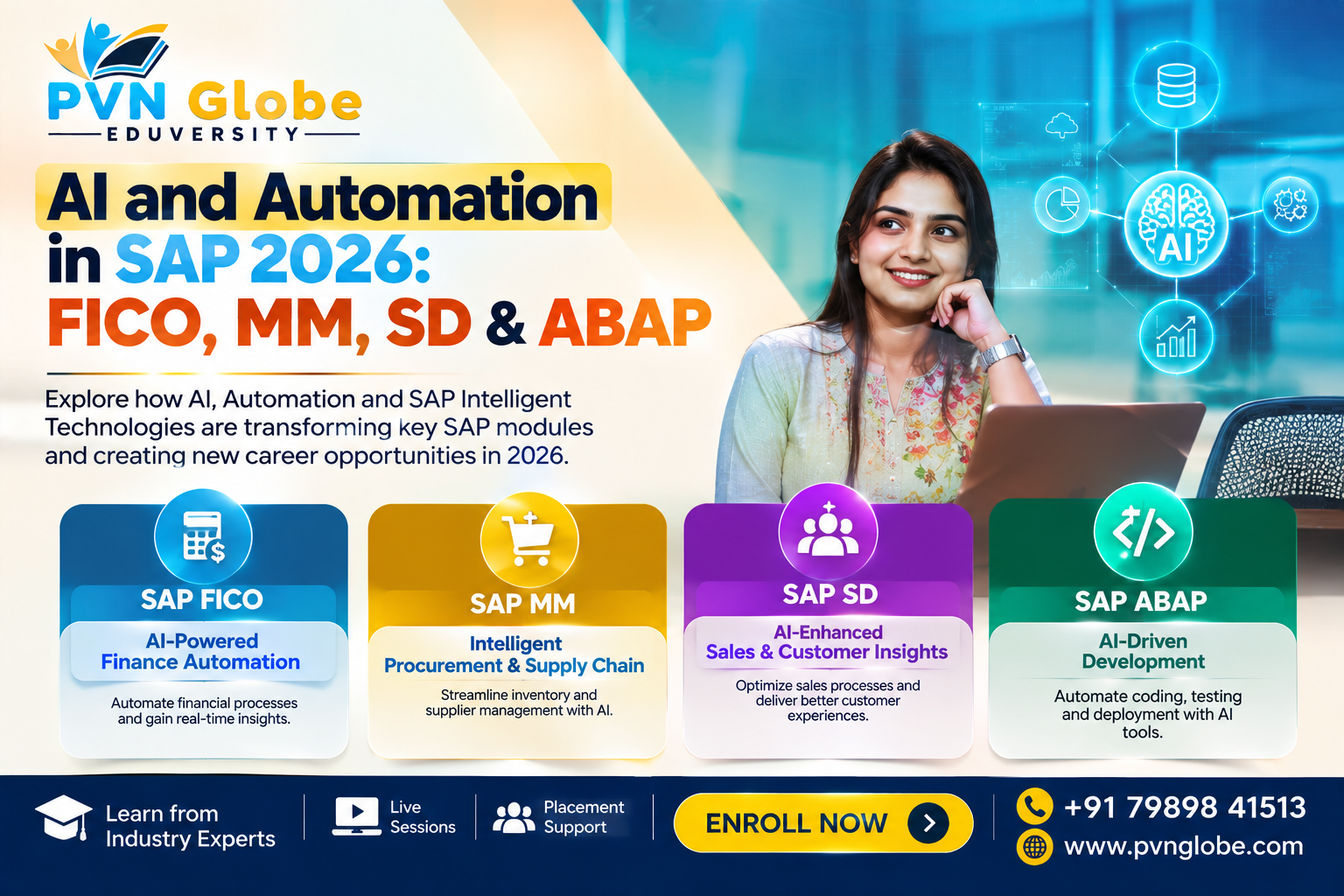
Artificial intelligence and automation are changing how organizations manage finance, procurement, sales, and enterprise software development. In 2026, AI and Automation in SAP are becoming increasingly relevant as businesses modernize their operations and adopt intelligent enterprise technologies.
SAP systems support many important business processes. SAP FICO manages financial accounting and controlling activities. SAP MM supports procurement and inventory management. SAP SD handles sales and distribution processes. Meanwhile, SAP ABAP enables developers to create and extend business applications. Traditionally, many SAP activities required manual data entry, repetitive processing, and extensive technical configuration. However, modern SAP environments increasingly support automation, analytics, and AI-assisted workflows.
Technologies such as SAP S/4HANA, SAP Business AI, SAP Joule, and SAP Build are helping organizations explore new ways to improve productivity. These developments are also changing the skills required for SAP consultants and developers.
In this guide, PVN Globe Academy, Hyderabad, explores how AI and automation are transforming SAP FICO, MM, SD, and ABAP in 2026.
What Is AI and Automation in SAP?
AI in SAP refers to artificial intelligence capabilities used within SAP business applications and related technologies.
These capabilities can support tasks such as document processing, information retrieval, recommendations, and business analysis.
Automation involves using predefined rules, workflows, software integrations, and intelligent technologies to reduce repetitive manual activities.
For example, an organization may automate purchase approval routing based on predefined business rules.
It may also use AI-assisted document processing to extract information from invoices.
However, AI and automation are not identical.
Traditional automation follows configured rules. AI can support tasks involving language, pattern recognition, and prediction.
Modern enterprise systems may combine both approaches.
How AI Is Transforming SAP FICO in 2026
SAP FICO includes Financial Accounting and Controlling.
It supports financial transactions, accounting processes, cost management, and reporting.
AI and automation can help finance teams reduce repetitive activities and investigate financial information more efficiently.
1. Automated Invoice Processing
Invoice processing often involves receiving documents, checking information, and recording transactions.
Document extraction technologies can help capture invoice details.
Automated workflows can then route documents for validation or approval.
However, organizations still need controls to verify financial accuracy.
2. Financial Reconciliation Support
Financial reconciliation involves comparing accounting records and identifying differences.
Automation can support matching processes based on predefined rules.
AI-assisted tools may help users investigate unusual transactions or understand discrepancies.
However, financial professionals remain responsible for reviewing exceptions.
3. Intelligent Financial Reporting
Finance teams regularly analyze revenue, expenses, profitability, and other business metrics.
Modern analytical tools can help users explore financial information and generate explanations.
AI assistance may simplify certain reporting activities.
However, results must be verified against reliable accounting data.
4. Workflow Automation
Organizations may automate approval routing, notifications, and selected finance processes.
These workflows can reduce manual coordination.
However, controls and authorization rules remain important.
Emerging SAP FICO Skills
SAP FICO professionals should understand SAP S/4HANA Finance, general ledger accounting, accounts payable, accounts receivable, asset accounting, and controlling.
Knowledge of financial workflows, integration, analytics, and relevant SAP AI capabilities can complement these foundations.
How AI Is Transforming SAP MM in 2026
SAP MM focuses on materials management and procurement processes.
It supports purchasing, inventory management, goods movements, and supplier-related activities.
AI and automation can help organizations improve procurement efficiency and information visibility.
1. Procurement Process Automation
Purchasing workflows often involve purchase requisitions, purchase orders, approvals, and goods receipts.
Automation can help route approvals and coordinate process steps.
For example, a purchase requisition may be directed to an authorized manager based on configured rules.
However, business requirements determine how the workflow operates.
2. Inventory Analysis
Organizations need accurate inventory information to support purchasing decisions.
Analytical systems can help identify stock trends and unusual movements.
AI-based forecasting capabilities may also support demand-related planning in appropriate solutions.
However, forecasting accuracy depends on data quality and business conditions.
3. Supplier Information Management
Procurement teams may need to review supplier information, purchasing history, and delivery performance.
Automation can help organize and process relevant information.
AI-assisted analytics may support supplier evaluation in suitable applications.
However, supplier decisions require business judgment and governance.
4. Document Processing
Purchase-related documents may contain large amounts of information.
Document extraction and automated validation can reduce selected manual tasks.
However, organizations should verify extracted information before using it in business transactions.
Emerging SAP MM Skills
SAP MM learners should understand procurement cycles, purchase requisitions, purchase orders, goods receipts, invoice verification, inventory management, and integration with finance.
Knowledge of SAP S/4HANA procurement, workflows, analytics, and relevant automation capabilities can provide additional value.
How AI Is Transforming SAP SD in 2026
SAP SD supports sales and distribution processes.
It covers important activities such as sales orders, pricing, delivery processing, billing, and customer-related transactions.
Automation can help organizations manage these activities more consistently.
1. Sales Order Processing
Sales orders contain information about customers, products, quantities, prices, and delivery requirements.
Automation can support order creation, validation, and processing in suitable scenarios.
For example, an integrated application may transfer approved customer order information into an SAP sales process.
However, business rules and master data must be configured correctly.
2. Pricing and Sales Analytics
SAP SD supports pricing procedures and sales-related business rules.
Analytical tools can help organizations review sales performance and customer purchasing patterns.
AI-assisted analysis may help users explore trends and identify areas requiring attention.
However, pricing decisions should follow approved business policies.
3. Delivery and Order Fulfillment
Sales processes often involve coordination between order management, inventory, and logistics.
Automated workflows can support notifications and process tracking.
Integration between SAP modules helps maintain consistent information.
4. Customer Service Support
AI assistants can help users retrieve relevant information and understand business processes.
In appropriate applications, AI may also support customer-facing service activities.
However, these capabilities depend on the specific SAP products and integrations implemented.
Emerging SAP SD Skills
SAP SD professionals should understand sales order processing, pricing, shipping, billing, partner determination, and integration with SAP MM and FICO.
Knowledge of SAP S/4HANA Sales, process automation, analytics, and integration can complement traditional functional skills.
How AI Is Transforming SAP ABAP in 2026
SAP ABAP is a programming language used to develop and extend SAP applications.
ABAP developers work with business logic, reports, interfaces, enhancements, and application extensions.
AI-assisted development tools are changing how developers approach selected programming tasks.
1. AI-Assisted Code Development
AI coding assistants can help developers understand code and generate initial suggestions.
For example, an assistant may help explain an unfamiliar ABAP method or propose a code structure.
However, generated code must be reviewed and tested.
2. Code Explanation and Documentation
Enterprise applications may contain complex business logic.
AI assistance can help developers summarize selected code sections and prepare documentation drafts.
However, developers should verify technical accuracy and business context.
3. Testing and Troubleshooting
AI tools may help suggest test scenarios or explain error messages.
However, debugging still requires understanding ABAP behavior, system configuration, and business requirements.
4. Modern ABAP Development
SAP development increasingly emphasizes modern programming practices.
ABAP Cloud, the ABAP RESTful Application Programming Model, and released APIs are important concepts in supported development environments.
Developers should also understand extension strategies and SAP’s clean-core approach.
Emerging SAP ABAP Skills
ABAP developers should learn modern ABAP syntax, object-oriented programming, CDS views, RAP, APIs, and relevant cloud development concepts.
AI-assisted coding can support productivity, but strong programming knowledge remains essential.
SAP Joule, SAP Business AI and SAP Build
SAP provides several technologies relevant to intelligent enterprise applications.
SAP Joule is an AI copilot designed to assist users within supported SAP experiences.
SAP Business AI refers to AI capabilities across SAP’s portfolio.
SAP Build supports application development, process automation, and related business extension scenarios.
However, these technologies have different purposes.
Joule does not automatically provide every AI feature in every SAP application.
Similarly, SAP Build automation capabilities depend on the tools, configurations, and processes implemented.
Therefore, consultants should verify which capabilities are supported in their organization’s SAP environment.
Traditional SAP vs AI-Enabled SAP Processes
SAP Area | Traditional Activities | AI and Automation Opportunities |
SAP FICO | Manual reconciliation and invoice handling | Document processing and reconciliation support |
SAP MM | Manual purchasing coordination | Approval workflows and procurement analytics |
SAP SD | Repetitive order processing | Order validation and sales analysis |
SAP ABAP | Manual coding and documentation | AI-assisted code explanation and development |
AI can support productivity across these areas.
However, implementation success depends on process design, accurate data, system integration, and governance.
Will AI Replace SAP Consultants in 2026?
AI can automate selected activities and assist with routine tasks.
However, SAP consulting involves understanding business requirements, configuring enterprise processes, managing integrations, and resolving complex issues.
For example, an SAP FICO consultant must understand accounting requirements.
An SAP MM consultant must understand procurement processes.
An SAP SD consultant must understand sales operations.
An SAP ABAP developer must understand application architecture and business logic.
AI may help professionals perform parts of their work, but it does not remove the need for these skills.
Therefore, SAP professionals should focus on combining functional or technical expertise with automation knowledge.
Emerging SAP Skills to Learn in 2026
SAP S/4HANA Knowledge
SAP S/4HANA remains important for professionals working with modern SAP environments.
Learners should understand the relevant business processes and application concepts.
SAP Business AI Awareness
Professionals should understand where AI can support enterprise workflows and where human review remains necessary.
Process Automation
Workflow design, approvals, integration, and exception handling are useful across functional modules.
SAP BTP Fundamentals
SAP Business Technology Platform supports application development, integration, automation, data, and AI-related scenarios.
Its relevance depends on the learner’s target role.
Integration Knowledge
SAP business processes often connect multiple modules and external applications.
Understanding integration helps consultants troubleshoot end-to-end workflows.
Data Security and Governance
Enterprise systems contain sensitive business information.
Therefore, professionals should understand access controls, authorization, and responsible data handling.
Which SAP Course Is Best for an AI-Driven Career in 2026?
The best SAP course depends on your background.
SAP FICO may suit commerce graduates, accounting professionals, and finance-oriented learners.
SAP MM may suit students interested in procurement, inventory, and supply chain operations.
SAP SD may suit learners interested in sales processes, order management, and business operations.
SAP ABAP may suit students who enjoy programming and application development.
However, none of these courses is automatically the best choice for everyone.
AI knowledge should complement your chosen specialization rather than replace its foundational skills.
Practical SAP Automation Project Ideas
Practical exercises help learners understand how SAP business processes work.
For SAP FICO, a project could demonstrate an invoice approval workflow with validation steps.
For SAP MM, a project could illustrate purchase requisition approval and procurement tracking.
For SAP SD, a project could focus on sales order validation and billing integration.
For SAP ABAP, a project could involve developing a business application using modern ABAP concepts in a suitable practice environment.
Learners can also document where AI assistance might support these workflows.
However, they should distinguish simulated examples from capabilities actually implemented in SAP software.
SAP Career Opportunities in 2026
SAP professionals may explore several career directions.
SAP FICO learners may work toward finance-related functional consulting roles.
SAP MM learners may pursue procurement and materials management consulting.
SAP SD learners may explore sales and distribution consulting.
SAP ABAP learners may pursue technical development positions.
Additional opportunities may involve SAP integration, business process automation, application extensions, and SAP BTP technologies.
However, job requirements depend on employers, experience, and project environments.
Freshers should review entry-level job descriptions and develop practical knowledge before applying.
SAP Training in Hyderabad at PVN Globe Academy
Students and working professionals interested in SAP careers can explore relevant learning paths at PVN Globe Academy in Hyderabad.
Learners considering SAP FICO, MM, SD, or ABAP should enquire about current course availability and syllabus details.
Before enrolling, confirm whether the training covers SAP S/4HANA concepts, practical exercises, module integration, and relevant modern technologies.
Students can also ask whether the curriculum introduces AI and automation concepts applicable to their chosen SAP module.
A strong learning path should combine technical knowledge, business understanding, and practical experience.
Frequently Asked Questions
How is AI changing SAP in 2026?
AI is supporting selected activities such as document processing, code assistance, business analysis, and information retrieval. Automation also helps coordinate workflows and reduce repetitive tasks.
Will AI replace SAP FICO consultants?
AI may automate selected finance activities, but accounting knowledge, configuration, compliance, and business judgment remain important.
How is automation used in SAP MM?
Automation can support purchasing approvals, document processing, procurement workflows, and inventory-related activities.
Does AI affect SAP SD careers?
AI and automation can change how sales information is processed and analyzed. However, SAP SD professionals still need strong sales process and integration knowledge.
Is SAP ABAP still worth learning in 2026?
SAP ABAP remains relevant for developing and extending SAP applications. Modern ABAP concepts and cloud-compatible development practices are important areas to explore.
What is SAP Joule?
SAP Joule is an AI copilot that supports users within compatible SAP products and experiences. Available features depend on the specific application and environment.
Which SAP module is best for freshers?
SAP FICO may suit finance-oriented learners, SAP MM may suit procurement interests, SAP SD may suit sales operations interests, and SAP ABAP may suit programming-focused students.
Where can I explore SAP training in Hyderabad?
Learners can enquire about SAP FICO, MM, SD, and ABAP training options at PVN Globe Academy, Hyderabad.
Conclusion
AI and Automation in SAP are changing how organizations manage finance, procurement, sales, and enterprise application development.
SAP FICO can benefit from automated finance workflows and intelligent analysis.
SAP MM can benefit from procurement automation and improved inventory insights.
SAP SD can benefit from sales process automation and analytical capabilities.
SAP ABAP developers can use AI-assisted tools to support coding, documentation, and troubleshooting.
However, AI does not eliminate the need for strong SAP knowledge.
Instead, professionals should develop module expertise while learning relevant automation, integration, and AI concepts.
For learners interested in SAP training in Hyderabad, PVN Globe Academy is an option to explore SAP FICO, MM, SD, and ABAP learning paths.
PVN Globe Academy – Hyderabad, Telangana