
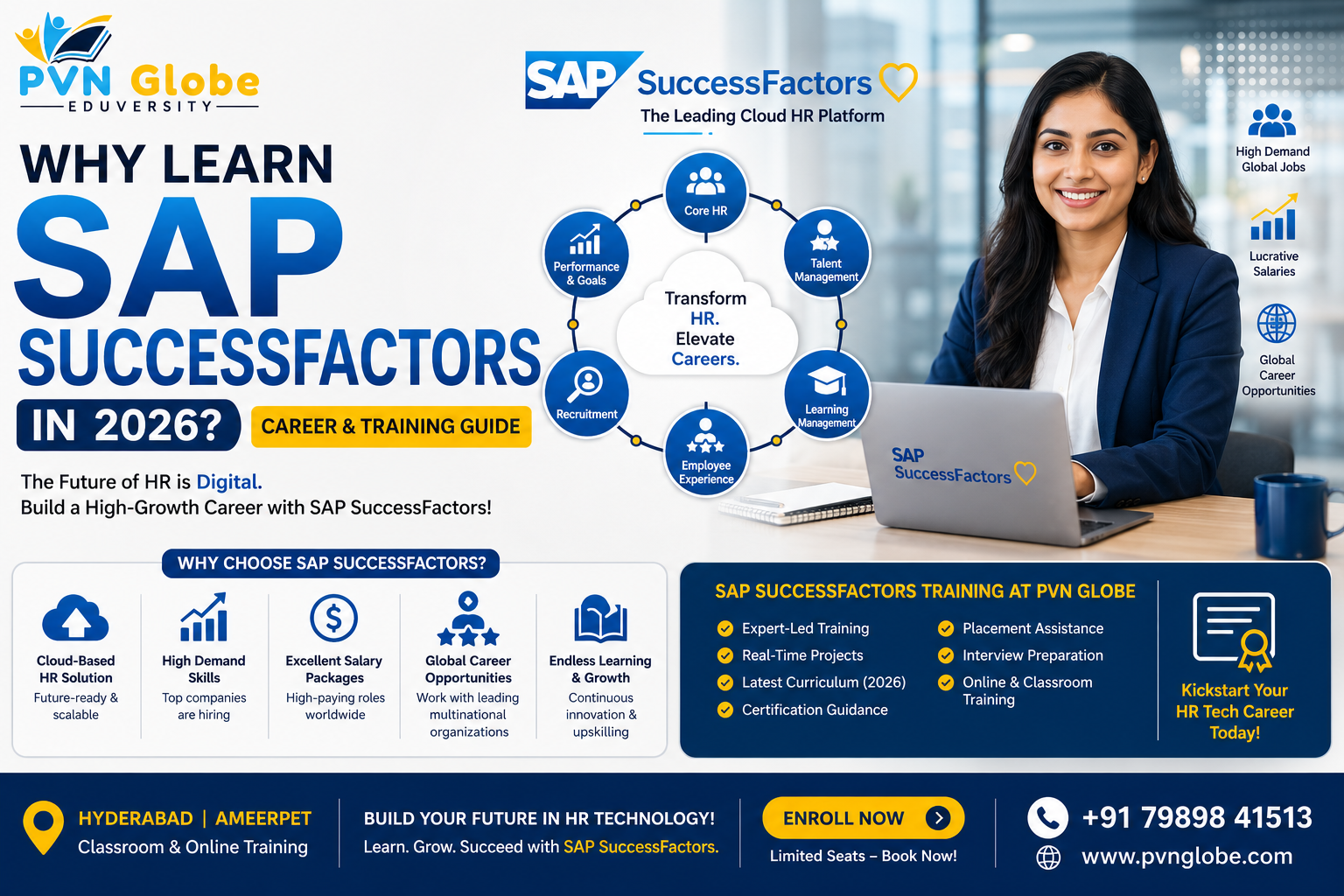
Introduction:
Why SAP SuccessFactors Matters in 2026
Human resources have changed dramatically over the last few years.
Traditional HR processes that once depended heavily on spreadsheets, emails, paperwork, and disconnected systems are increasingly moving toward integrated digital platforms. Organizations want HR technology that can support employee data, workforce processes, talent development, learning, performance, succession, and career growth.
This is where SAP SuccessFactors becomes important.
SAP SuccessFactors is SAP’s cloud-based human experience management platform. It helps organizations manage important workforce and HR processes through connected digital capabilities.
For professionals planning an SAP career in 2026, learning SAP SuccessFactors can be an interesting path because it combines three important areas:
- SAP technology
- Human resources processes
- Cloud-based enterprise applications
The technology is also continuing to evolve. SAP’s 1H 2026 release information highlights new innovations in SAP SuccessFactors Learning, including intelligent Q&A and the Learning Compliance Agent.
At the same time, SAP continues to develop career and talent capabilities around skills, career development, succession, learning, and AI-assisted experiences.
This means professionals entering the field should not think of SuccessFactors as simply another HR software course.
It is better understood as a combination of:
HR + Cloud + SAP + Configuration + Business Processes + Data + Continuous Learning
This article explains why learning SAP SuccessFactors in 2026 can be valuable, what skills you should develop, what career opportunities exist, how training can help, and what you can expect from SAP SuccessFactors training at PVN Globe Academy.
1. What Is SAP SuccessFactors?
SAP SuccessFactors is an enterprise human experience management solution designed to help organizations manage and develop their workforce.
Instead of treating HR as a collection of isolated activities, modern HXM platforms connect different employee and workforce processes.
Depending on the organization’s requirements, SuccessFactors can support areas such as:
- Employee information
- Organizational structures
- Position management
- Recruiting
- Onboarding
- Performance management
- Compensation
- Learning
- Career development
- Succession planning
- Workforce analytics
- Employee experiences
One of the most important concepts for beginners is understanding that SAP SuccessFactors is not just about screens and transactions.
A successful consultant needs to understand the business process behind the system.
For example:
An employee joins an organization.
The organization needs to create the employee’s profile, assign organizational information, manage employment details, establish permissions, initiate onboarding activities, and potentially connect the employee with learning and performance processes.
A consultant needs to understand how these processes work and how the system can be configured to support them.
That is why SAP SuccessFactors training should combine technical learning with business-process understanding.
Why Learn SAP SuccessFactors in 2026?
There are several reasons professionals are considering SuccessFactors as a career skill in 2026.
2.1 Cloud HR Technology Is Becoming More Important
Organizations increasingly use cloud applications to manage business operations.
Cloud platforms provide organizations with scalable systems, centralized data, regular product updates, and easier access to modern digital capabilities.
For HR departments, this means moving beyond traditional HR administration toward connected digital employee experiences.
Learning SAP SuccessFactors gives professionals exposure to one of the major enterprise HR technology ecosystems.
2.2 SAP SuccessFactors Continues to Evolve
One of the strongest reasons to learn SuccessFactors is that the platform is not static.
SAP continues to release new capabilities.
For example, SAP’s 1H 2026 SuccessFactors Learning release highlights intelligent Q&A and the Learning Compliance Agent.
SAP’s Career and Talent Development capabilities are also incorporating AI-driven interactions and personalized recommendations for learning, roles, and career paths.
For professionals, this creates an important lesson:
Learning SuccessFactors is not a one-time activity.
You need to develop the habit of staying current with product releases and evolving HR technology.
SAP SuccessFactors and the Future of HR
The HR department of the future is expected to become increasingly data-driven and technology-enabled.
Companies want to understand questions such as:
- What skills do our employees have?
- What skills will we need?
- Which employees are ready for new roles?
- Which employees need additional training?
- How can we improve employee development?
- Which talent should be prepared for leadership?
- How can learning support business objectives?
SAP SuccessFactors provides capabilities that support many of these workforce processes.
SAP’s Career and Talent Development documentation describes capabilities around career paths, role readiness, employee development, succession, and opportunity discovery.
This creates opportunities for professionals who understand both HR processes and enterprise technology.
Major SAP SuccessFactors Modules You Should Know
A major advantage of SuccessFactors is its broad HR functionality.
However, beginners should avoid trying to learn everything simultaneously.
Start with the fundamentals and then specialize.
4.1 Employee Central
Employee Central is one of the most important areas of SAP SuccessFactors.
It focuses on core employee information and HR processes.
Typical areas include:
- Employee data
- Job information
- Personal information
- Employment information
- Organizational structures
- Position information
- Workflows
- Foundation objects
- Data management
- Permissions
Employee Central is often an excellent starting point because it helps learners understand the basic structure of SuccessFactors.
Employee Central Skills to Develop
A learner should aim to understand more than just navigation.
Important areas include:
Employee Data Management
Understand how employee information is maintained and managed.
Organizational Structures
Learn how organizations represent departments, business units, locations, jobs, and other organizational information.
Position Management
Understand how positions can be created and managed.
Workflows
Learn how approval processes work.
Role-Based Permissions
Understand how access is controlled.
Data Import and Export
Learn how employee and organizational data can be managed.
Business Rules
Understand how rules can automate or control business processes.
SAP’s current certification information for Employee Central Core identifies areas such as workflow management, data management, data import/export, corporate data management, and access controls among the skills associated with the certification.
SAP SuccessFactors Learning
Learning is another important area of SuccessFactors.
Organizations need employees to continuously develop their knowledge and skills.
SAP SuccessFactors Learning supports learning activities such as:
- Courses
- Learning assignments
- Training programs
- Learning content
- Assessments
- Learning history
- Certifications
- Compliance-related learning
- Reporting
SAP’s official SuccessFactors Learning Academy covers administration, learning content, learning programs, user access, reporting, configuration, approval processes, and data migration.
SAP also provides a dedicated SuccessFactors Learning Administration course covering areas such as reporting, curricula, programs, classes, assessments, online content, training evaluation, and administration.
This demonstrates how broad the Learning area can be.
Recruiting and Onboarding
Modern organizations need efficient recruitment and onboarding processes.
SuccessFactors can support organizations in managing talent acquisition and employee onboarding processes.
Professionals working in this area may encounter processes involving:
- Job requisitions
- Candidate management
- Recruitment workflows
- Interview processes
- Offer management
- Hiring
- Onboarding
- New employee activities
- Employee documentation
Understanding the complete process is important.
A consultant should be able to ask:
What does the HR team want to achieve?
Then determine:
How can the system be configured to support that requirement?
This business-oriented thinking is extremely valuable.
Performance and Goals
Organizations do not simply hire employees.
They also need to manage performance and employee development.
Performance and goals functionality can help organizations establish objectives, evaluate employee performance, and support development conversations.
A learner should understand concepts such as:
- Goals
- Performance forms
- Employee evaluations
- Manager reviews
- Development objectives
- Feedback
- Performance cycles
SAP’s Career and Talent Development capabilities also connect employee development, goals, career growth, succession, and skills.
Compensation
Compensation management is another important HR process.
Organizations need structured approaches for:
- Salary planning
- Compensation cycles
- Budget management
- Employee compensation
- Manager planning
- Compensation statements
Professionals who understand compensation processes can work toward specialized SuccessFactors roles.
However, beginners should first establish strong SuccessFactors fundamentals before moving into advanced specialization.
Career Development and Succession
Career development has become increasingly important.
Employees want to understand:
- What can I learn next?
- What skills do I need?
- What roles could I move into?
- How can I prepare for leadership?
- What learning opportunities are relevant to me?
Organizations also want to identify and develop future talent.
SAP’s Career and Talent Development capabilities include career development planning, role readiness, career paths, succession, and opportunity discovery.
SAP’s 1H 2026 updates also describe enhanced personalized recommendations for learning, roles, and career paths, alongside new AI agents in career and talent development.
This makes the intersection of skills + HR + AI + career development an important area to watch.
What Skills Do You Need for an SAP SuccessFactors Career?
Learning the software interface is only one part of becoming a SuccessFactors professional.
You should develop a combination of technical, functional, and communication skills.
11.1 HR Process Knowledge
You should understand basic HR concepts.
For example:
- Employee lifecycle
- Hiring
- Onboarding
- Organizational management
- Performance
- Compensation
- Learning
- Career development
- Succession
You do not necessarily need to be an HR expert before starting.
However, understanding HR terminology will make SuccessFactors much easier to learn.
Functional Configuration Skills
SuccessFactors professionals frequently work with configuration.
You should learn how requirements are converted into system settings.
A typical implementation process may look like:
Business Requirement → Analysis → Configuration → Testing → Validation → Deployment
For example:
A company may say:
Employees must receive manager approval when their job information changes.
The consultant needs to understand the requirement and determine how the relevant SuccessFactors process should be configured.
This is why practical training matters.
Data Management Skills
Enterprise HR systems depend heavily on accurate data.
SuccessFactors professionals should understand:
- Data structures
- Imports
- Exports
- Data validation
- Employee records
- Organizational data
- Data quality
- Error handling
Poor data can lead to incorrect HR processes.
Therefore, data management is an important skill for a SuccessFactors consultant.
Role-Based Permissions
Security is another major area.
Different users should have different access levels.
For example:
- Employee
- Manager
- HR administrator
- HR business partner
- Consultant
- System administrator
A professional should understand how access is structured and why permissions matter.
Security knowledge becomes especially important when working with sensitive employee information.
Business Rules and Workflows
Business rules and workflows can help automate HR processes.
Examples include:
- Approval processes
- Automatic field updates
- Validation
- Conditional logic
- Notifications
- HR process automation
Learning how rules and workflows operate can make a candidate more useful in implementation and support environments.
Integration Knowledge
Modern enterprise systems rarely operate alone.
Organizations may connect SuccessFactors with:
- Payroll systems
- ERP systems
- Identity platforms
- Time-management systems
- Third-party applications
- Reporting platforms
Therefore, basic integration knowledge can be beneficial.
You do not necessarily need to become an integration developer immediately.
But understanding concepts such as:
- APIs
- Data exchange
- Interfaces
- Integration flows
- Authentication
- Error handling
Can strengthen your overall profile.
Reporting and Analytics
HR teams need information to make decisions.
SuccessFactors professionals may work with reports involving:
- Employee data
- Learning activity
- Performance
- Organizational information
- Workforce trends
- Compliance
Reporting skills can therefore complement your SuccessFactors knowledge.
A consultant who understands both configuration and reporting can often troubleshoot business requirements more effectively.
AI and SAP SuccessFactors in 2026
Artificial intelligence is becoming increasingly relevant to enterprise HR technology.
However, learning AI does not mean that every SuccessFactors professional needs to become a machine-learning engineer.
Instead, professionals should understand how AI can influence HR processes.
Potential areas include:
- Employee assistance
- Learning recommendations
- Career recommendations
- Talent insights
- Workforce skills
- Automation
- HR productivity
SAP’s 1H 2026 Career and Talent Development updates mention AI agents and personalized recommendations across learning, roles, and career paths.
SAP SuccessFactors Learning’s 1H 2026 release also includes intelligent Q&A and a Learning Compliance Agent.
This makes basic AI awareness a useful complementary skill for future SuccessFactors professionals.
Career Opportunities After SAP SuccessFactors Training
Once you develop sufficient knowledge and practical skills, there are several possible career directions.
SAP SuccessFactors Consultant
A consultant works with organizations to understand requirements and configure SuccessFactors solutions.
Typical responsibilities can include:
- Requirement gathering
- Configuration
- Testing
- Documentation
- User support
- Issue analysis
- Client communication
SAP SuccessFactors Functional Consultant
A functional consultant specializes in business processes and system configuration.
Possible specializations include:
- Employee Central
- Recruiting
- Onboarding
- Learning
- Performance and Goals
- Compensation
- Career Development
- Succession
SAP SuccessFactors Support Consultant
Support professionals help organizations maintain and troubleshoot existing systems.
Typical activities include:
- Issue investigation
- Configuration corrections
- User support
- Testing
- Data validation
- Incident resolution
- Documentation
SAP SuccessFactors Implementation Consultant
Implementation consultants participate in new SuccessFactors deployments.
They may work on:
- Requirement gathering
- System design
- Configuration
- Data migration
- Testing
- Integration coordination
- Go-live preparation
- Post-go-live support
SAP HR / HXM Consultant
Professionals with broader HR technology knowledge can also explore roles that combine SAP HR and HXM expertise.
This can be particularly useful for professionals who want to understand HR technology beyond a single module.
Who Should Learn SAP SuccessFactors?
SAP SuccessFactors is not limited to one type of learner.
It can be considered by:
Fresh Graduates
Graduates interested in enterprise software and HR technology can begin with fundamentals.
HR Professionals
HR professionals can learn how technology supports HR processes.
SAP Professionals
Existing SAP professionals can add HXM skills to their profile.
SAP HCM Professionals
Professionals familiar with traditional SAP HCM may explore cloud HXM and SuccessFactors capabilities.
IT Professionals
IT professionals can develop functional knowledge of enterprise HR applications.
Career Switchers
Professionals moving toward SAP consulting can consider SuccessFactors as one possible specialization.
Do You Need HR Experience to Learn SuccessFactors?
Not necessarily.
A learner can start without extensive HR experience.
However, basic knowledge of HR concepts can make the learning process easier.
For example, understanding what an employee lifecycle looks like will help you understand why SuccessFactors contains different modules.
If you are completely new to HR, do not worry.
A good training program should explain both:
Business Process + System Configuration
That combination can help beginners build a stronger foundation.
SAP SuccessFactors Certification
Certification can be useful for validating your knowledge.
However, certification should not be treated as a replacement for practical experience.
A strong career profile ideally combines:
Training + Hands-on Practice + Business Knowledge + Projects + Certification
SAP’s current certification information shows an emphasis on keeping skills current. For example, the Employee Central Core certification information states that certification is valid for 12 months and can be extended through successful assessments.
This highlights an important point:
SAP professionals need continuous learning.
The platform changes, releases evolve, and organizations adopt new capabilities.
Why Hands-On Practice Matters
Imagine learning SuccessFactors only through presentations.
You may remember definitions.
But when someone gives you a real business requirement, you may not know how to approach it.
Hands-on practice solves this problem.
A practical training program should give learners opportunities to work through scenarios such as:
- Creating employee records
- Configuring organizational structures
- Creating workflows
- Managing permissions
- Working with business rules
- Performing data imports
- Generating reports
- Testing configurations
- Troubleshooting errors
SAP’s own learning ecosystem emphasizes hands-on learning and system access as part of its broader learning approach.
How to Build an SAP SuccessFactors Career Step by Step
A structured learning plan can make the journey easier.
Step 1: Understand SAP and HCM Basics
Start with:
- What is SAP?
- What is HCM?
- What is HXM?
- What is cloud HR?
- What is SuccessFactors?
Step 2: Choose a Core Module
Employee Central is often a logical starting point for learners who want broad SuccessFactors fundamentals.
Step 3: Learn Configuration
Understand:
- Objects
- Fields
- Workflows
- Business rules
- Permissions
- Data management
Step 4: Practice Real Scenarios
Do not only memorize menus.
Practice business requirements.
Step 5: Learn Testing
Understand how to validate configuration.
Practice:
- Positive testing
- Negative testing
- Regression testing
- Data validation
- Workflow testing
Step 6: Develop Documentation Skills
Learn how to prepare:
- Requirement documents
- Configuration documents
- Test cases
- Test results
- User guides
- Issue documentation
Step 7: Explore Integration
After developing functional fundamentals, explore integration concepts.
Step 8: Consider Certification
Once your fundamentals and practical knowledge are strong, consider the relevant SAP certification path.
Step 9: Keep Learning
Follow SAP releases and product updates.
SAP’s Learning Journeys are specifically designed to help learners move from introductory knowledge toward competency, certification, staying current, and expanding skills.
What Makes a Good SAP SuccessFactors Training Program?
Choosing the right training program is important.
A good course should ideally include:
Structured Curriculum
The course should progress from fundamentals to advanced concepts.
Experienced Trainer
The trainer should be able to explain both technical configuration and business processes.
Practical Exercises
Learners should get opportunities to practice.
Real-Time Scenarios
Business scenarios help learners understand why configuration is required.
Interview Preparation
The course should help learners explain concepts clearly during interviews.
Project Exposure
Projects can help learners understand implementation methodology.
Updated Content
Because SuccessFactors changes over time, course content should be reviewed regularly.
SAP SuccessFactors Training at PVN Globe Academy
For learners looking to develop SAP SuccessFactors skills, PVN Globe Academy can provide a structured training environment focused on practical learning and career development.
The goal should not be simply to complete a syllabus.
The goal should be to understand how SuccessFactors is used in real business environments.
A strong learning approach can include:
- SAP SuccessFactors fundamentals
- HCM concepts
- Employee Central
- Configuration
- Business rules
- Workflows
- Role-based permissions
- Data management
- Reporting
- Integration concepts
- Testing
- Real-time scenarios
- Interview preparation
- Project-based learning
The exact course structure, module coverage, batch schedule, trainer availability, and certification preparation should be confirmed directly with PVN Globe Academy before enrollment.
Why Choose Practical Training?
There is a major difference between knowing a definition and being able to solve a problem.
For example:
Definition-based learning:
“What is a workflow?”
Practical learning:
“An employee’s job information should require HR approval. How would you approach the requirement?”
The second question tests your understanding.
This is how consultants think.
A practical course should encourage learners to move from:
Learn → Practice → Test → Troubleshoot → Explain
That learning cycle can help develop stronger confidence.
Common Mistakes Beginners Make
Mistake 1: Trying to Learn Every Module
SuccessFactors is broad.
Do not try to master every module at once.
Start with one strong foundation.
Mistake 2: Memorizing Instead of Understanding
Memorizing configuration steps without understanding the business process can make troubleshooting difficult.
Mistake 3: Ignoring HR Concepts
SuccessFactors is HR technology.
Understanding HR terminology is important.
Mistake 4: Avoiding Hands-On Practice
Watching videos is not enough.
Practice is essential.
Mistake 5: Ignoring New Releases
SuccessFactors continuously evolves.
SAP professionals need to stay current.
Mistake 6: Focusing Only on Certification
Certification can strengthen a profile, but practical knowledge is equally important.
SAP SuccessFactors Interview Preparation
Candidates preparing for SuccessFactors interviews should be ready for different types of questions.
Basic Questions
- What is SAP SuccessFactors?
- What is Employee Central?
- What is HXM?
- What is cloud HCM?
- What are SuccessFactors modules?
Configuration Questions
- How do workflows work?
- What are business rules?
- How are permissions managed?
- How is employee data maintained?
Scenario Questions
- How would you handle an employee data change?
- How would you troubleshoot a workflow?
- How would you validate imported employee data?
- How would you approach a client requirement?
Project Questions
- Explain your project.
- What was your role?
- What configuration did you perform?
- What challenges did you face?
- How did you test the solution?
The best interview preparation is not memorizing answers.
It is understanding the system well enough to explain your approach.
Career Growth in SAP SuccessFactors
A possible career progression can look like:
Learner → Junior Consultant → Consultant → Senior Consultant → Lead Consultant → Solution/Functional Architect
The exact career path depends on experience, specialization, organization, project exposure, and individual performance.
Professionals can also specialize.
For example:
Employee Central Specialist
or
SAP SuccessFactors Learning Consultant
or
SAP SuccessFactors Recruiting Consultant
or
SAP SuccessFactors Compensation Consultant
or
SAP SuccessFactors Career & Talent Consultant
Specialization can help professionals build deeper expertise.
SuccessFactors + AI: A Future-Oriented Skill Combination
The future of HR technology is not only about cloud applications.
It is also about intelligent experiences.
Professionals who understand both SuccessFactors and emerging AI capabilities may be better positioned to understand how modern HR teams use technology.
However, the foundation remains important.
A useful combination is:
SAP SuccessFactors + HR Processes + Data + Automation + AI Awareness
This is more valuable than learning AI concepts without understanding the HR business context.
Is SAP SuccessFactors a Good Career Choice in 2026?
There is no single technology career that is perfect for everyone.
But SuccessFactors can be a strong option for people who enjoy:
- Enterprise software
- HR technology
- Business processes
- Configuration
- Client interaction
- Problem-solving
- Cloud applications
- Continuous learning
The platform is continuing to evolve, and SAP’s 2026 materials show active development across learning and career/talent capabilities.
Therefore, professionals should approach SuccessFactors as a long-term skill rather than a quick shortcut to employment.
Frequently Asked Questions
What is SAP SuccessFactors?
SAP SuccessFactors is SAP’s cloud-based human experience management platform used to support various HR and workforce processes.
Is SAP SuccessFactors difficult to learn?
The difficulty depends on your background and the module you choose. A structured learning path with practical exercises can make the process easier.
Can freshers learn SAP SuccessFactors?
Yes. Freshers can begin with SAP, HR, and SuccessFactors fundamentals before progressing toward configuration and practical scenarios.
Is HR experience mandatory?
No, but understanding basic HR processes can be helpful.
Which SuccessFactors module should beginners learn first?
Employee Central is a common starting point because it introduces core employee and organizational concepts.
Is SAP SuccessFactors certification important?
Certification can validate knowledge, but practical skills and project understanding are also important.
Can SAP HCM professionals learn SuccessFactors?
Yes. Professionals with SAP HCM experience may find their existing HR process knowledge useful when moving into SuccessFactors.
Is SuccessFactors a cloud technology?
Yes. SAP SuccessFactors is positioned as SAP’s cloud HXM solution.
Does SuccessFactors use AI?
SAP is actively introducing AI-related capabilities across SuccessFactors. Current 2026 materials describe AI-enabled features in learning and career/talent development.
Can I build a career as a SuccessFactors consultant?
Yes. Possible roles include functional consultant, implementation consultant, support consultant, and module specialist.
How long does it take to learn SAP SuccessFactors?
The time varies depending on your background, module, training schedule, practice time, and career goal. Focus on skill development rather than completing the course as quickly as possible.
Final Thoughts
SAP SuccessFactors is becoming an important part of the modern HR technology landscape.
For professionals considering an SAP career in 2026, the platform offers an opportunity to combine:
HR Knowledge + SAP Technology + Cloud HCM + Configuration + Data + Business Processes
The most important thing is to learn systematically.
Do not focus only on memorizing configuration steps.
Understand the business requirement.
Practice the solution.
Test it.
Troubleshoot it.
Explain it.
And keep learning as the platform evolves.
SAP’s current learning ecosystem supports this approach through learning journeys, hands-on learning, assessments, and certification pathways.
For learners who want structured SAP SuccessFactors training, PVN Globe Academy can be considered as a training option. Before joining, compare the curriculum, practical system access, trainer experience, project exposure, interview preparation, and current course coverage.
Ready to Start Your SAP SuccessFactors Journey?
If your goal is to build skills in SAP SuccessFactors and move toward an HR technology career, start by building strong fundamentals.
Learn the concepts.
Practice the configuration.
Understand the business process.
Build project knowledge.
Prepare for interviews.
Keep upgrading your skills.
Your SAP SuccessFactors journey starts with the right foundation.
Explore SAP SuccessFactors Training at PVN Globe Academy and take the next step toward building your SAP HXM skills.