
Introduction
How to Become an SAP MM Consultant in 2026
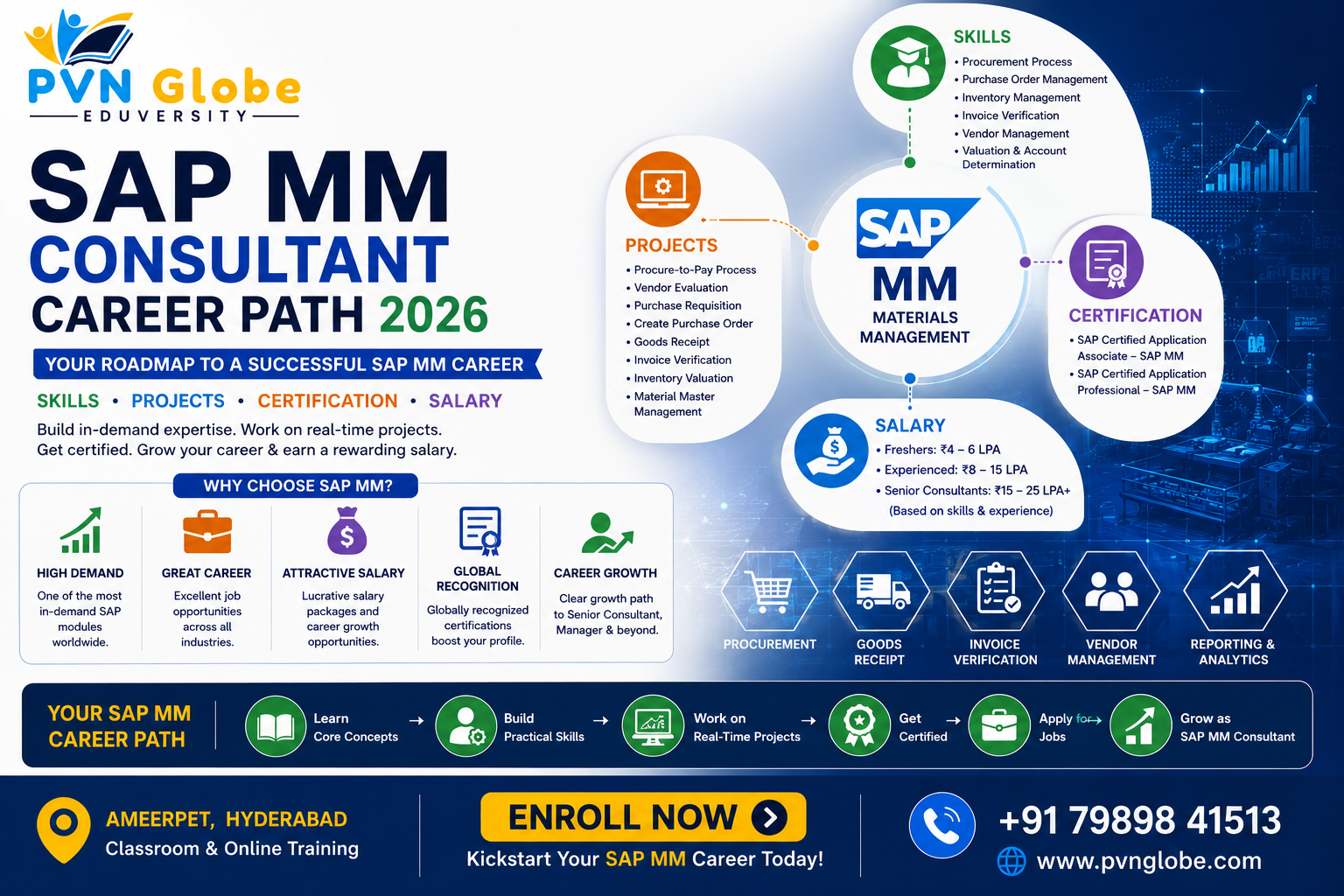
Enterprise resource planning has become an essential part of modern business operations. Organizations across manufacturing, retail, pharmaceuticals, logistics, automotive, technology, and other industries depend on integrated ERP systems to manage procurement, inventory, suppliers, finance, production, and supply chain activities.
Within the SAP ecosystem, SAP Materials Management (SAP MM) plays an important role in procurement and inventory-related business processes.
An SAP MM Consultant helps organizations design, configure, implement, test, and support SAP materials management processes. The role combines business-process knowledge with SAP functional expertise.
If you are planning to become an SAP MM Consultant in 2026, you should develop knowledge in:
- SAP MM fundamentals
- Procurement
- Purchasing
- Material Master
- Supplier Master
- Inventory Management
- Invoice Verification
- Material Valuation
- SAP MM integration
- SAP S/4HANA procurement
- Configuration
- Testing
- Real-time project scenarios
- Business-process analysis
For learners searching for SAP MM Training in Hyderabad, PVN GLOBE can be a career-focused learning destination for developing these skills.
This comprehensive guide explains the SAP MM Consultant career path, required skills, projects, certification direction, salary considerations, job roles, and a practical learning roadmap for 2026.
Understanding the SAP MM Consultant Role
An SAP MM Consultant is a functional professional who works with procurement, inventory, materials, and supply chain business processes.
The consultant’s responsibility is not limited to configuring SAP screens. A strong consultant first understands the organization’s business requirements and then maps those requirements to appropriate SAP processes.
Major Responsibilities
An SAP MM Consultant may work on:
- Business requirement analysis
- Procurement process design
- SAP MM configuration
- Material master processes
- Supplier-related processes
- Purchasing
- Inventory management
- Invoice verification
- Pricing procedures
- Account determination
- Release processes
- Testing
- Data migration
- User training
- Documentation
- Production support
- Issue resolution
Typical Consultant Workflow
- Business Requirement
- Process Analysis
- Solution Design
- SAP MM Configuration
- Testing
- User Acceptance Testing
- Go-Live
- Production Support
This makes SAP MM consulting a combination of business knowledge, SAP functional skills, analytical thinking, communication, and problem-solving.
SAP MM Career Opportunities in 2026
The growth of digital supply chains and integrated ERP systems continues to create opportunities for professionals with procurement and enterprise application knowledge.
SAP MM is particularly relevant for professionals interested in:
- Procurement
- Supply chain
- Inventory
- ERP consulting
- Manufacturing
- Logistics
- Enterprise applications
Organizations need professionals who understand both the business process and the technology supporting it.
Advantages of an SAP MM Career
Business + Technology
SAP MM combines business operations with enterprise technology.
Multiple Industries
SAP skills can be relevant across manufacturing, retail, pharmaceuticals, automotive, logistics, and other sectors.
Functional Consulting Opportunities
Professionals can progress from support roles toward implementation and consulting responsibilities.
Integration Knowledge
SAP MM professionals can develop knowledge of SAP FI, PP, SD, QM, and warehouse-related processes.
Career Growth
With experience, professionals may progress toward senior consultant, solution architect, lead consultant, or SAP supply-chain-related roles.
SAP MM Skills for Beginners
Before attempting advanced SAP MM consulting responsibilities, beginners should develop a strong foundation.
1. SAP Fundamentals
Understand:
- ERP concepts
- SAP architecture basics
- SAP modules
- Master data
- Transactional data
- Organizational structures
2. Procurement
Learn:
- Purchase requisitions
- Purchase orders
- Requests for quotation
- Source determination
- Purchasing information
- Supplier-related procurement processes
3. Inventory Management
Understand:
- Goods receipt
- Goods issue
- Stock transfer
- Transfer posting
- Reservations
- Physical inventory
4. Material Master
Learn how material information is maintained and used across business processes.
5. Invoice Verification
Understand how invoices relate to procurement and goods receipt.
6. Integration
Learn how MM interacts with:
- FI
- CO
- PP
- SD
- QM
- WM/EWM
A strong foundation in these areas is essential for SAP MM Consultant Training.
Master SAP MM Organizational Structure
Organizational structure is one of the first concepts an SAP MM learner should understand.
SAP uses organizational units to represent the structure of an organization.
Client
The highest organizational level in an SAP environment.
Company Code
Represents an accounting entity.
Plant
A location where materials may be produced, stored, or managed.
Storage Location
Represents a storage area within a plant.
Purchasing Organization
Responsible for purchasing activities.
Purchasing Group
Represents purchasing responsibilities or buyers.
Example Business Structure
A company may have:
- Company
- Company Code
- Plant
- Storage Locations
Alongside this structure, purchasing organizations and purchasing groups support procurement activities.
Why Organizational Structure Matters
SAP MM configuration depends heavily on organizational relationships.
For example, procurement processes may depend on:
- Plant
- Purchasing organization
- Purchasing group
- Company code
- Storage location
Therefore, understanding organizational structure is a fundamental requirement for becoming an SAP MM Consultant.
SAP MM Master Data
Master data is the foundation of many SAP MM processes.
Material Master
The Material Master stores information about materials used by an organization.
Examples include:
- Raw materials
- Finished goods
- Semi-finished materials
- Consumables
- Packaging materials
- Spare parts
Material data can support multiple business processes.
Important areas may include:
- Basic information
- Purchasing
- MRP
- Accounting
- Plant-related information
- Storage information
Supplier Master
Supplier-related information is also important for procurement processes.
In modern SAP S/4HANA environments, supplier management is closely associated with the Business Partner approach.
Why Master Data Matters
Poor master data can create issues in:
- Procurement
- Inventory
- Planning
- Accounting
- Reporting
- Production
Therefore, an SAP MM Consultant should understand master-data design, maintenance, validation, and business impact.
SAP MM Procure-to-Pay Process
The Procure-to-Pay (P2P) process is one of the most important SAP MM processes.
It represents the complete journey from identifying a purchasing requirement to processing the supplier invoice.
Step 1: Requirement
A department identifies a requirement for a material or service.
Step 2: Purchase Requisition
The requirement is converted into a purchasing request.
Step 3: Source Determination
The purchasing team determines the appropriate source or supplier.
Step 4: Purchase Order
A purchase order is created and communicated to the supplier.
Step 5: Goods Receipt
The organization receives the material and records the goods receipt.
Step 6: Invoice Verification
The supplier invoice is checked against purchasing and receipt information.
Step 7: Payment
The financial process continues according to the organization’s payment process.
P2P Flow
Requirement
→ PR
→ Source Determination
→ PO
→ Goods Receipt
→ Invoice Verification
→ Payment
Understanding this end-to-end process is critical for SAP MM functional consultants.
SAP MM Configuration Skills
An SAP MM Consultant should understand how business requirements are translated into SAP configuration.
Configuration areas may include:
Enterprise Structure
- Company code
- Plant
- Storage location
- Purchasing organization
- Purchasing group
Purchasing Configuration
- Purchase requisition
- Purchase order
- Document types
- Number ranges
- Item categories
- Account assignment
- Release processes
Inventory Management
- Movement types
- Goods movements
- Stock transfers
- Physical inventory
Pricing
Understand how purchasing prices and conditions can be determined according to business requirements.
Account Determination
Understand how relevant procurement and inventory transactions integrate with financial accounting.
Output
Understand how purchasing documents can generate appropriate communications.
Release Processes
Learn how organizations can implement approval workflows for purchasing documents.
A consultant should not learn configuration as isolated steps. Instead, configuration should be connected to the business requirement and process objective.
SAP MM Integration with Other SAP Modules
SAP MM is highly integrated with other SAP functional areas.
SAP MM and SAP FI
Integration can occur during:
- Goods movements
- Invoice verification
- Material valuation
- Accounting postings
Understanding MM-FI integration is important because procurement transactions can have financial consequences.
SAP MM and SAP PP
MM supports production by helping ensure the availability of required materials.
Integration may involve:
- Material requirements
- Procurement
- Inventory
- Production orders
- Goods movements
SAP MM and SAP SD
MM and SD can interact through:
- Material availability
- Inventory
- Sales processes
- Stock movements
SAP MM and SAP QM
Quality processes may be involved when materials are received from suppliers.
SAP MM and Warehouse Management
MM inventory processes can integrate with warehouse solutions such as SAP Warehouse Management and SAP Extended Warehouse Management.
Career Advantage
Professionals who understand integration can move beyond basic SAP MM support and participate in larger implementation and transformation projects.
SAP MM in the SAP S/4HANA Era
SAP S/4HANA has changed many aspects of traditional SAP ERP processes.
For professionals entering the SAP MM field in 2026, learning SAP S/4HANA procurement concepts is highly valuable.
Important areas to explore include:
- Modern procurement processes
- Business Partner
- Fiori user experience
- Simplified data models
- Embedded analytics
- Procurement automation
- Integration
- Digital supply chain concepts
SAP MM vs S/4HANA Procurement Learning
A learner should avoid focusing only on older transaction-based approaches.
Instead, build knowledge across:
Traditional SAP MM Concepts
S/4HANA Procurement Concepts
Modern SAP User Experience
Business Process Understanding
This approach can make SAP MM learning more relevant to current enterprise environments.
SAP MM Real-Time Projects for Career Development
Projects are one of the most valuable parts of SAP MM learning.
Instead of only studying definitions, learners should practice complete business scenarios.
Project 1: Procure-to-Pay Implementation
Design a complete process:
PR → PO → GR → Invoice Verification
Study:
- Organizational structure
- Master data
- Purchasing
- Inventory
- Invoice verification
- Integration
Project 2: Material Master Implementation
Create a material-management scenario involving multiple plants and purchasing processes.
Project 3: Inventory Management Project
Practice:
- Goods receipt
- Goods issue
- Stock transfers
- Physical inventory
- Inventory adjustments
Project 4: Supplier Procurement Project
Develop a procurement scenario involving supplier selection, purchasing, delivery, and invoice processing.
Project 5: SAP MM-FI Integration
Study the financial impact of procurement and inventory transactions.
What Projects Teach You
Real-time project work can help learners understand:
- Requirement gathering
- Configuration
- Testing
- Business scenarios
- Troubleshooting
- Documentation
- Integration
- User acceptance testing
This is why SAP MM Real-Time Project Training can be an important part of career preparation.
SAP MM Certification in 2026
Certification can be useful for demonstrating structured knowledge of SAP technologies.
However, certification should complement—not replace—practical skills.
Before choosing an SAP certification, candidates should verify the current SAP certification portfolio, exam structure, and eligibility requirements because SAP certification offerings can change over time.
How to Prepare for SAP Certification
Step 1: Learn SAP Fundamentals
Understand ERP and SAP concepts.
Step 2: Learn SAP MM
Study:
- Procurement
- Inventory
- Master data
- Purchasing
- Invoice verification
- Integration
Step 3: Learn S/4HANA Concepts
Understand modern SAP procurement processes.
Step 4: Practice
Work through business scenarios and configuration exercises.
Step 5: Review Official Exam Topics
Use current official certification information when planning your preparation.
Step 6: Combine Certification with Projects
A strong candidate should be able to demonstrate both:
Certification Knowledge + Practical Business Understanding
SAP MM Consultant Salary in 2026
Salary for SAP MM professionals varies significantly based on:
- Experience
- Skills
- Location
- Employer
- SAP version
- Project experience
- Industry
- Certification
- Integration knowledge
- Consulting responsibilities
Because compensation changes across companies and locations, candidates should treat salary figures found online as estimates rather than guarantees.
Career Progression
A typical career path may look like:
Entry Level
- SAP MM Trainee / Junior SAP Professional
Early Career
- SAP MM Support Consultant
Mid-Level
- SAP MM Functional Consultant
Experienced
- Senior SAP MM Consultant
Advanced
- Lead SAP MM Consultant
Strategic
SAP Solution Architect / SAP Supply Chain Consultant
The actual progression depends on skills, project exposure, employer structure, and individual performance.
SAP MM Training in Hyderabad with PVN GLOBE
If you are searching for SAP MM Training in Hyderabad, a structured course should cover both SAP concepts and business processes.
PVN GLOBE provides career-oriented training designed to help learners develop practical technology skills.
PVN GLOBE SAP MM Training Roadmap
Module 1: SAP Fundamentals
Learn ERP and SAP concepts.
Module 2: Organizational Structure
Understand:
- Company code
- Plant
- Storage location
- Purchasing organization
- Purchasing group
Module 3: Master Data
Learn:
- Material Master
- Supplier/Business Partner concepts
Module 4: Purchasing
Learn:
- Purchase requisition
- Purchase order
- Source determination
- Purchasing processes
Module 5: Inventory
Learn:
- Goods receipt
- Goods issue
- Stock transfer
- Physical inventory
Module 6: Invoice Verification
Understand procurement and invoice integration.
Module 7: Integration
Study:
- MM-FI
- MM-PP
- MM-SD
- MM-QM
- Warehouse integration
Module 8: Configuration
Understand SAP MM configuration and implementation methodology.
Module 9: Real-Time Projects
Practice business scenarios.
Module 10: Career Preparation
Develop:
- Resume skills
- Project explanation
- Interview preparation
- Functional consulting skills
SAP MM Career Roadmap and PVN GLOBE Conclusion
Becoming an SAP MM Consultant is a step-by-step process.
Step 1 — Learn ERP Fundamentals
Understand how enterprise systems support business processes.
Step 2 — Learn SAP Fundamentals
Understand SAP architecture, modules, master data, and transactions.
Step 3 — Master SAP MM
Focus on:
- Procurement
- Purchasing
- Inventory
- Material Master
- Supplier Master
- Invoice Verification
Step 4 — Learn Configuration
Understand how business requirements are mapped into SAP configuration.
Step 5 — Learn Integration
Build knowledge of:
MM + FI + PP + SD + QM + Warehouse
Step 6 — Learn SAP S/4HANA
Develop knowledge of modern procurement processes and SAP user experience.
Step 7 — Build Real-Time Projects
Practice end-to-end business scenarios.
Step 8 — Consider Certification
Select a current SAP certification aligned with your career objectives.
Step 9 — Prepare for Interviews
Focus on:
- Business scenarios
- Configuration
- Integration
- Troubleshooting
- Project explanation
Step 10 — Continue Learning
SAP technology continues to evolve. Successful professionals should continue developing their skills.
Why Choose PVN GLOBE for SAP MM Training?
PVN GLOBE can be a strong option for learners who want a structured approach to SAP MM learning.
A career-focused learning journey should combine:
Concepts + Business Processes + Configuration + Projects + Interview Preparation
PVN GLOBE’s SAP MM-focused learning can help learners understand the complete journey from procurement requirements to inventory and invoice processes.
Ideal for
✔ Freshers
✔ Graduates
✔ Working Professionals
✔ Procurement Professionals
✔ Supply Chain Professionals
✔ Inventory Professionals
✔ ERP Professionals
✔ SAP Career Aspirants
Start Your SAP MM Consultant Journey with PVN GLOBE
If your goal is to become an SAP MM Consultant in 2026, start by building strong fundamentals and gradually move toward configuration, integration, S/4HANA procurement, and real-time project experience.
Your Career Roadmap
Learn SAP MM
→ Understand Procurement
→ Master Inventory
→ Learn Configuration
→ Understand Integration
→ Practice Real-Time Projects
→ Prepare for Certification
→ Develop Consulting Skills
→ Build Your SAP Career
SAP MM Training in Hyderabad — PVN GLOBE
PVN GLOBE
🌐 www.pvnglobe.com
📞 +91 79898 41513
Learn SAP MM. Build Practical Skills. Work Toward Your SAP Consultant Career.