
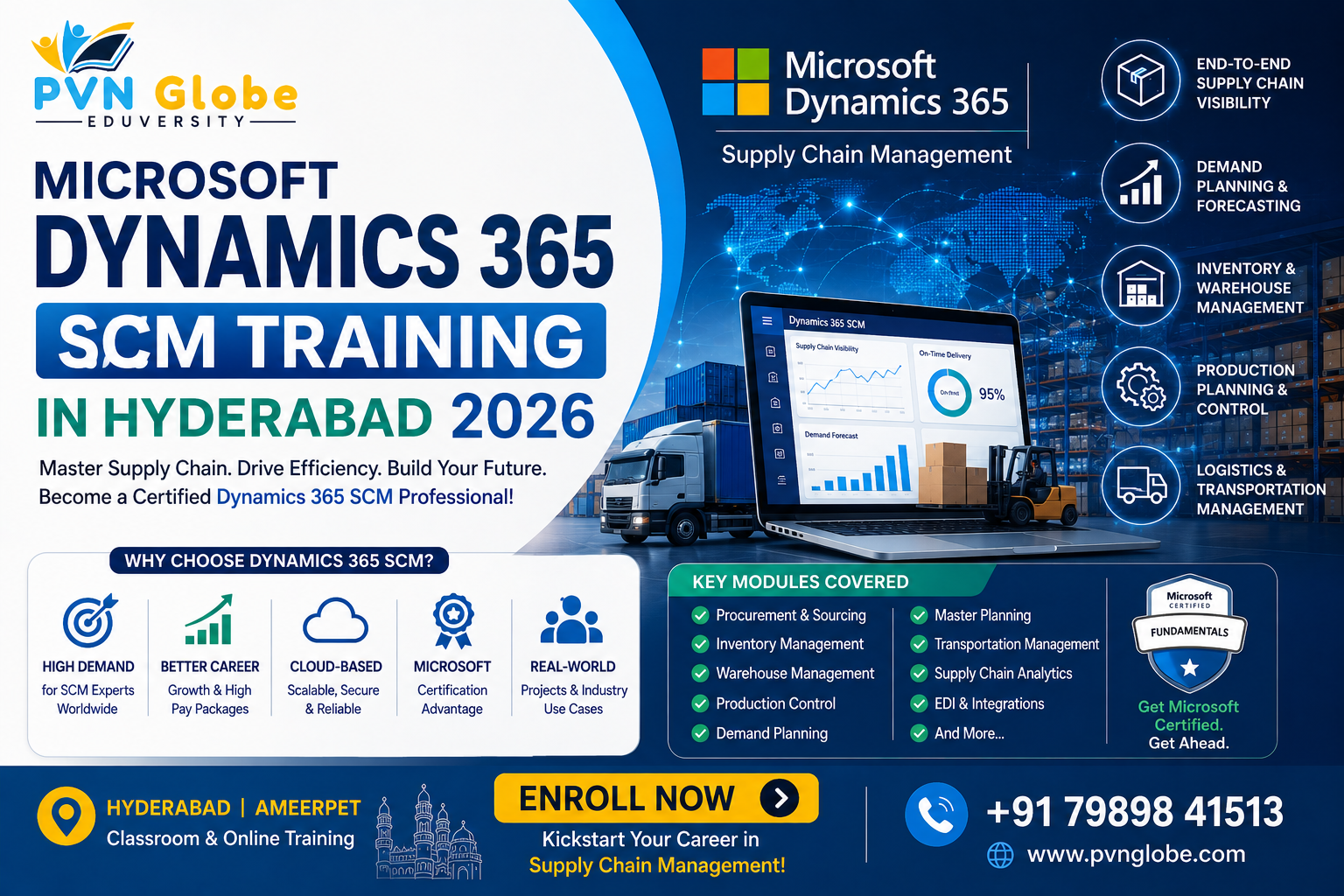
Microsoft Dynamics 365 Supply Chain Management (D365 SCM) has become an important enterprise technology for organizations looking to improve procurement, inventory, warehouse management, manufacturing, planning, transportation, and supply-chain visibility.
For students, freshers, supply-chain professionals, ERP consultants, business analysts, and experienced IT professionals, Microsoft Dynamics 365 SCM Training in Hyderabad can provide a structured pathway toward a career in enterprise applications and digital supply-chain transformation.
PVN Globe offers a career-focused learning approach for candidates interested in MD 365 SCM Training, practical business scenarios, functional consulting concepts, certification preparation, and project-oriented learning.
This complete guide explains what Dynamics 365 SCM is, why it matters in 2026, important modules, required skills, certification, career opportunities, real-time project concepts, interview preparation, and how to choose the right MD 365 SCM Training Institute in Hyderabad.
Introduction
Microsoft Dynamics 365 SCM
Supply chains have become more complex because businesses now operate across multiple suppliers, warehouses, manufacturing facilities, distribution centers, transportation networks, and markets.
Organizations need technology that can help them manage these processes efficiently.
Microsoft Dynamics 365 Supply Chain Management is designed to support end-to-end supply-chain operations, including product information, demand forecasting, planning, procurement, inventory, production, warehousing, transportation, and asset maintenance. Microsoft continues to expand these capabilities through its Dynamics 365 release program.
This creates opportunities for professionals who understand both supply-chain business processes and enterprise applications.
What Is MD 365 SCM?
MD 365 SCM is commonly used to refer to Microsoft Dynamics 365 Supply Chain Management.
It helps organizations manage processes such as:
- Product information management
- Procurement and sourcing
- Vendor management
- Inventory management
- Warehouse management
- Master planning
- Demand planning
- Production control
- Manufacturing
- Transportation management
- Quality management
- Asset management
- Supply-chain costing
A professional trained in Dynamics 365 SCM can work with business users to understand requirements, configure processes, perform testing, document solutions, and support implementation projects.
Why MD 365 SCM Training Is Important
Simply understanding supply-chain terminology is not enough for an enterprise application career.
Professionals need to understand:
Business Process + ERP Concepts + Dynamics 365 Configuration + Real-Time Scenarios + Testing + Consulting Skills
This is why a structured Microsoft Dynamics 365 SCM Training program can be valuable.
At PVN Globe, the learning approach can be positioned around practical understanding rather than only theoretical concepts.
Why Learn Microsoft Dynamics 365 SCM in 2026?
The supply-chain industry is undergoing continuous digital transformation.
Businesses increasingly need better visibility into:
- Inventory
- Demand
- Procurement
- Suppliers
- Warehouse operations
- Production
- Transportation
- Product availability
- Supply risks
- Operational costs
Microsoft’s 2026 release wave 1 includes continued investments in intelligent demand planning, supply planning, supplier communication, supplier engagement, AI-driven warehouse capabilities, and inventory rebalancing.
These developments make Dynamics 365 SCM an interesting technology area for candidates who want to build an ERP or supply-chain technology career.
Why Hyderabad?
Hyderabad has a strong ecosystem of:
- IT services
- Global capability centers
- Consulting companies
- Manufacturing organizations
- Technology companies
- Enterprise application projects
- Supply-chain organizations
For candidates searching for MD 365 SCM Training in Hyderabad, the city can provide access to both technology-learning opportunities and a large enterprise employment ecosystem.
Who Should Learn MD 365 SCM?
The course can be relevant for:
Freshers
Graduates who want to enter ERP and enterprise technology.
Supply Chain Professionals
Professionals working in procurement, logistics, inventory, warehousing, or planning.
ERP Professionals
Candidates with experience in SAP, Oracle, or other ERP platforms.
Business Analysts
Professionals interested in connecting business requirements with technology.
Functional Consultants
Experienced professionals looking to specialize in Dynamics 365 SCM.
Career Switchers
Professionals who want to transition into ERP consulting.
What Does a Dynamics 365 SCM Functional Consultant Do?
A Dynamics 365 SCM Functional Consultant works between business users and technology teams.
The consultant needs to understand what the organization wants to achieve and then determine how Dynamics 365 Supply Chain Management can support the business requirement.
Microsoft’s certification profile describes the role as designing solutions and configuring Dynamics 365 Supply Chain Management to meet customer business requirements while understanding end-to-end supply-chain processes.
Main Responsibilities
A functional consultant may work on:
- Requirement gathering
- Business-process analysis
- Gap analysis
- Solution design
- Functional configuration
- Master-data setup
- Testing
- User acceptance testing
- Documentation
- User training
- Production support
- Issue analysis
- Implementation activities
Example
Suppose a manufacturing company says:
“Our warehouse team is spending too much time locating inventory.”
A consultant should not immediately start changing configuration.
The consultant should first understand:
- Current warehouse process
- Warehouse structure
- Inventory dimensions
- Picking process
- Location setup
- Work templates
- Location directives
- Mobile-device processes
- Business requirements
- Expected improvement
Then the consultant can recommend and configure an appropriate solution.
This is why PVN Globe MD 365 SCM Training should emphasize business scenarios and practical understanding.
Core Modules of Microsoft Dynamics 365 SCM
A comprehensive Dynamics 365 SCM Course should cover the major functional areas of Supply Chain Management.
1. Product Information Management
Product Information Management deals with:
- Products
- Product masters
- Product variants
- Product dimensions
- Product categories
- Released products
- Units
- Product configuration
2. Procurement and Sourcing
Procurement covers:
- Vendors
- Purchase requisitions
- Purchase orders
- Procurement categories
- Purchase agreements
- Vendor collaboration
- Purchasing policies
- Approval workflows
3. Inventory Management
Inventory topics include:
- Inventory dimensions
- Sites
- Warehouses
- Batch numbers
- Serial numbers
- Inventory journals
- Inventory transactions
- Inventory counting
4. Warehouse Management
Warehouse management includes:
- Warehouse setup
- Locations
- Location directives
- Work templates
- Picking
- Put-away
- Receiving
- Packing
- Shipping
- Mobile warehouse processes
5. Master Planning
Master planning covers:
- Supply planning
- Demand
- Forecasting
- Planned orders
- Safety stock
- Coverage
- Material requirements
6. Manufacturing
Manufacturing can include:
- Production orders
- Bills of materials
- Routes
- Resources
- Capacity
- Production control
- Lean manufacturing
- Process manufacturing
- Batch orders
7. Transportation Management
Transportation topics include:
- Carriers
- Loads
- Shipments
- Freight
- Transportation planning
- Routes
8. Quality Management
Quality processes can include:
- Quality orders
- Inspection
- Sampling
- Nonconformance
- Quality associations
9. Asset Management
Asset management includes:
- Assets
- Maintenance
- Work orders
- Maintenance plans
- Asset lifecycle
Product Information Management
Product Information Management is one of the foundational areas of Dynamics 365 Supply Chain Management.
Organizations may manage thousands or millions of products, and accurate product information is essential for procurement, inventory, sales, manufacturing, and warehouse operations.
Important Product Concepts
A learner should understand:
- Product
- Product master
- Product variant
- Product dimensions
- Released product
- Item group
- Item model group
- Storage dimensions
- Tracking dimensions
- Units of measure
Why Product Data Matters
Incorrect product master data can affect:
- Purchasing
- Inventory
- Warehouse operations
- Production
- Planning
- Sales
- Reporting
A functional consultant therefore needs to understand not only how to create products but also how product configuration affects downstream business processes.
Practical Training Scenario
A company sells laptops in:
- 3 colors
- 2 screen sizes
- 3 storage configurations
The consultant needs to understand how these product variations should be represented and managed in Dynamics 365 SCM.
This kind of scenario can be included in MD 365 SCM Real-Time Project Training.
Procurement and Sourcing
Procurement is a critical business process in almost every supply-chain organization.
The procurement team needs to purchase goods and services from approved suppliers while controlling cost, quality, delivery, and compliance.
Typical Procurement Cycle
Requirement → Purchase Requisition → Approval → Purchase Order → Receipt → Invoice
Important Procurement Topics
A learner should understand:
- Vendors
- Vendor groups
- Procurement categories
- Purchase requisitions
- Purchase orders
- Purchase agreements
- Purchasing policies
- Workflows
- Product receipts
- Vendor collaboration
- Returns
Real-Time Example
A manufacturing company requires 10,000 units of raw material.
The consultant must understand:
- How demand is generated
- How purchasing requirements are created
- How vendors are selected
- How purchase orders are processed
- How goods are received
- How inventory is updated
- How the process connects with other ERP areas
This is why Dynamics 365 SCM Training in Hyderabad should focus on end-to-end business processes.
Inventory Management
Inventory is at the heart of supply-chain operations.
Businesses need to know:
- What inventory do we have?
- Where is it located?
- How much is available?
- What is reserved?
- What is damaged?
- What is in transit?
- Which batches are available?
- Which serial numbers are assigned?
Important Inventory Concepts
Training should cover:
- Sites
- Warehouses
- Inventory dimensions
- Storage dimensions
- Tracking dimensions
- Batch numbers
- Serial numbers
- Inventory journals
- Inventory transactions
- Counting
- Transfers
- Reservations
Inventory Dimensions
Inventory dimensions help organizations track inventory according to business requirements.
Examples include:
- Site
- Warehouse
- Location
- Batch
- Serial number
- Inventory status
Why Inventory Skills Matter
Strong inventory knowledge is essential for professionals who want to become:
- Dynamics 365 SCM Consultant
- Inventory Consultant
- Warehouse Consultant
- Supply Chain Functional Consultant
- ERP Business Analyst
Warehouse Management
Warehouse operations directly affect fulfillment speed and customer satisfaction.
Dynamics 365 Supply Chain Management provides capabilities that can be configured for different warehouse layouts and operational scenarios. Microsoft’s 2026 roadmap also includes continued improvements around warehouse efficiency, AI-driven operations, dynamic item placement, and hands-free scanning.
Warehouse Topics to Learn
A good MD 365 SCM Training Course should cover:
- Warehouse setup
- Warehouses
- Locations
- Location profiles
- Location directives
- Work templates
- Work classes
- Picking
- Put-away
- Receiving
- Packing
- Shipping
- Cycle counting
- Mobile device processes
Warehouse Process Example
A customer order is created.
The warehouse needs to:
Receive Order → Create Work → Pick Inventory → Pack → Ship
A functional consultant must understand how the system supports each stage.
2026 Warehouse Trends
Microsoft’s current 2026 release plan includes warehouse improvements such as AI-driven inventory rebalancing, picking-route optimization, and wearable scanning support.
This means future SCM professionals should increasingly understand how ERP + AI + Warehouse Automation work together.
Master Planning and Demand Planning
Planning is essential for maintaining the right balance between demand and supply.
If a company produces too much, it may create excess inventory.
If it produces too little, it may experience stockouts and delayed deliveries.
Master Planning
Master planning helps organizations determine what supply is required to meet demand.
Important concepts include:
- Demand
- Supply
- Forecast
- Coverage
- Planned orders
- Safety stock
- Purchase orders
- Production orders
- Transfer orders
- Planning Optimization
Demand Planning
Demand planning helps organizations estimate future requirements.
Candidates should understand:
- Forecasting
- Historical demand
- Demand patterns
- Supply requirements
- Forecast adjustments
- Planning scenarios
Microsoft’s 2026 release wave includes enhancements to demand and supply planning, including price-demand relationships and protection of confirmed capable-to-promise dates.
Career Value
Planning knowledge can help candidates target roles such as:
- Supply Planner
- Demand Planner
- SCM Functional Consultant
- Planning Consultant
- ERP Business Analyst
Manufacturing and Production Control
Manufacturing organizations need to coordinate:
- Raw materials
- Production capacity
- Labor
- Machines
- Production orders
- Bills of materials
- Routes
- Finished products
Dynamics 365 SCM provides manufacturing capabilities for production and supply-chain processes.
Manufacturing Topics
Candidates can learn:
- Bill of Materials
- Production orders
- Routes
- Resources
- Operations
- Capacity
- Production control
- Manufacturing execution
- Batch orders
- Lean manufacturing
- Process manufacturing
- Discrete manufacturing
- Kanban
Example Manufacturing Scenario
A company manufactures smartphones.
The production process may involve:
Raw Materials → Components → Assembly → Testing → Finished Product → Warehouse
The SCM consultant needs to understand how the system represents:
- Components
- BOM
- Routes
- Production orders
- Inventory consumption
- Finished goods
Why Manufacturing Knowledge Helps
Manufacturing experience combined with Dynamics 365 knowledge can be valuable for candidates targeting ERP consulting positions.
Transportation, Quality and Asset Management
A modern supply chain does not stop when products leave the warehouse.
Businesses also need to manage:
- Transportation
- Freight
- Quality
- Assets
- Maintenance
Transportation Management
Transportation management can include:
- Carriers
- Transportation modes
- Loads
- Shipments
- Routes
- Freight
- Transportation planning
Quality Management
Quality management helps organizations monitor product quality.
Topics include:
- Quality orders
- Inspection
- Sampling
- Nonconformance
- Quality associations
Asset Management
Asset management helps organizations manage operational equipment and maintenance activities.
Topics include:
- Assets
- Asset types
- Maintenance
- Work orders
- Maintenance schedules
- Preventive maintenance
Landed Cost
Professionals working with international supply chains can also benefit from understanding landed-cost concepts such as:
- Freight
- Duties
- Handling
- Transportation
- Other acquisition-related costs
Microsoft’s current certification scope includes areas such as inventory and asset management, warehouse management, transportation management, and master planning.
Skills Required for a Dynamics 365 SCM Career
Learning software screens is not enough to become a successful functional consultant.
Candidates should develop a combination of functional, analytical, technical-awareness, and communication skills.
Functional Skills
Learn:
- Supply-chain fundamentals
- Procurement
- Inventory
- Warehousing
- Manufacturing
- Planning
- Transportation
- Product information
- Quality
- Asset management
ERP Skills
Understand:
- Master data
- Transaction data
- Legal entities
- Organizations
- Workflows
- Security concepts
- Integrations
- Data migration
- Testing
Analytical Skills
A consultant should be able to:
- Analyze requirements
- Identify gaps
- Understand root causes
- Map business processes
- Recommend solutions
- Evaluate alternatives
Communication Skills
Develop:
- Requirement-gathering skills
- Documentation
- Presentation
- Business communication
- Stakeholder management
- User training
Future-Ready Skills
In 2026, candidates should also become familiar with:
- AI in supply chain
- Automation
- Data analytics
- Power Platform concepts
- Integration concepts
- Cloud ERP
- Business intelligence
Microsoft Dynamics 365 SCM Certification
Certification can help candidates validate their knowledge of Dynamics 365 Supply Chain Management.
Microsoft currently lists the Microsoft Certified: Dynamics 365 Supply Chain Management Functional Consultant Associate certification as an intermediate-level certification for the Dynamics 365 functional-consultant role.
MB-330
The MB-330: Microsoft Dynamics 365 Supply Chain Management Functional Consultant exam is associated with this certification path.
Microsoft’s study guide describes the exam as assessing candidates on their ability to design solutions and configure Dynamics 365 SCM based on business requirements.
Certification Preparation Areas
Candidates should develop knowledge of:
- Product information management
- Procurement
- Sales processes
- Vendor collaboration
- Inventory
- Warehouse management
- Transportation
- Master planning
- Supply-chain operations
Certification Strategy
A practical preparation approach is:
Step 1: Learn SCM fundamentals
Step 2: Learn Dynamics 365 SCM modules
Step 3: Practice configuration
Step 4: Complete business scenarios
Step 5: Work on a project
Step 6: Review Microsoft Learn
Step 7: Practice exam-style questions
Step 8: Attempt the certification
Microsoft’s current study guide states that a score of 700 or greater is required to pass the MB-330 exam.
Certification should complement practical knowledge rather than replace it.
MD 365 SCM Real-Time Project Training
Project experience is one of the most important components of career preparation.
A candidate may understand every module theoretically but still struggle in an interview if they cannot explain how an actual business process works.
Example PVN Globe Training Project
Project: End-to-End Manufacturing Supply Chain Implementation
Consider a manufacturing company with:
- Multiple sites
- Multiple warehouses
- Vendors
- Raw materials
- Finished products
- Production lines
- Customer orders
- Transportation requirements
Project Phase 1: Requirement Gathering
Understand:
- Current process
- Business challenges
- Existing systems
- Future requirements
Project Phase 2: Process Mapping
Map:
Procure-to-Pay
Plan-to-Produce
Inventory-to-Warehouse
Order-to-Delivery
Project Phase 3: Configuration
Configure:
- Legal entity
- Sites
- Warehouses
- Products
- Vendors
- Inventory settings
- Procurement processes
- Planning parameters
Project Phase 4: Transactions
Perform:
- Purchase orders
- Product receipts
- Inventory transfers
- Production orders
- Picking
- Packing
- Shipments
Project Phase 5: Testing
Perform:
- Unit testing
- Functional testing
- Integration testing
- User acceptance testing
Project Phase 6: Documentation
Create:
- Functional design documents
- Test scripts
- Configuration documents
- User manuals
- Process documentation
This type of scenario-based approach can help PVN Globe MD 365 SCM Training prepare learners for real implementation environments.
MD 365 SCM Career Opportunities in 2026
A Dynamics 365 SCM career can develop in several directions.
1. Dynamics 365 SCM Functional Consultant
Focuses on:
- Requirements
- Configuration
- Testing
- Business processes
2. Dynamics 365 SCM Business Analyst
Focuses on:
- Business analysis
- Process improvement
- Requirements
- Documentation
3. Dynamics 365 SCM Implementation Consultant
Works on:
- Implementation projects
- Configuration
- Testing
- Deployment support
4. Dynamics 365 SCM Support Consultant
Works on:
- User issues
- Functional problems
- Root-cause analysis
- Application support
5. Supply Chain Business Analyst
Combines:
Supply Chain + Analytics + Technology
6. ERP Functional Consultant
Works across broader enterprise application processes.
Career Growth Path
A possible career progression is:
Fresher
↓
Junior SCM Consultant
↓
Dynamics 365 SCM Functional Consultant
↓
Senior Functional Consultant
↓
Lead Consultant
↓
Solution Architect / Functional Lead
↓
Practice Lead / Solution Manager
Actual career progression varies by organization, experience, specialization, and project exposure.
MD 365 SCM Training for Freshers and Experienced Professionals
Freshers can begin with fundamental concepts.
Recommended Learning Sequence
Step 1: Supply-chain fundamentals
Step 2: ERP fundamentals
Step 3: Dynamics 365 introduction
Step 4: Product information
Step 5: Procurement
Step 6: Inventory
Step 7: Warehouse
Step 8: Planning
Step 9: Manufacturing
Step 10: Transportation
Step 11: Project
Step 12: Certification preparation
MD 365 SCM for Experienced Professionals
Experienced professionals can use their existing domain knowledge.
For example:
Procurement Professional
Can leverage:
- Vendor management
- Purchasing
- Negotiation
- Procurement processes
Warehouse Professional
Can leverage:
- Warehouse operations
- Picking
- Put-away
- Inventory
Manufacturing Professional
Can leverage:
- Production
- BOM
- Routing
- Capacity
SAP Professional
Can leverage existing ERP and supply-chain concepts while learning how Dynamics 365 implements similar business processes.
Career Switchers
Professionals moving from another domain can start with:
Supply Chain Fundamentals → ERP Fundamentals → Dynamics 365 SCM → Practical Project → Certification → Interview Preparation
Why Choose PVN Globe for MD 365 SCM Training in Hyderabad?
Selecting the right training provider is important because enterprise applications require both theoretical and practical knowledge.
PVN Globe can position its Microsoft Dynamics 365 SCM Training in Hyderabad around career-focused and practical learning.
What Learners Should Expect
A comprehensive program should cover:
✔ Instructor-led learning
✔ Functional SCM concepts
✔ Business-process scenarios
✔ Product Information Management
✔ Procurement and Sourcing
✔ Inventory Management
✔ Warehouse Management
✔ Master Planning
✔ Manufacturing
✔ Transportation
✔ Quality Management
✔ Asset Management
✔ Real-time project scenarios
✔ Configuration practice
✔ Testing scenarios
✔ Interview preparation
✔ Certification guidance
Why Practical Training Matters
An interviewer may ask:
- How do you configure a warehouse?
- What is a purchase order lifecycle?
- What is master planning?
- What are inventory dimensions?
- How does a production order work?
- How do you troubleshoot an inventory issue?
- What is the difference between a product and product master?
- How does procurement integrate with inventory?
- How would you gather requirements from a business user?
Candidates need practical explanations rather than memorized definitions.
PVN Globe Career-Focused Learning
A strong PVN Globe MD 365 SCM Course can help learners build a structured roadmap:
Learn → Practice → Configure → Execute Scenarios → Complete Project → Prepare Certification → Prepare Interviews
This approach can be particularly useful for freshers and professionals seeking an entry or transition into Dynamics 365 SCM consulting.
Conclusion, Career Roadmap & FAQs
Conclusion
Microsoft Dynamics 365 SCM Training in Hyderabad can be a valuable learning path for candidates interested in supply-chain technology, ERP consulting, business applications, and digital transformation.
Dynamics 365 Supply Chain Management continues to evolve, with Microsoft’s 2026 release wave emphasizing intelligent planning, supplier engagement, procurement improvements, warehouse efficiency, AI capabilities, and operational resilience.
However, becoming job-ready requires more than completing a course.
The strongest candidates combine:
- Supply Chain Knowledge
- Dynamics 365 SCM Skills
- Configuration Practice
- Real-Time Project Experience
- Certification Preparation
- Communication Skills
- Interview Preparation
Recommended Career Roadmap
Step 1: Learn supply-chain fundamentals
Step 2: Understand ERP concepts
Step 3: Join a structured MD 365 SCM course
Step 4: Learn the core SCM modules
Step 5: Practice business scenarios
Step 6: Complete a real-time project
Step 7: Prepare for MB-330
Step 8: Build a strong resume
Step 9: Practice scenario-based interviews
Step 10: Apply for Dynamics 365 SCM opportunities