
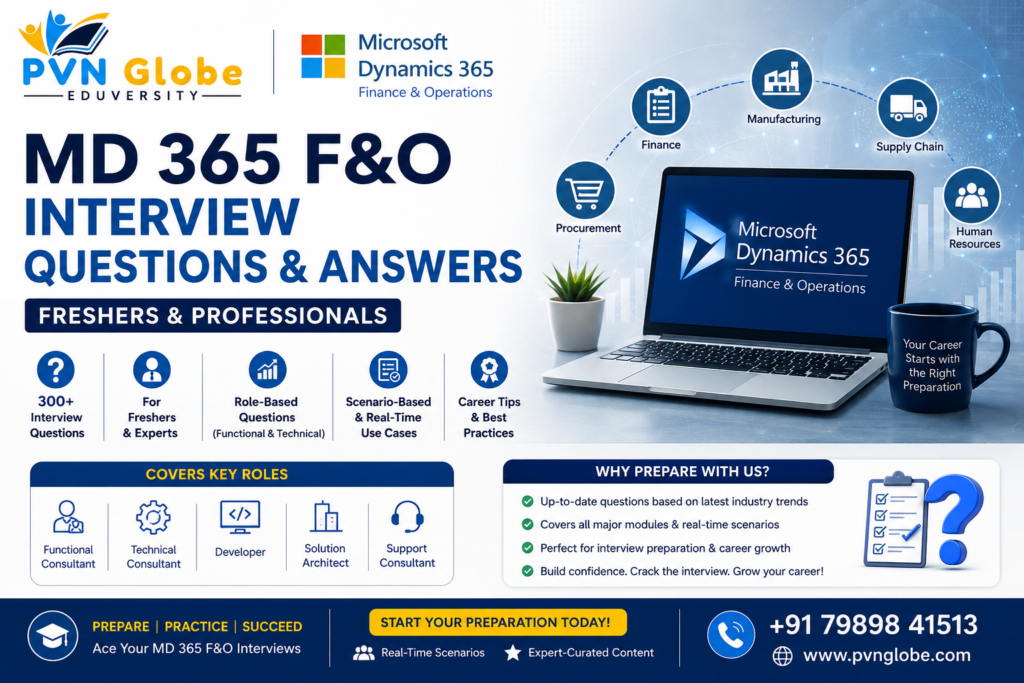
PVN Globe Academy – MD 365 F&O Training Content
Master Microsoft Dynamics 365 Finance & Operations with PVN Globe Academy Build practical ERP skills. Learn business processes. Work on real-time project scenarios. Prepare for your D365 F&O career.
Microsoft Dynamics 365 Finance & Operations, widely known as D365 F&O or MD 365 F&O, is a powerful enterprise business application used to manage finance, procurement, inventory, supply chain, warehouse, manufacturing, and other critical business processes.
For students, fresh graduates, finance professionals, supply-chain professionals, IT professionals, ERP consultants, and career switchers, learning Microsoft Dynamics 365 Finance & Operations can be an effective way to develop modern ERP and functional consulting skills.
PVN Globe Academy provides a structured learning approach designed to help learners understand D365 F&O concepts from fundamentals through practical project scenarios.
MD 365 F&O – 50 Questions & Answers for Freshers
1. What is Microsoft Dynamics 365 F&O?
Answer:
Microsoft Dynamics 365 Finance & Operations, commonly called D365 F&O or MD 365 F&O, is a Microsoft enterprise business application used to manage financial and operational processes such as finance, procurement, inventory, supply chain, warehouse management, and reporting.
2. What does F&O stand for?
Answer:
F&O stands for Finance & Operations. It refers to the business application capabilities covering financial and operational processes.
3. What is ERP?
Answer:
ERP stands for Enterprise Resource Planning. An ERP system integrates business processes such as finance, procurement, inventory, sales, manufacturing, and human resources into a connected system.
4. Why do companies use D365 F&O?
Answer:
Companies use D365 F&O to manage business processes, improve visibility, standardize operations, integrate departments, manage financial transactions, and support data-driven decision-making.
5. What is a D365 F&O Functional Consultant?
Answer:
A functional consultant understands business requirements and maps them to Dynamics 365 F&O functionality. They commonly work on requirements, configuration, testing, documentation, and user support.
6. What is a D365 F&O Technical Consultant?
Answer:
A technical consultant focuses on technical areas such as development, X++, extensions, integrations, data entities, reporting, security, and technical troubleshooting.
7. What is the difference between functional and technical consultants?
Answer:
A functional consultant primarily focuses on business processes and configuration, while a technical consultant focuses on development, integrations, data, and technical solutions.
8. What are the major areas of D365 F&O?
Answer:
Major areas include:
- Finance
- Procurement
- Inventory
- Supply Chain Management
- Warehouse Management
- Product Information Management
- Manufacturing
- Planning
- Data Management
- Reporting
9. What is Microsoft Dynamics 365 Finance?
Answer:
Dynamics 365 Finance supports financial processes such as General Ledger, Accounts Payable, Accounts Receivable, Cash and Bank Management, Fixed Assets, budgeting, tax, and financial reporting.
10. What is Dynamics 365 Supply Chain Management?
Answer:
Dynamics 365 Supply Chain Management supports processes such as procurement, inventory, planning, warehouse management, manufacturing, transportation, and fulfillment.
11. What is a legal entity?
Answer:
A legal entity represents an organization or company within the ERP system and is used for processes such as financial accounting and statutory reporting.
12. What is a chart of accounts?
Answer:
A chart of accounts is a structured list of financial accounts used by an organization to record and report financial transactions.
13. What is General Ledger?
Answer:
General Ledger is the central accounting area where financial transactions are recorded and posted to financial accounts.
14. What is Accounts Payable?
Answer:
Accounts Payable manages money the organization owes to vendors. A common process is:
Purchase → Receipt → Vendor Invoice → Payment
15. What is Accounts Receivable?
Answer:
Accounts Receivable manages money owed to an organization by customers.
A basic process is:
Sales → Customer Invoice → Payment → Settlement
16. What are financial dimensions?
Answer:
Financial dimensions are additional classifications used with financial transactions for analysis and reporting. Examples include department, cost center, business unit, and location.
17. What is a vendor?
Answer:
A vendor is a supplier that provides products or services to an organization.
18. What is a customer?
Answer:
A customer is an organization or individual to whom a company sells products or services.
19. What is a product master?
Answer:
A product master represents a product definition that can be used across business processes such as procurement, inventory, sales, and supply chain.
20. What is inventory management?
Answer:
Inventory management involves controlling and tracking products, quantities, locations, movements, and inventory transactions.
21. What is on-hand inventory?
Answer:
On-hand inventory represents the quantity of inventory currently available or held at relevant inventory dimensions such as site, warehouse, and location.
22. What is a purchase order?
Answer:
A purchase order is a formal document created to request products or services from a vendor under agreed purchasing conditions.
23. What is a sales order?
Answer:
A sales order records a customer’s request to purchase products or services from an organization.
24. What is Procure-to-Pay?
Answer:
Procure-to-Pay, or P2P, is the process of purchasing goods or services and paying the vendor.
Requirement → Purchase Order → Receipt → Invoice → Payment
25. What is Order-to-Cash?
Answer:
Order-to-Cash, or O2C, covers the process from receiving a customer order through fulfillment, invoicing, and payment.
Customer Order → Shipment → Invoice → Payment
26. What is Record-to-Report?
Answer:
Record-to-Report is the financial process of recording transactions, completing accounting activities, closing periods, and generating financial reports.
27. What is procurement?
Answer:
Procurement is the process of obtaining products and services required by an organization.
28. What is a purchase requisition?
Answer:
A purchase requisition is an internal request to purchase products or services before the purchasing process proceeds.
29. What is an RFQ?
Answer:
RFQ stands for Request for Quotation. It is used to request pricing and related information from potential vendors.
30. What is a product receipt?
Answer:
A product receipt records the receipt of purchased goods or services against a purchase order.
31. What is an inventory journal?
Answer:
An inventory journal is used to record certain inventory-related transactions or adjustments.
32. What is warehouse management?
Answer:
Warehouse management involves controlling warehouse activities such as receiving, put-away, picking, packing, and shipping.
33. What is data migration?
Answer:
Data migration is the process of moving required data from a legacy system or source into the new D365 environment.
34. What is master data?
Answer:
Master data is relatively stable business information used repeatedly in transactions.
Examples include:
- Customers
- Vendors
- Products
- Warehouses
35. What is transaction data?
Answer:
Transaction data records business activities such as sales orders, purchase orders, invoices, payments, and inventory movements.
36. What are data entities?
Answer:
Data entities provide a structured way to work with business data for scenarios such as data migration, integration, import, and export.
37. What is configuration?
Answer:
Configuration means setting up the application according to the organization’s business requirements using available system functionality.
38. What is customization?
Answer:
Customization or extension involves modifying or extending application behavior when standard functionality does not sufficiently meet a business requirement.
39. What is UAT?
Answer:
UAT stands for User Acceptance Testing. Business users test the system to confirm that it meets their requirements before production deployment.
40. What is a real-time project?
Answer:
A real-time project simulates or represents actual business implementation activities such as requirements, configuration, data migration, testing, UAT, deployment, and support.
41. Why is project training important?
Answer:
Project training helps learners understand how theoretical D365 F&O concepts are applied to actual business processes and implementation activities.
42. What is requirement gathering?
Answer:
Requirement gathering is the process of understanding what the business needs from the ERP system.
43. What is fit-gap analysis?
Answer:
Fit-gap analysis compares business requirements with standard system functionality to determine what can be handled by the standard solution and where additional solutions may be required.
44. What is testing?
Answer:
Testing verifies that the configured application works correctly according to business requirements.
45. What is regression testing?
Answer:
Regression testing checks whether existing functionality continues to work correctly after changes or enhancements.
46. What is X++?
Answer:
X++ is the programming language associated with Dynamics 365 Finance & Operations development.
47. What is Power BI?
Answer:
Power BI is Microsoft’s business intelligence and analytics platform used to create reports and dashboards from business data.
48. Can D365 F&O work with Power BI?
Answer:
Yes. Organizations can use Power BI with Dynamics 365 data for analytics, reporting, dashboards, and business insights.
49. What skills should a fresher learn for D365 F&O?
Answer:
A fresher should focus on:
- ERP fundamentals
- D365 F&O fundamentals
- Finance or Supply Chain
- Business processes
- Configuration
- Data management
- Testing
- Communication
- Project knowledge
50. How can a fresher start a D365 F&O career?
Answer:
A fresher can follow:
ERP Fundamentals → D365 F&O Course → Specialization → Business Processes → Practical Training → Real-Time Project → Certification Preparation → Interview Preparation
A structured MD 365 F&O Course from PVN Globe can be considered as part of this learning journey.
MD 365 F&O – 50 Questions & Answers for Professionals
1. How do you approach a D365 F&O implementation?
Answer:
A typical implementation approach involves:
Discovery → Requirement Gathering → Process Mapping → Fit-Gap → Solution Design → Configuration → Development → Data Migration → Testing → UAT → Deployment → Go-Live → Support
The exact methodology depends on the project.
2. How do you gather business requirements?
Answer:
I discuss the current process with stakeholders, identify pain points, document requirements, understand desired outcomes, and map them to standard D365 functionality.
3. What is fit-gap analysis?
Answer:
Fit-gap analysis determines whether a business requirement can be satisfied using standard D365 F&O functionality or whether an extension, integration, process change, or other solution is required.
4. How do you decide between configuration and customization?
Answer:
First, evaluate standard functionality and configuration options. Custom development should generally be considered only when standard functionality and acceptable process alternatives cannot meet the business requirement.
5. How do you handle a customization request?
Answer:
I first understand the business requirement and its business value, evaluate standard functionality, assess alternatives, consider maintainability and upgrade impact, and then work with technical teams if development is justified.
6. Explain the Procure-to-Pay process in D365 F&O.
Answer:
Purchase Requirement → Requisition/RFQ → Purchase Order → Product Receipt → Vendor Invoice → Payment → Settlement
The exact process can vary based on organizational configuration and policies.
7. Explain Order-to-Cash.
Answer:
Customer → Sales Order → Picking/Shipment → Invoice → Payment → Settlement
The detailed flow depends on the organization’s sales and warehouse processes.
8. Explain Record-to-Report.
Answer:
Business Transaction → Accounting Entry → Reconciliation → Period Close → Financial Reporting
It connects operational transactions with financial reporting.
9. How do you troubleshoot a posting failure?
Answer:
I would:
- Review the exact error.
- Identify the transaction and module.
- Check master data.
- Check relevant configuration.
- Review posting setup.
- Reproduce the issue if possible.
- Identify the root cause.
- Apply the appropriate correction.
- Retest.
- Document the resolution.
10. How do you troubleshoot an invoice posting issue?
Answer:
I would review the vendor/customer, transaction details, posting configuration, required dimensions, tax, financial setup, quantities, prices, and any workflow or validation errors before retesting.
11. How do you handle data migration?
Answer:
Source Analysis → Data Extraction → Cleansing → Transformation → Mapping → Validation → Import → Reconciliation → Testing
Business users and technical teams should collaborate throughout the process.
12. What is a data entity used for?
Answer:
Data entities can be used to simplify business-data movement for scenarios such as migration, integration, import, and export.
13. How do you validate migrated data?
Answer:
I compare source and target data, validate mandatory fields, check record counts, review relationships, test transactions, and reconcile important financial or inventory balances.
14. What is UAT and why is it important?
Answer:
UAT allows business users to validate that the solution meets real business requirements before production deployment.
15. How do you prepare UAT scenarios?
Answer:
I derive test scenarios from approved requirements and end-to-end business processes and include positive, negative, exception, integration, and reporting scenarios where applicable.
16. What is regression testing?
Answer:
Regression testing confirms that existing business processes continue functioning correctly after configuration changes, development, integrations, or updates.
17. How do you handle a production issue?
Answer:
I first assess business impact and severity, reproduce or investigate the issue, identify the root cause, determine a safe resolution, test it appropriately, communicate with stakeholders, and document the incident.
18. How do you prioritize production issues?
Answer:
I consider business impact, number of affected users, financial or operational risk, regulatory impact, availability of workarounds, and urgency.
19. How do you explain a technical issue to a business user?
Answer:
I avoid unnecessary technical terminology and explain:
What happened → Why it happened → Business impact → Solution → Required user action
20. How do you document functional requirements?
Answer:
A functional document should clearly describe the business requirement, current process, proposed process, assumptions, business rules, inputs, outputs, validations, security considerations, and expected results.
21. What is a functional design?
Answer:
A functional design translates a business requirement into a detailed description of the proposed application behavior, including process flow, rules, validations, and expected outcomes.
22. What is a technical design?
Answer:
A technical design explains how developers will technically implement a requirement, including development approach, integrations, data structures, extensions, and other technical considerations.
23. What is X++ used for?
Answer:
X++ is used for Dynamics 365 Finance & Operations development, including implementing extensions and business logic where development is required.
24. What are extensions in D365 F&O?
Answer:
Extensions allow organizations to add or modify application functionality while following the platform’s extensibility model rather than directly modifying standard application code.
25. Why is extensibility important?
Answer:
Extensibility helps organizations implement required functionality while improving maintainability and reducing risks associated with modifying standard application code.
26. How do you approach integration requirements?
Answer:
I first identify the systems, business process, data exchanged, frequency, direction, security requirements, error handling, monitoring, and business ownership before selecting an appropriate integration approach.
27. What information is required for an integration design?
Answer:
Important information includes:
- Source system
- Target system
- Data fields
- Direction
- Frequency
- Volume
- Authentication
- Error handling
- Monitoring
- Business rules
28. How do you handle a failed integration?
Answer:
I review logs and error details, identify whether the problem is data, authentication, configuration, connectivity, or application logic, correct the root cause, reprocess where appropriate, and document the incident.
29. What is master data governance?
Answer:
Master data governance establishes rules for creating, validating, approving, maintaining, and controlling important business data such as customers, vendors, and products.
30. Why is master data important?
Answer:
Incorrect master data can cause transaction failures, reporting problems, incorrect inventory, payment issues, and financial discrepancies.
31. How do financial dimensions help businesses?
Answer:
Financial dimensions provide additional classification of financial transactions, enabling organizations to analyze financial information by areas such as department, cost center, business unit, or location.
32. How do you troubleshoot incorrect financial posting?
Answer:
I trace the transaction from the source document through accounting, review posting setup and dimensions, identify the incorrect configuration or master data, correct the issue, and retest.
33. How do you approach period-close issues?
Answer:
I review outstanding transactions, required reconciliations, subledger activities, posting errors, adjustments, and dependencies while following the organization’s documented closing procedures.
34. What is the importance of security in D365 F&O?
Answer:
Security controls who can access data and perform business operations. Proper role-based access helps protect sensitive information and supports segregation of duties.
35. What is segregation of duties?
Answer:
Segregation of duties means separating conflicting responsibilities between users to reduce the risk of fraud, error, or unauthorized transactions.
36. How would you improve an inefficient business process?
Answer:
I would first understand the current process and identify bottlenecks. Then I would analyze standard D365 functionality, automation opportunities, workflow, process redesign, and reporting before recommending a solution.
37. How do you handle conflicting stakeholder requirements?
Answer:
I document the different requirements, understand the business reasons behind each, evaluate impacts, facilitate discussion, and help stakeholders reach a decision based on business priorities and solution feasibility.
38. How do you manage scope creep?
Answer:
I document the new requirement, assess its business value, effort, risk, timeline, and dependencies, and route it through the project’s agreed change-control process.
39. What is a change request?
Answer:
A change request formally proposes a modification to an approved requirement, scope, process, or solution and is evaluated for impact before approval.
40. How do you prepare for go-live?
Answer:
I verify configuration, migrated data, integrations, security, testing completion, UAT approval, user readiness, cutover activities, support procedures, and rollback/contingency plans where applicable.
41. What is a cutover plan?
Answer:
A cutover plan defines the activities required to transition from the existing system or process to the new production environment.
It can include:
- Final data migration
- Validation
- Configuration checks
- Integration activation
- User readiness
- Go-live activities
42. What is hypercare support?
Answer:
Hypercare is the intensive support period immediately following go-live, when the implementation team closely monitors issues and helps stabilize the new solution.
43. How can Power BI complement D365 F&O?
Answer:
Power BI can provide dashboards and analytics that help users understand financial, inventory, procurement, sales, and operational data.
44. How can Power Platform complement D365 F&O?
Answer:
Power Platform technologies can support automation, business applications, workflows, and analytics around Dynamics 365 business processes.
45. What skills should an experienced D365 F&O consultant develop in 2026?
Answer:
Professionals should consider strengthening:
- D365 Finance/Supply Chain
- Business process analysis
- Solution design
- Data
- Integrations
- Testing
- Security
- Power Platform
- Power BI
- Azure concepts
- Communication
- AI-related enterprise capabilities
46. How do you stay updated with D365 F&O?
Answer:
I follow Microsoft’s official documentation and learning resources, review product updates, practice new functionality, participate in professional communities, and apply relevant knowledge to project scenarios.
47. How do you explain your project in an interview?
Answer:
Use a structured format:
Project → Client Industry → Business Problem → Modules → Responsibilities → Configuration → Integrations → Data Migration → Testing → Challenges → Solution → Result
Avoid claiming responsibilities you did not actually perform.
48. What makes a strong D365 F&O consultant?
Answer:
A strong consultant combines:
Business Knowledge + Product Knowledge + Problem Solving + Communication + Project Experience + Continuous Learning
49. How can professionals move toward a senior D365 F&O role?
Answer:
They should progressively develop deeper module expertise, end-to-end implementation knowledge, stakeholder management, solution design, mentoring, troubleshooting, and leadership skills.
50. What is the recommended career roadmap for a D365 F&O professional?
Answer:
D365 Fundamentals → Specialization → Business Processes → Configuration → Projects → Data → Integration → Testing → Certification → Consultant → Senior Consultant → Lead/Architect
For professionals looking to strengthen their skills, PVN Globe’s MD 365 F&O training can be positioned as a structured learning option covering the platform, business processes, practical scenarios, project understanding, and interview preparation.