
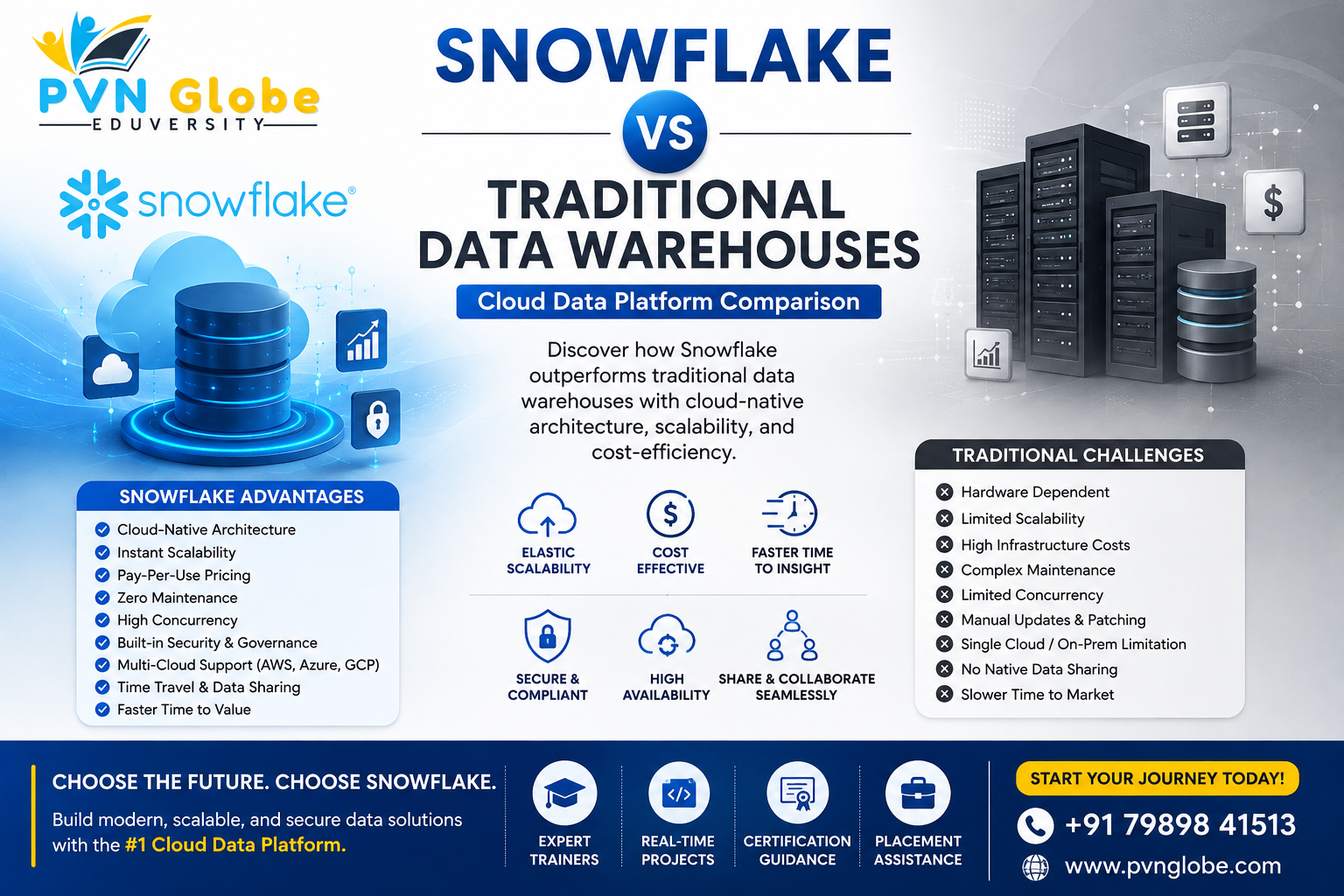
Data has become one of the most important assets for modern businesses. Organizations collect information from applications, websites, customer platforms, ERP systems, CRM systems, IoT devices, financial systems, and digital services.
As data volumes continue to increase, businesses need data platforms that can store, process, analyze, secure, and share information efficiently. For many years, organizations depended on traditional data warehouse technologies hosted in on-premises data centers. These platforms played an important role in business intelligence and enterprise reporting.
However, the growth of cloud computing has changed how businesses approach data management. Modern organizations increasingly look toward cloud data platforms that can provide scalable infrastructure, flexible computing, centralized data management, analytics capabilities, and integration with modern data engineering tools.
This is where Snowflake has become an important technology.Snowflake is a cloud-based data platform designed to support data warehousing, analytics, data engineering, data sharing, and other data workloads.
This creates an important question:
Snowflake vs Traditional Data Warehouses — which approach is better for modern businesses?
The answer depends on business requirements, existing infrastructure, workloads, security requirements, migration plans, budget, technical skills, and long-term data strategy.
In this comprehensive guide, we will compare Snowflake and traditional data warehouses across architecture, scalability, performance, cost, maintenance, security, data engineering, ETL/ELT, analytics, cloud integration, and career opportunities.
We will also explain why learning Snowflake can be valuable for professionals interested in modern cloud data engineering.
For learners searching for Snowflake Training in Hyderabad, Snowflake Course in Hyderabad, or Snowflake Online Training, understanding this difference is an important part of building a modern data engineering career.
What Is a Traditional Data Warehouse?
A traditional data warehouse is a centralized system used to store and analyze structured business data.
Organizations have traditionally used data warehouses to combine information from different operational systems and create a central environment for reporting and business intelligence.
For example, a company may have data stored in:
- ERP systems
- CRM applications
- Financial applications
- HR systems
- Sales applications
- Customer databases
- Operational databases
Data from these systems can be extracted, transformed, and loaded into a centralized warehouse.
Traditional Data Warehouse Architecture
A common architecture looks like:
- Source Systems
- ETL Process
- Staging Area
- Data Warehouse
- Data Marts
- BI & Reporting
- This approach has been used successfully by organizations for many years.
However, traditional environments often require organizations to manage infrastructure, storage, compute capacity, software, upgrades, maintenance, and scaling.
Traditional Data Warehouse Challenges
As business requirements change, organizations may face challenges such as:
- Hardware management
- Capacity planning
- Infrastructure maintenance
- Scaling limitations
- Long procurement cycles
- Separate storage and compute requirements
- Complex upgrades
- High administration requirements
- Increasing data volumes
- Integration with modern cloud applications
These challenges are among the reasons businesses are exploring cloud data warehouse platforms.
What Is Snowflake Cloud Data Platform?
Snowflake is a cloud-based data platform that supports data storage, processing, analytics, data engineering, data sharing, and related workloads.
One of the important differences between Snowflake and many traditional data warehouse architectures is its cloud-native design.
Snowflake separates storage and compute, allowing organizations to scale computing resources independently according to workload requirements.
Snowflake Architecture
At a simplified level:
- Data Sources
- Data Ingestion
- Snowflake Storage
- Virtual Warehouses / Compute
- Transformation & Analytics
- BI / Applications / Data Sharing
- Snowflake can support structured and semi-structured data workloads and integrates with various data engineering and analytics technologies.
Key Snowflake Concepts
Learners pursuing a Snowflake Course should understand:
- Databases
- Schemas
- Tables
- Views
- Virtual warehouses
- Stages
- File formats
- Data loading
- Snowpipe
- Streams
- Tasks
- Dynamic Tables
- Snowpark
- Security
- Data sharing
- Performance optimization
This makes Snowflake an important platform for modern Snowflake Data Engineering.
Snowflake vs Traditional Data Warehouse Architecture
Architecture is one of the biggest areas where cloud data platforms differ from traditional environments.
Traditional Architecture
A traditional warehouse may depend heavily on physical or virtual infrastructure.
Organizations typically need to plan:
- CPU capacity
- Memory
- Storage
- Network
- Hardware
- Software
- Database administration
- Backup infrastructure
- Disaster recovery
Scaling can require additional infrastructure planning.
Snowflake Architecture
Snowflake is designed around cloud infrastructure.
Its architecture separates:
Storage
Data is stored independently from compute resources.
Compute
Virtual warehouses provide compute resources for workloads.
Cloud Services
Cloud services support activities such as authentication, metadata, access control, and query coordination.
Why Separation Matters
Imagine two departments:
Department A: Running heavy analytical queries.
Department B: Running smaller reporting workloads.
In a traditional environment, both workloads may compete for shared resources depending on architecture.
Snowflake can provide separate virtual warehouses for different workloads.
This can help organizations isolate workloads and scale compute resources according to requirements.
Snowflake vs Traditional Data Warehouse: Scalability
Scalability is one of the major reasons organizations consider cloud data platforms.
Traditional Data Warehouse Scaling
Traditional environments often require capacity planning.
When data volumes or workloads increase, organizations may need to:
- Add hardware
- Upgrade servers
- Increase storage
- Increase processing capacity
- Reconfigure infrastructure
- Schedule maintenance
- Plan procurement
This process can take time.
Snowflake Scaling
Snowflake uses cloud infrastructure and virtual warehouses to provide flexible compute resources.
Organizations can select different warehouse sizes based on workload requirements.
A business can also separate compute resources for different workloads.
Example
Consider an organization with:
- Finance reporting
- Marketing analytics
- Customer analytics
- Data engineering pipelines
Instead of forcing all workloads onto the same compute environment, Snowflake can use separate virtual warehouses.
This approach can help organizations manage workload isolation and scaling.
Why Scalability Matters
Modern businesses may experience:
- Seasonal traffic
- Marketing campaigns
- End-of-month reporting
- Real-time analytics
- Large data ingestion workloads
- Increasing customer data
Cloud scalability can help organizations adapt more easily to changing requirements.
Snowflake vs Traditional Data Warehouses: Performance
Performance depends on many factors, including data architecture, SQL queries, data models, workload design, compute resources, and optimization techniques.
It would be incorrect to say that Snowflake is automatically faster than every traditional data warehouse.
Instead, Snowflake provides architectural capabilities that can make it easier to scale and manage modern analytical workloads.
Traditional Data Warehouse Performance
Performance tuning may involve:
- Indexing
- Partitioning
- Query optimization
- Hardware upgrades
- Memory management
- Resource allocation
- Database configuration
Database administrators may need to spend significant time tuning the environment.
Snowflake Performance
Snowflake provides capabilities such as:
- Virtual warehouse sizing
- Workload isolation
- Query optimization
- Caching mechanisms
- Automatic infrastructure management
- Scaling options
- Clustering capabilities where appropriate
Important Point
Good SQL still matters.
A poorly designed query can perform badly on any platform.
Therefore, Snowflake Training should include both Snowflake features and strong SQL optimization skills.
Snowflake vs Traditional Data Warehouses: Cost
Cost is another major consideration when organizations compare cloud and traditional data warehouse platforms.
Traditional Data Warehouse Costs
Organizations operating their own infrastructure may need to consider:
- Hardware
- Storage
- Software licensing
- Data center costs
- Electricity
- Cooling
- Database administrators
- Maintenance
- Upgrades
- Backup systems
- Disaster recovery
- Infrastructure expansion
These costs can be significant.
Snowflake Cost Model
Snowflake uses a consumption-oriented model in which costs can depend on factors such as storage and compute usage.
This means organizations need to manage their workloads carefully.
Cloud Does Not Automatically Mean Cheaper
This is an important point.
Moving to Snowflake does not guarantee lower costs.
Poorly managed warehouses, inefficient queries, excessive workloads, and unnecessary compute usage can increase cloud spending.
Therefore, businesses should implement:
- Warehouse management
- Resource monitoring
- Query optimization
- Workload scheduling
- Cost governance
- Usage monitoring
A skilled Snowflake Data Engineer should understand both technical performance and cost management.
Snowflake vs Traditional Data Warehouse: Maintenance
Traditional data warehouse environments can require extensive infrastructure management.
Organizations may be responsible for:
- Server maintenance
- Operating systems
- Database software
- Hardware failures
- Patching
- Upgrades
- Storage management
- Backup infrastructure
- Capacity planning
Cloud platforms can reduce some of these infrastructure-management responsibilities.
Snowflake Management
With Snowflake, organizations do not manage the underlying physical servers in the same way as an on-premises warehouse.
This can allow data teams to focus more on:
- Data modeling
- Data pipelines
- SQL
- Data quality
- Analytics
- Security
- Governance
- Business requirements
Why This Matters
The role of the data engineer is changing.
Instead of spending most of their time managing infrastructure, modern data engineers increasingly focus on designing reliable data pipelines and building useful data products.
This is one reason Snowflake Data Engineer Training is becoming relevant for professionals interested in cloud data careers.
Snowflake and Modern ETL/ELT
Traditional data warehouses have historically relied heavily on ETL architectures.
Traditional ETL
- Extract
- Transform
- Load
- Data is transformed before it reaches the warehouse.
Cloud platforms have helped popularize ELT.
Modern ELT
- Extract
- Load
- Transform
- Data is first loaded into the cloud data platform and then transformed using available compute resources.
Snowflake can support modern ELT architectures where raw or staged data is loaded into the platform and transformed for analytics.
Why ELT Is Important
ELT can simplify modern data pipelines by allowing organizations to centralize raw data and perform transformations inside the data platform.
Snowflake data engineers may work with:
- SQL transformations
- Streams
- Tasks
- Dynamic Tables
- Snowpark
- dbt
- External ETL tools
- Cloud storage
- APIs
Snowflake Data Engineering Flow
- Source
- Ingestion
- Raw Data
- Transformation
- Curated Data
- Analytics
- This architecture is particularly relevant for professionals learning Snowflake ETL and Snowflake ELT.
Snowflake Data Integration
Modern businesses rarely keep all their information in one system.
Data may come from:
- Applications
- APIs
- Databases
- Cloud storage
- ERP systems
- CRM platforms
- Streaming systems
- SaaS applications
A modern data platform needs to integrate these different sources.
Snowflake supports multiple approaches to data ingestion and integration.
Important Snowflake Data Engineering Technologies
Snowpipe
Used for continuous data-loading scenarios.
Snowpipe Streaming
Designed for low-latency ingestion of streaming data.
Streams
Can support change-data-capture workflows by tracking data changes.
Tasks
Can automate data-processing workflows.
Dynamic Tables
Can support declarative data transformation pipelines.
Snowpark
Allows developers to work with Snowflake using languages such as Python.
For anyone preparing for a Snowflake Data Engineer career, these concepts are important because modern data engineering is no longer limited to traditional batch ETL.
Snowflake vs Traditional Data Warehouse: Security
Data security is essential regardless of whether an organization uses an on-premises warehouse or a cloud platform.
Traditional environments often require organizations to manage many security layers themselves.
These may include:
- Network security
- Server security
- Database security
- Identity management
- Encryption
- Access control
- Backup security
Cloud platforms provide their own security capabilities, but organizations still have significant responsibility for configuration, access management, governance, and data protection.
Snowflake Security Concepts
Important topics include:
- Roles
- Users
- Privileges
- Role hierarchy
- Access control
- Authentication
- Data protection
- Encryption
- Secure data sharing
- Governance
- Monitoring
Important Principle
Cloud adoption does not remove the need for security expertise.
Instead, security responsibilities change.
A Snowflake Developer or Snowflake Data Engineer should understand how users and roles access data and how sensitive datasets should be protected.
Why Are Businesses Moving to Cloud Data Platforms?
The move from traditional data warehouses to cloud data platforms is driven by several business requirements.
1. Faster Scalability
Businesses can adapt compute resources to changing workloads.
2. Cloud Accessibility
Teams can access cloud data environments from distributed locations based on organizational access policies.
3. Modern Data Engineering
Cloud platforms support modern data pipelines, integrations, and analytics workflows.
4. Workload Isolation
Separate compute resources can support different workloads.
5. Data Sharing
Organizations can share governed data across teams and business environments.
6. Reduced Infrastructure Management
Businesses can reduce the amount of physical infrastructure they need to manage directly.
7. Modern Analytics
Cloud data platforms can support large-scale analytics and business intelligence workloads.
8. Faster Innovation
Development teams can experiment with modern data technologies without waiting for traditional infrastructure procurement cycles.
Does Every Business Need Snowflake?
No.
Snowflake is not automatically the right choice for every company.
Businesses should evaluate:
- Existing infrastructure
- Data volume
- Workloads
- Cloud strategy
- Security requirements
- Compliance
- Budget
- Existing technical skills
- Migration complexity
The correct platform is the one that fits the organization’s actual requirements.
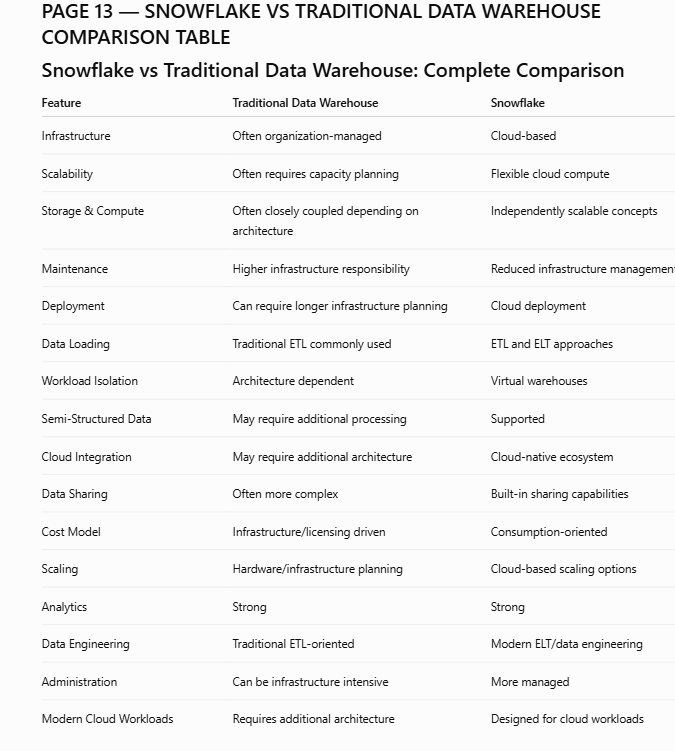
Which Is Better?
There is no universal answer.
For organizations with mature on-premises infrastructure and stable workloads, traditional data warehouses can still be appropriate.
For organizations seeking cloud scalability, modern data engineering, flexible compute, and cloud-native analytics, Snowflake can be an attractive option.
The right decision depends on the business’s architecture and goals.
SNOWFLAKE CAREER + PVN GLOBE TRAINING
Snowflake Career Opportunities in 2026
The growth of cloud data platforms has created opportunities for professionals who understand modern data engineering.
Potential roles include:
Snowflake Data Engineer
Designs and manages data pipelines and analytical data environments.
Snowflake Developer
Develops SQL-based solutions, data transformations, and Snowflake database objects.
Cloud Data Engineer
Works across cloud platforms and data engineering technologies.
ETL/ELT Developer
Builds data ingestion and transformation pipelines.
Data Warehouse Developer
Designs analytical warehouse structures and data models.
Data Analyst
Uses SQL and analytical platforms to generate business insights.
Data Architect
Designs broader enterprise data architectures.
Why Choose PVN GLOBE for Snowflake Training?
If you are searching for Snowflake Training in Hyderabad, learning both the technology and its real-world applications is important.
PVN GLOBE focuses on career-oriented technology learning and practical understanding.
A structured Snowflake Course in Hyderabad can help learners build knowledge across:
✔ Snowflake Fundamentals
✔ Snowflake Architecture
✔ Advanced SQL
✔ Data Warehousing
✔ ETL & ELT
✔ Data Loading
✔ Snowpipe
✔ Streams & Tasks
✔ Dynamic Tables
✔ Snowpark
✔ Python
✔ Performance Optimization
✔ Security & Governance
✔ Real-Time Data Engineering Projects
✔ Interview Preparation
For students, freshers, and working professionals, PVN GLOBE Snowflake Training can provide a structured path toward modern cloud data engineering skills.
PVN GLOBE Snowflake Career Roadmap
- SQL
- Database Concepts
- Data Warehousing
- Cloud Fundamentals
- Snowflake
- ETL / ELT
- Python
- Data Pipelines
- Real-Time Projects
- Interview Preparation
- Snowflake Data Engineer Career
Snowflake vs Traditional Data Warehouses: Final Verdict
Traditional data warehouses have played a critical role in enterprise analytics for decades.
They continue to be valuable for organizations with established infrastructure, predictable workloads, and specific business requirements.
However, the growth of cloud computing has changed the expectations businesses have from their data platforms.
Organizations increasingly need:
- Flexible scalability
- Cloud accessibility
- Modern data engineering
- Faster analytics
- Data integration
- Data sharing
- Workload isolation
- Reduced infrastructure management
- Support for modern data workloads
Snowflake addresses many of these requirements through its cloud-based architecture and data platform capabilities.
But moving to Snowflake should not be viewed simply as replacing one database with another.
A successful cloud data strategy requires organizations to rethink:
Architecture + Data Engineering + Security + Governance + Cost + Skills + Business Requirements
For technology professionals, this transformation creates an opportunity.
Learning Snowflake, SQL, Python, cloud computing, ETL/ELT, data modeling, and modern data engineering can help build a strong foundation for a cloud data career.
If your goal is to become a Snowflake Data Engineer, start with SQL and database fundamentals, understand data warehousing, learn Snowflake architecture, build data pipelines, complete real-world projects, and continuously develop your cloud data engineering skills.
For learners looking for Snowflake Training in Hyderabad, Snowflake Course in Hyderabad, or Snowflake Online Training, PVN GLOBE can be part of that learning journey.
The future of data is increasingly cloud-driven, and professionals who understand how to build reliable, scalable, and secure data platforms can position themselves for opportunities in the modern data engineering ecosystem.
Frequently Asked Questions
Is Snowflake better than a traditional data warehouse?
It depends on the organization’s requirements. Snowflake provides cloud-native capabilities, flexible compute, workload isolation, and modern data engineering features. Traditional warehouses can still be appropriate for organizations with established infrastructure and specific workloads.
Why are companies moving from traditional data warehouses to Snowflake?
Common reasons include cloud scalability, reduced infrastructure management, flexible compute, modern data engineering capabilities, data sharing, and integration with cloud technologies.
Is Snowflake a data warehouse or a cloud platform?
Snowflake is a cloud-based data platform that includes data warehousing capabilities along with features for data engineering, analytics, data sharing, and other workloads.
Is Snowflake good for data engineering?
Yes. Snowflake supports several capabilities relevant to data engineering, including data ingestion, SQL transformations, Snowpipe, Streams, Tasks, Dynamic Tables, Snowpark, and integrations with data tools.
What is the difference between Snowflake and a traditional data warehouse?
A major difference is the cloud-native architecture and separation of storage and compute in Snowflake. Traditional data warehouses often involve more direct infrastructure and capacity management, depending on the architecture.
Is Snowflake expensive?
Snowflake uses a consumption-oriented pricing approach, so costs depend on usage. Organizations need to monitor compute, storage, and workload patterns carefully.
Can freshers learn Snowflake?
Yes. Freshers should ideally start with SQL, databases, data warehousing, and basic cloud concepts before learning advanced Snowflake features.
What skills are needed for Snowflake Data Engineer jobs?
Important skills include SQL, Python, data warehousing, ETL/ELT, Snowflake architecture, data loading, Snowpipe, Streams, Tasks, Dynamic Tables, Snowpark, cloud platforms, data modeling, security, and performance optimization.
What is Snowflake Training in Hyderabad?
Snowflake Training in Hyderabad refers to structured learning programs designed to teach Snowflake concepts, SQL, data warehousing, data engineering, data loading, transformations, security, performance, and practical projects.
What is the best Snowflake Course in Hyderabad?
The right course depends on the learner’s background and goals. Candidates should compare curriculum, practical projects, trainer experience, course duration, learning format, and career support before selecting a Snowflake Course in Hyderabad.
Can I learn Snowflake online?
Yes. Snowflake Online Training can be suitable for students and working professionals who prefer flexible learning.
Is Snowflake useful for cloud data engineering?
Yes. Snowflake can be combined with cloud storage, ETL/ELT tools, Python, SQL, BI platforms, APIs, and other cloud data technologies.
What should I learn before Snowflake?
Start with SQL, databases, data warehousing, basic Python, and cloud fundamentals.