

Data engineering has become one of the most important technology career paths as organizations generate and process massive amounts of data every day. Businesses need professionals who can collect, transform, store, manage, and prepare data for analytics and decision-making.
Cloud data platforms have changed the way companies build modern data infrastructure. Among these platforms, Snowflake has become an important technology for cloud data warehousing, analytics, data engineering, data sharing, and data workloads.
This has created growing interest in careers such as Snowflake Data Engineer, Snowflake Developer, Cloud Data Engineer, Data Warehouse Developer, ETL Developer, and Analytics Engineer.
If you are searching for how to become a Snowflake Data Engineer in 2026, this guide explains the skills, certification path, projects, tools, learning roadmap, interview preparation, and career opportunities you should understand.
For students, freshers, SQL developers, ETL professionals, database administrators, data analysts, cloud professionals, and experienced IT professionals, learning Snowflake can provide a pathway into modern cloud data engineering.
PVN GLOBE provides technology-focused training for learners who want to build practical skills in modern data platforms. If you are looking for Snowflake Training in Hyderabad, Snowflake Course in Hyderabad, or Snowflake Online Training, a structured learning roadmap can help you progress from fundamentals to job-oriented data engineering skills.
The goal should not simply be to earn a certificate.
The goal should be to become capable of designing and explaining real-world Snowflake data pipelines.
WHAT IS A SNOWFLAKE DATA ENGINEER?
What Is a Snowflake Data Engineer?
A Snowflake Data Engineer is a data professional who works with Snowflake and related technologies to build, manage, and optimize data pipelines and analytical data environments.
The role typically involves moving data from source systems into Snowflake, transforming that data, designing data models, managing workloads, implementing data quality processes, optimizing performance, and supporting analytics teams.
A Snowflake Data Engineer may work with:
- Snowflake
- SQL
- Python
- Snowpark
- Snowpipe
- Snowpipe Streaming
- Streams
- Tasks
- Dynamic Tables
- Cloud storage
- ETL/ELT tools
- dbt
- APIs
- BI platforms
- Git
- CI/CD
- Cloud platforms
Snowflake’s current platform provides several approaches for data transformation and ingestion, including Dynamic Tables, Streams and Tasks, Snowpark, Snowpipe Streaming, and connectors.
What Does a Snowflake Data Engineer Do?
A typical Snowflake Data Engineer may:
- Collect data from source systems.
- Design data ingestion processes.
- Load data into Snowflake.
- Transform raw data using SQL or Python.
- Build reusable data pipelines.
- Implement incremental processing.
- Monitor pipeline performance.
- Improve query performance.
- Manage data quality.
- Implement security and access controls.
- Support analysts and business intelligence teams.
- Deploy and maintain production data workflows.
This makes the role broader than simply writing SQL queries.
WHY BECOME A SNOWFLAKE DATA ENGINEER IN 2026?
Why Become a Snowflake Data Engineer in 2026?
Modern organizations increasingly depend on cloud-based data platforms.
Data engineers are responsible for creating the infrastructure that allows organizations to use this data effectively.
Snowflake is particularly relevant to modern data engineering because its ecosystem supports data ingestion, transformation, SQL analytics, Python-based development, streaming workloads, governance, and modern data architectures.
Snowflake’s 2026 data-engineering material highlights technologies such as Dynamic Tables, OpenFlow, Snowpipe Streaming, Snowpark, and Iceberg interoperability as part of modern data engineering workflows.
Reasons to Learn Snowflake
Cloud Data Skills
Learn how modern cloud data platforms are designed and operated.
Strong SQL Foundation
SQL remains a core skill for data engineering and analytics.
Modern Data Pipelines
Understand batch, incremental, and streaming-oriented data workflows.
Python Integration
Snowpark allows developers to use Python and other supported programming approaches within Snowflake workflows.
Career Flexibility
Snowflake skills can complement AWS, Azure, GCP, Python, SQL, dbt, Spark, Power BI, and other data technologies.
Is Snowflake a Good Skill for Freshers?
Yes, but beginners should build their foundation first.
A fresher should learn:
SQL → Database Concepts → Data Warehousing → Python → Snowflake → ETL/ELT → Projects
This progression is more useful than trying to memorize advanced Snowflake features immediately.
SKILLS REQUIRED TO BECOME A SNOWFLAKE DATA ENGINEER
Snowflake Data Engineer Skills
If your goal is to become a Snowflake Data Engineer in 2026, you need more than knowledge of Snowflake alone.
A strong candidate should develop skills across several areas.
1. SQL
SQL is one of the most important skills for a Snowflake Data Engineer.
You should understand:
- SELECT
- WHERE
- GROUP BY
- HAVING
- ORDER BY
- JOINs
- Subqueries
- CTEs
- Window functions
- CASE statements
- Aggregate functions
- MERGE
- INSERT
- UPDATE
- DELETE
- Views
- Stored procedures
2. Python
Python is increasingly useful for data engineering.
Learn:
- Python fundamentals
- Functions
- Lists
- Dictionaries
- File handling
- APIs
- JSON
- Pandas basics
- Exception handling
- Object-oriented concepts
3. Data Warehousing
Understand:
- Fact tables
- Dimension tables
- Star schema
- Snowflake schema
- Data marts
- OLTP vs OLAP
- Dimensional modeling
- Slowly changing dimensions
4. ETL and ELT
Learn how data moves from source systems into analytical environments.
5. Cloud Fundamentals
Understand at least one cloud platform such as:
- AWS
- Microsoft Azure
- Google Cloud
6. Snowflake
Finally, develop deep knowledge of:
- Architecture
- Warehouses
- Databases
- Schemas
- Stages
- File formats
- Data loading
- Snowpipe
- Streams
- Tasks
- Dynamic Tables
- Snowpark
- Security
- Performance
- Data sharing
Learn Snowflake Architecture
Snowflake architecture is a core topic for anyone preparing for Snowflake Data Engineer jobs.
Snowflake uses a cloud-native architecture with separate concepts for data storage, compute, and cloud services.
Key Snowflake Components
Database
A logical container for schemas and database objects.
Schema
A structure used to organize tables, views, stages, and other objects.
Virtual Warehouse
A compute resource used for executing SQL queries and processing workloads.
Storage
Snowflake manages data storage separately from compute resources.
Cloud Services
Cloud services support activities such as metadata management, authentication, access control, and query coordination.
Why Architecture Matters
A data engineer needs to understand how these components work together.
For example:
- Source Data
- Data Ingestion
- Snowflake Storage
- Virtual Warehouse
- Transformation
- Analytics Layer
Understanding this architecture can help candidates answer technical interview questions and design efficient solutions.
SNOWFLAKE SQL & DATA ENGINEERING
Master Snowflake SQL
SQL is one of the most important skills for anyone pursuing Snowflake Data Engineering.
A Snowflake Data Engineer should be comfortable writing SQL for data extraction, transformation, validation, aggregation, and loading.
Important SQL Skills
Data Retrieval
Learn SELECT statements and filtering.
Joins
Understand:
- INNER JOIN
- LEFT JOIN
- RIGHT JOIN
- FULL OUTER JOIN
- CROSS JOIN
Aggregations
Work with:
- COUNT
- SUM
- AVG
- MIN
- MAX
Window Functions
Understand:
- ROW_NUMBER
- RANK
- DENSE_RANK
- LEAD
- LAG
CTEs
Common Table Expressions can make complex transformation logic easier to structure.
MERGE
MERGE is particularly useful for upsert and data synchronization scenarios.
Advanced SQL
You should eventually become comfortable with:
- Complex joins
- Nested queries
- Analytical functions
- Conditional transformations
- Date calculations
- Data cleansing
- Deduplication
- Incremental transformations
Strong SQL knowledge can significantly improve your performance in Snowflake Data Engineer interviews.
Learn Snowflake Data Loading and Ingestion
A data engineer needs to understand how information moves from source systems into Snowflake.
Snowflake provides multiple data-ingestion approaches.
Common Data Loading Concepts
Internal Stages
Used for staging files within Snowflake.
External Stages
Can be connected to cloud storage environments.
COPY INTO
Used for loading data from staged files into Snowflake tables.
Snowpipe
Supports continuous data loading scenarios.
Snowpipe Streaming
Snowpipe Streaming supports low-latency row-level data ingestion directly into Snowflake tables rather than relying on files.
Connectors
Snowflake provides connectors for integrating external applications and systems.
What Should a Data Engineer Practice?
Build pipelines involving:
CSV → Cloud Storage → Snowflake → Transformation → Reporting
Then progress to:
API → Python → Snowflake → Transformation → Dashboard
Finally, explore:
Streaming Source → Snowpipe Streaming → Snowflake → Analytics
This progression can make your portfolio stronger.
Learn Snowflake Streams, Tasks and Dynamic Tables
Modern Snowflake data engineering requires understanding different approaches to data transformation and pipeline automation.
Snowflake Streams
A Stream records changes made to data and can support change data capture (CDC) workflows. Snowflake documentation describes streams as objects that record DML changes such as inserts, updates, and deletes.
Snowflake Tasks
Tasks automate processing.
They can run SQL statements or stored procedures based on schedules or triggers. Snowflake also supports task graphs for more complex workflows.
A common architecture is:
- Source Table
- Stream
- Task
- Transformation
- Target Table
Dynamic Tables
Dynamic Tables provide a declarative approach to maintaining transformed data.
Instead of manually coordinating every transformation step, you define the desired result and freshness requirements.
Snowflake’s current documentation provides guidance for choosing between Dynamic Tables, Streams & Tasks, and Materialized Views depending on the pipeline scenario.
What Should You Learn?
Do not simply memorize these technologies.
Understand when to use each one.
That is the type of knowledge that can differentiate a project-ready data engineer from someone who has only completed theoretical training.
SNOWPARK, PYTHON & MODERN DATA ENGINEERING
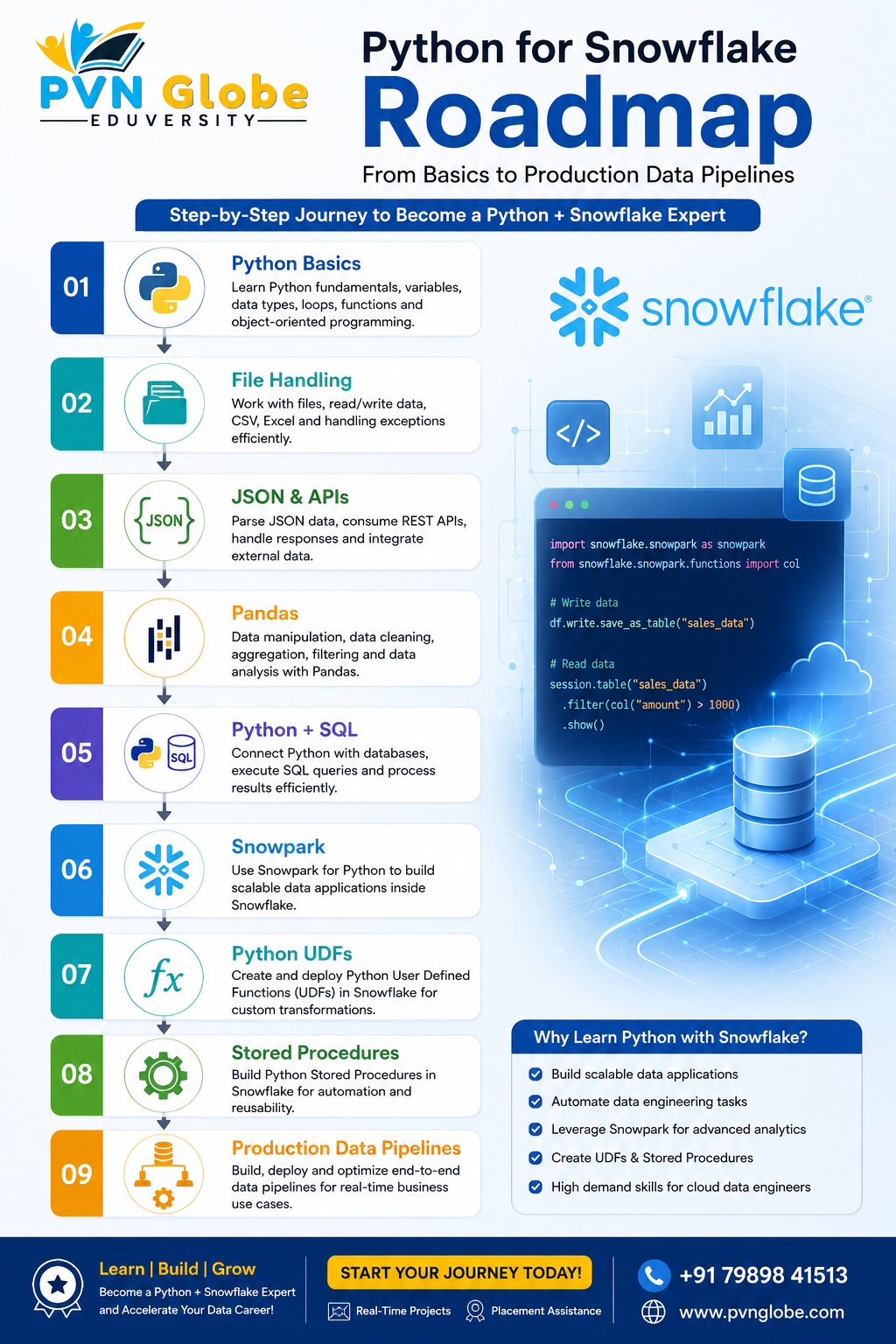
Learn Snowpark and Python for Snowflake
Python is an important supporting skill for modern data engineers.
Snowpark enables developers to work with Snowflake using programming languages such as Python, Java, and Scala.
Why Learn Snowpark?
Snowpark can be useful for:
- Complex transformations
- Python-based data processing
- Reusable functions
- Stored procedures
- Data engineering workflows
- Application development
Snowflake’s Python Data Engineering training material specifically highlights skills such as secure Snowpark
Python UDFs, stored procedures, tasks, DAGs, automation, monitoring, and debugging.
Recommended Python Roadmap
Build Real-World Snowflake Data Engineering Projects
Projects are one of the most important parts of becoming job-ready.
A candidate should be able to explain:
- What problem the project solved
- Where the data came from
- How the pipeline worked
- Why specific Snowflake features were selected
- How data quality was managed
- How performance was optimized
- How security was implemented
Project 1: E-Commerce Data Warehouse
Build a complete e-commerce data platform.
Source Data
- Customers
- Products
- Orders
- Payments
- Shipping
Pipeline
CSV/API → Cloud Storage → Snowflake → Transformation → Analytics
Skills
- SQL
- Data modeling
- Data loading
- ELT
- Snowflake
- Data validation
Project 2: Customer Analytics Platform
Build a customer analytics warehouse.
Analyze:
- Customer lifetime value
- Purchase frequency
- Revenue
- Product preferences
- Customer segmentation
Project 3: Incremental Data Pipeline
Use:
Streams + Tasks
to process changed records.
Snowflake officially documents Streams and Tasks as mechanisms for continuous data pipelines and CDC-based processing.
Project 4: Real-Time Streaming Pipeline
Build:
Python → Snowpipe Streaming → Snowflake → Dashboard
Snowflake currently provides guidance for building streaming pipelines using the Snowpipe Streaming Python SDK.
Snowflake Certification: What Should You Know?
Certification can help demonstrate structured knowledge, but it should not replace practical experience.
Snowflake currently provides SnowPro certifications designed to validate Snowflake AI Data Cloud skills.
Before selecting a certification, candidates should check the current official Snowflake certification catalog, exam objectives, prerequisites, and exam format, because certification offerings can change.
Recommended Learning Sequence
Stage 1 — Fundamentals
Learn:
- SQL
- Databases
- Data warehousing
- Cloud basics
Stage 2 — Snowflake
Learn:
- Architecture
- Warehouses
- Tables
- Views
- Stages
- File formats
- Loading
Stage 3 — Data Engineering
Learn:
- Snowpipe
- Streams
- Tasks
- Dynamic Tables
- Snowpark
- Data pipelines
Stage 4 — Advanced Skills
Learn:
- Performance optimization
- Security
- Governance
- Cost management
- Data sharing
- Monitoring
Stage 5 — Certification
Review the current official Snowflake certification objectives and prepare accordingly.
Stage 6 — Projects
Build at least 2–3 end-to-end projects.
Certification + Projects + SQL + Python + Cloud Skills creates a much stronger profile than certification alone.
Snowflake Data Engineer Career Path
A career in Snowflake data engineering does not have to begin with an advanced role.
You can build your skills progressively.
Beginner
- SQL Learner
- Database Fundamentals
- Data Warehouse Concepts
- Snowflake Fundamentals
- Junior Data Professional
Intermediate
- Snowflake Developer
- ETL/ELT Developer
- Cloud Data Engineer
- Snowflake Data Engineer
Advanced
- Senior Data Engineer
- Data Platform Engineer
- Data Architect
- Cloud Data Architect
The exact career progression depends on your experience, organization, technical depth, and responsibilities.
Skills to Add Along the Way
- Python
- AWS/Azure/GCP
- dbt
- Git
- CI/CD
- Apache Airflow
- Spark/PySpark
- Power BI
- Data quality
- Data governance
- Data modeling
The modern data engineer increasingly needs to work across multiple layers of the data platform.
How to Prepare for a Snowflake Data Engineer Interview
Learning Snowflake is only one part of becoming job-ready.
You also need to explain technical decisions clearly.
Common Interview Areas
SQL
Be prepared for questions involving:
- Joins
- CTEs
- Window functions
- Aggregations
- Deduplication
- Ranking
- Date functions
Snowflake
Prepare for:
- Snowflake architecture
- Virtual warehouses
- Storage and compute
- Stages
- File formats
- COPY INTO
- Snowpipe
- Streams
- Tasks
- Dynamic Tables
- Snowpark
Data Engineering
Understand:
- ETL vs ELT
- Batch processing
- Incremental loading
- CDC
- Data quality
- Data modeling
- Pipeline monitoring
Scenario Questions
For example:
“How would you design a Snowflake pipeline for millions of daily transactions?”
A strong answer should discuss:
- Source systems
- Ingestion method
- Storage
- Transformation
- Incremental processing
- Data quality
- Security
- Performance
- Monitoring
- Cost management
This demonstrates engineering thinking rather than memorization.
Why Choose PVN GLOBE for Snowflake Training?
If you are searching for Snowflake Training in Hyderabad, choosing a structured training program can help you organize your learning journey.
PVN GLOBE focuses on technology-oriented learning and career development for students, freshers, and working professionals.
The goal of a Snowflake training program should be to move beyond basic definitions and help learners understand how Snowflake fits into a complete data engineering environment.
What You Can Focus on With PVN GLOBE
✔ Snowflake fundamentals
✔ Snowflake architecture
✔ Advanced SQL
✔ Data warehousing
✔ Data loading
✔ ETL/ELT concepts
✔ Snowpipe
✔ Streams and Tasks
✔ Dynamic Tables
✔ Snowpark and Python
✔ Data engineering workflows
✔ Performance optimization
✔ Security concepts
✔ Practical projects
✔ Interview preparation
For learners looking for Snowflake Course in Hyderabad, Snowflake Online Training, Snowflake Data Engineer Training, or Snowflake Developer Training, a practical learning path can provide a structured way to build these skills.
PVN GLOBE Snowflake Learning Path
- Learn SQL
- Understand Data Warehousing
- Learn Snowflake
- Build Data Pipelines
- Practice Python
- Build Projects
- Prepare for Certification
- Prepare for Interviews
- Apply for Data Engineering Roles
The focus should always be on building demonstrable skills.
How to Become a Snowflake Data Engineer in 2026: Final Roadmap
Becoming a Snowflake Data Engineer is a journey rather than a single course or certification.
Start with the fundamentals.
Learn SQL.
Understand databases.
Learn data warehousing.
Build Python skills.
Understand cloud computing.
Learn Snowflake architecture.
Practice data loading.
Build ETL and ELT pipelines.
Learn Snowpipe.
Understand Streams and Tasks.
Learn Dynamic Tables.
Explore Snowpark.
Build real-world projects.
Learn data security and performance optimization.
Prepare for certification.
Practice technical interviews.
Build your professional portfolio.
This approach can help you develop a more complete profile for modern data engineering roles.
Snowflake’s current direction also shows that data engineering is expanding beyond traditional warehouse development into areas such as declarative pipelines, streaming ingestion, Python-based development, open table formats, and modern data applications.
Therefore, aspiring data engineers should avoid learning Snowflake as an isolated tool.
Instead, learn Snowflake as part of a modern data engineering ecosystem.
Frequently Asked Questions
1. How can I become a Snowflake Data Engineer in 2026?
Start with SQL, databases, data warehousing, Python and cloud fundamentals. Then learn Snowflake architecture, data loading, Snowpipe, Streams, Tasks, Dynamic Tables, Snowpark, security, performance and data engineering workflows. Build real-world projects and prepare for relevant certification and interviews.
2. Is Snowflake good for a data engineering career?
Snowflake is an important platform within modern cloud data engineering. It can be especially valuable when combined with SQL, Python, cloud platforms, ETL/ELT, data modeling and practical project experience.
3. What skills are required for a Snowflake Data Engineer?
Important skills include SQL, Python, data warehousing, ETL/ELT, Snowflake architecture, data loading, Snowpipe, Streams, Tasks, Dynamic Tables, Snowpark, cloud platforms, data modeling, security and performance optimization.
4. Is Python necessary for Snowflake Data Engineering?
Python is not the only language used with Snowflake, but it is a valuable supporting skill. Snowpark enables Python-based development and data transformation workflows.
5. Is SQL important for Snowflake?
Yes. SQL is one of the most important technical skills for Snowflake development and data engineering.
6. Can freshers become Snowflake Data Engineers?
Yes. Freshers can start with SQL, databases, data warehousing and Python before progressing into Snowflake and cloud data engineering.
7. What projects should I build for a Snowflake Data Engineer job?
Build end-to-end projects involving data ingestion, transformation, incremental processing, data quality and analytics. Examples include e-commerce data warehouses, customer analytics platforms, CDC pipelines and streaming pipelines.
8. What is Snowpipe?
Snowpipe is a Snowflake data-ingestion capability used for continuous data loading scenarios.
9. What are Snowflake Streams?
Streams record changes to data and can be used for change-data-capture workflows.
10. What are Snowflake Tasks?
Tasks automate processing and can execute SQL or stored procedures on schedules or based on triggers.
11. What are Dynamic Tables?
Dynamic Tables provide a declarative way to define transformed data and keep results refreshed according to a target freshness requirement.
12. Should I get a Snowflake certification?
Certification can help validate structured knowledge and demonstrate commitment to Snowflake skills. However, certification should be combined with hands-on projects and practical data engineering experience. Snowflake maintains its current SnowPro certification catalog officially.
13. What is the best Snowflake course in Hyderabad?
The best course depends on your existing skills, career goals, curriculum, practical training, projects and learning support. Learners searching for Snowflake Training in Hyderabad should compare the curriculum and practical exposure before choosing a program.
14. Can I learn Snowflake online?
Yes. Snowflake Online Training can be a flexible option for students and working professionals, especially when the program includes practical exercises, projects and instructor guidance.
15. Where can I learn Snowflake in Hyderabad?
Learners interested in Snowflake Training in Hyderabad can explore technology training providers such as PVN GLOBE and compare their curriculum, practical learning approach and career support