
Introduction
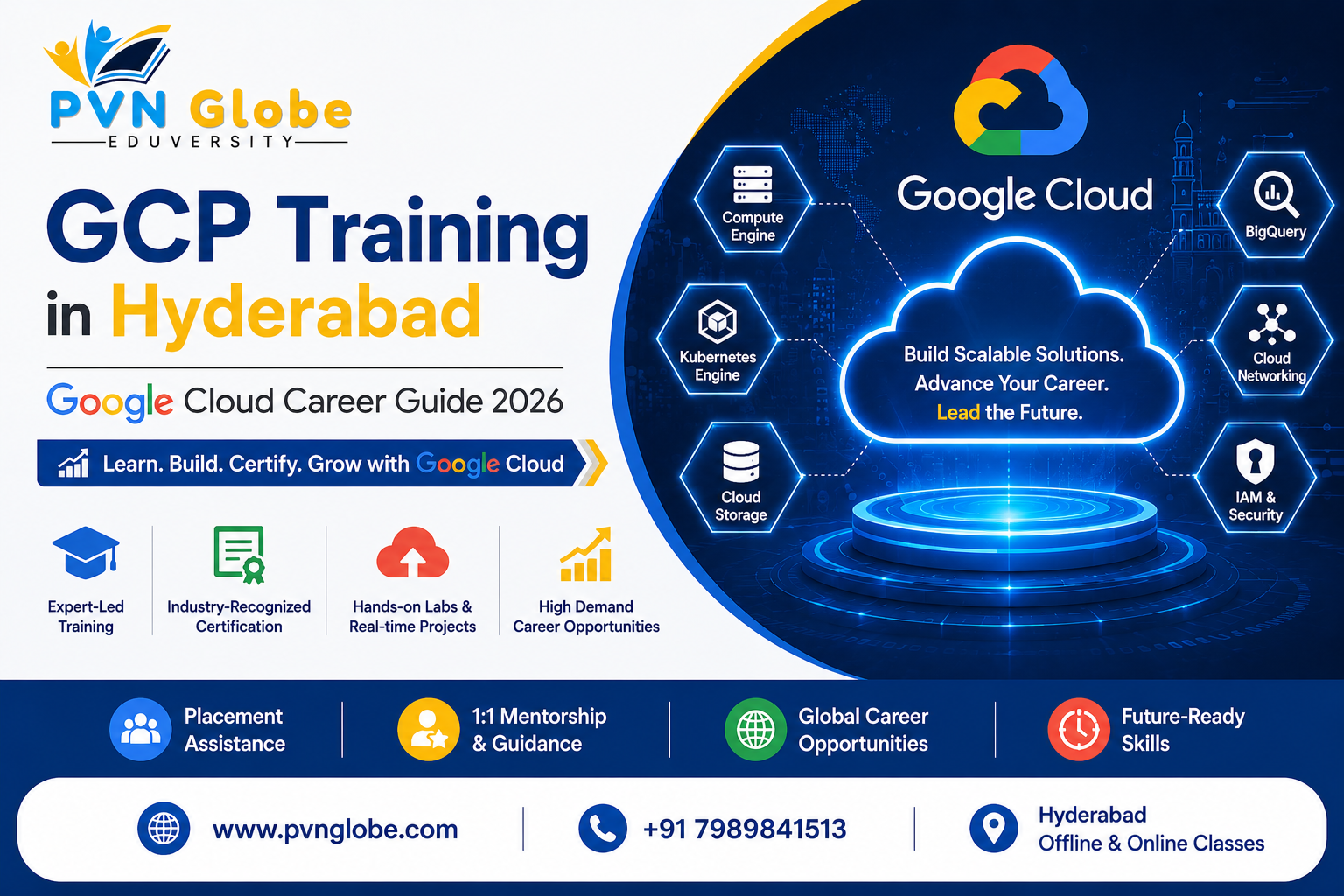
GCP Training in Hyderabad is becoming an increasingly popular choice for students, IT professionals, developers, system administrators, DevOps engineers, and cloud enthusiasts who want to build skills in Google Cloud Platform. As organizations continue moving applications, databases, analytics workloads, and infrastructure to the cloud, professionals with practical cloud skills are finding opportunities across development, infrastructure, DevOps, data engineering, cybersecurity, and cloud architecture.
Google Cloud Platform, commonly known as GCP, is Google’s cloud computing platform that provides infrastructure, computing, storage, databases, networking, analytics, artificial intelligence, machine learning, containers, and application development services. Learning GCP can help professionals understand how modern cloud applications are designed, deployed, secured, monitored, and scaled.
For learners searching for GCP Training in Hyderabad, choosing the right course involves more than learning a list of Google Cloud services. A career-focused program should combine cloud fundamentals, hands-on labs, real-world projects, security concepts, DevOps practices, troubleshooting, and certification preparation.
This complete guide explains GCP training, important Google Cloud services, syllabus, career opportunities, certification pathways, prerequisites, practical projects, and how to choose the right GCP training institute in Hyderabad in 2026.
What Is GCP?
Google Cloud Platform (GCP) is a collection of cloud computing services provided by Google. It allows organizations to build, deploy, operate, and scale applications and infrastructure without maintaining all of the underlying physical infrastructure themselves.
GCP provides services for compute, storage, networking, databases, data analytics, artificial intelligence, machine learning, containers, security, monitoring, and application development.
Some of the commonly used Google Cloud services include Compute Engine for virtual machines, Cloud Storage for object storage, Google Kubernetes Engine for container orchestration, BigQuery for analytics, Cloud SQL for relational databases, Cloud Run for containerized applications, and Vertex AI for AI and machine-learning workloads.
A strong GCP course should explain not only what these services do but also when and why a cloud engineer would use them.
Why Learn GCP in 2026?
Cloud computing has become an important part of modern IT infrastructure. Organizations are increasingly using cloud platforms to improve scalability, availability, automation, application delivery, data processing, and operational efficiency.
Google Cloud also provides a broad ecosystem covering infrastructure, application development, data analytics, AI, security, and Kubernetes. Google Cloud’s current training resources include role-based learning paths, hands-on labs, skill badges, and certification preparation.
For professionals, this means GCP skills can be useful across several career directions rather than being limited to one specific job role.
A learner may begin with cloud fundamentals and progress toward cloud engineering, DevOps, data engineering, cloud architecture, security, or AI-focused roles depending on their interests and previous experience.
Why Choose GCP Training in Hyderabad?
Hyderabad has a large technology ecosystem with professionals working across software development, IT infrastructure, cloud computing, data, DevOps, cybersecurity, and enterprise applications. This makes GCP Training in Hyderabad an attractive option for students and working professionals who want instructor-led or practical cloud training.
However, the location of a training institute should not be the only factor when selecting a course. The quality of the curriculum, practical environment, trainer experience, project work, learning support, and certification preparation are equally important.
A good GCP training program should help you progress from basic cloud concepts to deploying and managing practical workloads on Google Cloud.
What Will You Learn in GCP Training?
A comprehensive GCP course should begin with cloud computing fundamentals and gradually introduce Google Cloud architecture and services. Students should understand concepts such as regions, zones, projects, resources, billing accounts, quotas, IAM, and the Google Cloud resource hierarchy.
Once the foundation is established, learners can move into compute, storage, networking, databases, containers, monitoring, security, automation, and application deployment.
The objective should be to develop the ability to design and operate cloud solutions rather than simply memorize service definitions.
GCP Training Syllabus
A practical GCP Training syllabus can be organized into several progressive modules.
Module 1: Cloud Computing Fundamentals
The course should begin with an introduction to cloud computing and explain the differences between traditional infrastructure and cloud environments. Students should understand concepts such as Infrastructure as a Service, Platform as a Service, Software as a Service, scalability, elasticity, availability, virtualization, and cloud security.
The module should also introduce Google Cloud’s global infrastructure and explain the relationship between regions, zones, resources, and projects.
Module 2: Google Cloud Console and Resource Management
Students should learn how to navigate the Google Cloud Console and understand the Google Cloud resource hierarchy.
Important concepts include organizations, folders, projects, resources, billing, quotas, APIs, and service accounts. Understanding this structure is essential because cloud resources are managed within a logical hierarchy.
Module 3: Identity and Access Management
Google Cloud IAM is a fundamental part of cloud security. Students should learn how permissions and roles control access to Google Cloud resources.
Training should cover basic IAM concepts, predefined roles, custom roles, service accounts, policies, least-privilege access, and authentication concepts.
Understanding IAM is particularly important because cloud engineers must consider security while designing and deploying infrastructure.
Module 4: Compute Engine
Google Compute Engine provides virtual machine infrastructure on Google Cloud.
Students should learn how to create and configure virtual machines, select machine types, manage disks, configure networking, use images, connect to instances, and understand VM lifecycle management.
Practical exercises should involve deploying a virtual machine and configuring a simple application rather than only demonstrating the Google Cloud Console.
Module 5: Cloud Storage
Cloud Storage provides object storage for applications and data.
Students should understand buckets, objects, storage classes, permissions, lifecycle management, versioning, and access control. Practical exercises can include creating buckets, uploading data, configuring permissions, and managing storage lifecycle policies.
Module 6: Google Cloud Networking
Networking is one of the most important areas of GCP.
Students should learn about Virtual Private Cloud networks, subnets, IP addressing, firewall rules, routes, load balancing, Cloud NAT, VPN concepts, and connectivity between cloud resources.
A practical GCP course should explain how networking components work together when deploying production-style applications.
Module 7: Google Kubernetes Engine
Google Kubernetes Engine (GKE) is Google’s managed Kubernetes service. Because Kubernetes is widely used for containerized applications, GKE is an important topic for learners interested in cloud engineering and DevOps.
Training can introduce containers, Kubernetes fundamentals, clusters, nodes, deployments, services, scaling, networking, and application deployment on GKE.
Students should ideally deploy a containerized application to a GKE environment as part of their practical training.
Module 8: Cloud Run
Cloud Run provides a managed environment for running containerized applications.
Students should understand how to deploy applications, configure services, manage revisions, control traffic, and understand the difference between serverless container deployment and infrastructure-based approaches.
Cloud Run can be particularly useful for developers who want to deploy applications without managing traditional server infrastructure.
Module 9: Databases
GCP provides several database services for different application requirements.
Training should introduce services such as Cloud SQL, Firestore, Spanner, and other relevant database options. Students should understand how to choose an appropriate database based on application architecture, scalability, consistency, and workload requirements.
Module 10: BigQuery and Data Analytics
BigQuery is Google’s cloud data warehouse and analytics platform.
Learners should understand datasets, tables, SQL queries, data loading, analytical workloads, and basic BigQuery architecture.
For professionals interested in data engineering or analytics, BigQuery can become an important part of their Google Cloud learning path.
Module 11: Monitoring and Logging
Cloud environments require continuous monitoring and troubleshooting.
Students should learn about Google Cloud monitoring and logging concepts, metrics, logs, alerts, dashboards, and basic troubleshooting techniques.
The objective is to understand how engineers identify performance problems, service issues, configuration errors, and operational incidents.
Module 12: Security and Best Practices
Cloud security should be integrated throughout the course rather than treated as an optional topic.
Students should understand IAM, service accounts, least privilege, encryption concepts, network security, firewall rules, secure configuration, logging, monitoring, and basic security best practices.
Module 13: DevOps and Automation
A modern GCP professional can benefit from understanding automation and DevOps practices.
Training may introduce CI/CD, Cloud Build, source-control integration, Infrastructure as Code concepts, Terraform, containerization, deployment automation, and release management.
The exact DevOps content may vary depending on whether the program is designed for cloud engineers, developers, or DevOps professionals.
GCP Architecture and Real-World Cloud Design
Understanding individual services is only one part of becoming a cloud professional. You also need to understand how services work together.
For example, a typical web application could use Compute Engine or Cloud Run for application hosting, Cloud Load Balancing for traffic distribution, Cloud SQL for relational data, Cloud Storage for objects, IAM for access control, and Cloud Monitoring for operational visibility.
The best GCP Training in Hyderabad should therefore include architecture discussions and practical design scenarios. Students should learn how to select services based on requirements such as availability, scalability, security, performance, cost, and operational complexity.
GCP Hands-On Training
Hands-on practice is one of the most important parts of learning Google Cloud.
Reading about Compute Engine, GKE, IAM, BigQuery, or Cloud Storage is useful, but practical experience helps learners understand how cloud environments actually behave.
Google Cloud itself recommends gaining hands-on experience before attempting the Associate Cloud Engineer certification. Its current guidance recommends 6+ months of hands-on experience with Google Cloud before taking that certification exam.
A practical training program should therefore provide a cloud environment where students can create resources, configure services, deploy applications, troubleshoot issues, and clean up resources after completing exercises.
GCP Real-Time Projects
Projects can help students connect different Google Cloud services into a complete solution.
One useful beginner project is deploying a web application on Compute Engine with a custom network, firewall configuration, Cloud Storage integration, and monitoring.
An intermediate project could involve containerizing an application and deploying it using GKE or Cloud Run, while integrating a managed database and secure IAM permissions.
Another project could involve creating a data analytics solution using Cloud Storage and BigQuery, allowing students to practice data ingestion, SQL analysis, and reporting.
Project-based learning helps candidates explain their cloud experience during technical interviews because they can discuss the architecture, configuration decisions, security considerations, and troubleshooting steps involved.
Who Should Join GCP Training in Hyderabad?
GCP training can be useful for fresh graduates, developers, system administrators, DevOps professionals, network engineers, database professionals, data engineers, and working IT professionals who want to move toward cloud-based roles.
Developers can learn how to deploy applications on Google Cloud, while system administrators can expand their infrastructure skills into cloud environments. DevOps professionals can strengthen their knowledge of containers, Kubernetes, CI/CD, and infrastructure automation.
For freshers, the recommended approach is to begin with cloud fundamentals and gradually move into Google Cloud services and practical projects.
GCP Training for Freshers
Freshers do not necessarily need extensive cloud experience before beginning a GCP course. However, basic knowledge of operating systems, networking, databases, programming, or IT fundamentals can make the learning process easier.
A beginner-friendly course should introduce cloud concepts before moving into advanced services. Students should also receive enough hands-on practice to understand how resources are created, configured, secured, monitored, and deleted.
The objective should be to build a strong technical foundation rather than rushing through a large number of services.
GCP Training for Working Professionals
Working professionals often choose GCP training to transition from traditional infrastructure or application development into cloud computing.
For example, a Linux administrator can build cloud infrastructure skills, while a developer can learn cloud-native application deployment. A DevOps engineer can deepen their knowledge of Kubernetes, CI/CD, and automation, while a data professional can explore BigQuery and Google Cloud’s analytics ecosystem.
Flexible weekday and weekend training options can be useful for professionals who need to balance learning with their existing work schedules.
Google Cloud Certification Path
Google Cloud provides certifications across foundational, associate, and professional levels. Its current certification catalog identifies Cloud Engineer as an associate-level certification and includes professional-level certifications for advanced technical roles.
For many beginners and aspiring cloud engineers, the Associate Cloud Engineer certification can be a relevant milestone. Google states that the exam evaluates abilities including setting up a cloud solution environment, planning and implementing cloud solutions, operating cloud solutions, and configuring access and security.
The certification currently has no formal prerequisite, although Google recommends six or more months of hands-on Google Cloud experience.
Certification should be viewed as a way to validate skills rather than a replacement for practical experience.
How to Prepare for Google Cloud Certification
A good certification preparation strategy should combine official learning resources, hands-on labs, practice exercises, architecture understanding, and revision of the official exam guide.
Google Cloud provides role-based learning paths, hands-on labs, skill badges, and certification preparation resources through its training ecosystem.
Candidates should first understand the exam objectives and then build practical experience around the services and tasks covered by the certification.
Instead of memorizing answers, candidates should practice creating and managing cloud resources so they can understand how different services behave in real environments.
GCP Career Opportunities in 2026
GCP skills can support several career paths depending on a candidate’s background and specialization.
Common career directions include:
Google Cloud Engineer
Cloud Engineer
GCP DevOps Engineer
Cloud Administrator
Cloud Architect
Cloud Support Engineer
GCP Data Engineer
Cloud Security Engineer
Site Reliability Engineer
Cloud Consultant
The responsibilities and requirements for each role vary. A cloud engineer may focus on infrastructure deployment and operations, while a DevOps engineer may concentrate on automation, CI/CD, containers, and Kubernetes.
Professionals targeting architecture positions generally need broader experience with cloud design, networking, security, reliability, cost optimization, and application architecture.
What Does a GCP Cloud Engineer Do?
A Google Cloud Engineer may be responsible for deploying infrastructure, configuring cloud services, managing access, monitoring workloads, troubleshooting operational problems, and maintaining cloud environments.
Google’s current Associate Cloud Engineer description emphasizes deploying and securing applications, services, and infrastructure, monitoring multiple projects, and maintaining enterprise solutions to meet performance requirements.
In real projects, cloud engineers may also work with networking, virtual machines, containers, databases, storage, automation, logging, monitoring, and security.
Skills Required for a GCP Career
A successful GCP professional generally needs more than knowledge of Google Cloud service names.
Important supporting skills include Linux fundamentals, networking, security concepts, scripting, Git, containers, Kubernetes, databases, troubleshooting, and automation.
For DevOps-oriented roles, knowledge of CI/CD, Terraform, Docker, Kubernetes, monitoring, and source-control workflows can be particularly valuable.
For cloud architecture roles, professionals should additionally understand application architecture, scalability, high availability, disaster recovery, security, cost management, and service selection.
GCP vs AWS vs Azure
GCP is one of the major public cloud platforms alongside AWS and Microsoft Azure.
The best cloud platform to learn depends on your career objectives, employer requirements, existing technical background, and the types of workloads you want to work with.
GCP has particularly strong associations with areas such as Kubernetes, data analytics, cloud-native development, and Google’s broader AI ecosystem. AWS and Azure also have extensive enterprise ecosystems and large service portfolios.
Rather than trying to learn every cloud platform simultaneously, beginners may benefit from building strong skills in one platform first and then learning additional platforms later.
How to Choose the Best GCP Training Institute in Hyderabad
Selecting a GCP training institute requires careful evaluation. Do not choose a course solely because it advertises a low fee, short duration, or guaranteed job.
Start by checking the trainer’s practical experience and the depth of the syllabus. A strong course should cover cloud fundamentals, IAM, Compute Engine, networking, storage, databases, Kubernetes, monitoring, security, and relevant automation.
The training environment is equally important. Ask whether you receive hands-on access to Google Cloud and whether practical exercises are included throughout the course.
You should also ask about projects, interview preparation, certification guidance, doubt-clearing support, and the availability of recorded sessions if required.
Most importantly, check whether the institute clearly explains what is included in the course rather than relying on exaggerated career or salary promises.
Classroom vs Online GCP Training
Both classroom and online GCP training can be effective when the course is structured properly.
Classroom training provides direct interaction with the trainer and other learners. It can be useful for students who prefer face-to-face learning and immediate discussions.
Live online training provides flexibility and can be convenient for working professionals or learners who cannot attend classes physically.
Regardless of the format, the key factor is practical learning. A learner should be able to work with Google Cloud services and complete assignments or projects rather than simply watching demonstrations.
GCP Course Duration
The duration of GCP training varies depending on the depth of the course, learner background, practical requirements, and whether the program includes DevOps, Kubernetes, data engineering, or certification preparation.
A short introductory course may focus only on fundamentals, while a career-oriented program may require significantly more time because students need to complete hands-on labs and projects.
Therefore, instead of choosing a course based solely on duration, compare the actual curriculum and practical training hours.
GCP Course Fees in Hyderabad
GCP course fees in Hyderabad vary between training institutes based on course duration, training format, trainer experience, practical lab access, project support, and additional career services.
Some programs may focus on fundamentals, while others combine GCP with DevOps, Kubernetes, Terraform, or certification preparation.
Before comparing prices, make sure you are comparing similar course content. A cheaper program may not include cloud lab access or project work, while a more comprehensive program may include additional practical resources.
Common GCP Interview Questions
GCP interviews can include both conceptual and scenario-based questions. Candidates may be asked to explain IAM, Compute Engine, VPC networking, Cloud Storage, GKE, Cloud Run, BigQuery, monitoring, security, and cloud architecture.
Interviewers may also provide scenarios such as asking how you would secure a cloud application, troubleshoot connectivity problems, design a highly available application, control user permissions, deploy a containerized application, or monitor a production workload.
Hands-on project experience can make these discussions easier because candidates can explain how they approached similar problems during training or project work.
Benefits of GCP Training
A structured GCP course can help learners build a foundation in cloud computing and develop practical knowledge of Google’s cloud ecosystem.
It can also help professionals understand cloud infrastructure, application deployment, security, networking, containers, databases, monitoring, and automation.
For candidates preparing for Google Cloud certification, training can provide a structured path for learning the services and concepts covered by the relevant exam.
However, the strongest results usually come from combining training with independent practice and real-world project experience.
GCP Learning Roadmap for Beginners
If you are completely new to Google Cloud, avoid trying to learn every service at once.
A practical roadmap can start with cloud fundamentals and Google Cloud resource management. You can then progress through IAM, Compute Engine, Cloud Storage, networking, databases, monitoring, containers, Kubernetes, and automation.
After gaining foundational experience, choose a specialization based on your career goal. For example, a DevOps path can emphasize GKE, Docker, CI/CD, and Terraform, while a data-focused path can emphasize BigQuery and data-processing services.
For cloud engineering, focus on infrastructure, networking, security, operations, and automation.
Is GCP Training Worth It in 2026?
For professionals interested in cloud computing, GCP Training in Hyderabad can be a worthwhile learning investment when the training focuses on practical skills and relevant cloud technologies.
Google Cloud offers a broad technology ecosystem spanning infrastructure, application development, data analytics, Kubernetes, security, and AI. Its current learning platform also provides role-based learning paths and hands-on resources.
However, completing a GCP course alone does not guarantee a job. Candidates should combine training with practical projects, cloud labs, strong fundamentals, communication skills, interview preparation, and—where appropriate—industry certification.
Frequently Asked Questions About GCP Training in Hyderabad
What is GCP?
GCP, or Google Cloud Platform, is Google’s cloud computing platform. It provides services for computing, storage, networking, databases, analytics, containers, security, artificial intelligence, and application development.
Is GCP difficult to learn?
GCP becomes easier to learn when concepts are studied progressively. Beginners should start with cloud fundamentals and gradually move into compute, networking, storage, IAM, databases, containers, and monitoring.
Can freshers learn GCP?
Yes. Freshers can learn GCP by starting with basic cloud concepts and developing practical skills through guided labs and projects.
Do I need programming knowledge for GCP?
Programming knowledge is not mandatory for every GCP role. However, basic scripting or programming can be very useful for automation, application deployment, DevOps, and cloud engineering.
Is Linux knowledge required for GCP?
Linux knowledge is not mandatory for all roles, but it is highly useful for professionals managing virtual machines, applications, containers, and cloud infrastructure.
Which GCP certification should beginners consider?
The Associate Cloud Engineer certification can be a relevant certification path for learners targeting cloud engineering. Google currently states that there are no formal prerequisites, while recommending six or more months of hands-on Google Cloud experience.
Does GCP have good career opportunities?
GCP skills can support careers in cloud engineering, DevOps, cloud architecture, data engineering, security, infrastructure, and related areas. Actual opportunities depend on skills, experience, certifications, projects, and market conditions.
Is online GCP training available?
Yes. GCP training can be delivered through live online classes, self-paced learning, hands-on labs, and classroom programs. Google Cloud itself provides online learning paths and hands-on training resources.
How much hands-on practice is needed?
There is no universal number of hours that guarantees job readiness. However, practical experience is extremely important. Google recommends six or more months of hands-on Google Cloud experience before attempting the Associate Cloud Engineer certification.
What should I learn after basic GCP?
After learning the fundamentals, choose a specialization. DevOps learners can focus on Kubernetes, Docker, CI/CD, and Terraform. Data professionals can explore BigQuery and data services, while cloud engineers can focus on infrastructure, networking, security, monitoring, and automation.
Conclusion
GCP Training in Hyderabad: Complete Guide to Google Cloud Careers in 2026 provides a roadmap for students and professionals who want to enter or advance in cloud computing.
GCP offers a broad range of technologies covering infrastructure, networking, storage, databases, Kubernetes, application deployment, data analytics, security, and AI. Building knowledge across these areas can help learners prepare for different cloud career paths.
The most effective approach is to combine structured training with hands-on labs and real-world projects. Start with cloud fundamentals, learn the core Google Cloud services, understand IAM and networking, practice deployment and monitoring, and then specialize according to your career goals.
For certification-focused learners, Google provides official learning paths and recommends practical experience before attempting the Associate Cloud Engineer certification.
If you are searching for GCP Training in Hyderabad, compare institutes based on trainer experience, practical cloud access, updated syllabus, real-time projects, certification guidance, interview preparation, and overall learning support.
Start Your Google Cloud Journey
Ready to build your career with Google Cloud?
Choose a practical GCP Training in Hyderabad program that helps you learn cloud concepts, work with real Google Cloud services, complete projects, prepare for certification, and develop skills relevant to modern cloud roles.
Book a Free Demo Class and explore the GCP course syllabus, training methodology, practical labs, project structure, and career guidance.
Learn Google Cloud. Build Real Skills. Grow Your Cloud Career.
Target Keywords: GCP Training in Hyderabad, GCP Course in Hyderabad, Google Cloud Training in Hyderabad, Google Cloud Course Hyderabad, GCP Certification Training, GCP Training Institute in Hyderabad, Google Cloud Certification Training, GCP Online Training, GCP Course Fees in Hyderabad, GCP Syllabus, Google Cloud Engineer Training, GCP DevOps Training, Google Cloud Career, GCP Jobs in Hyderabad