
Introduction
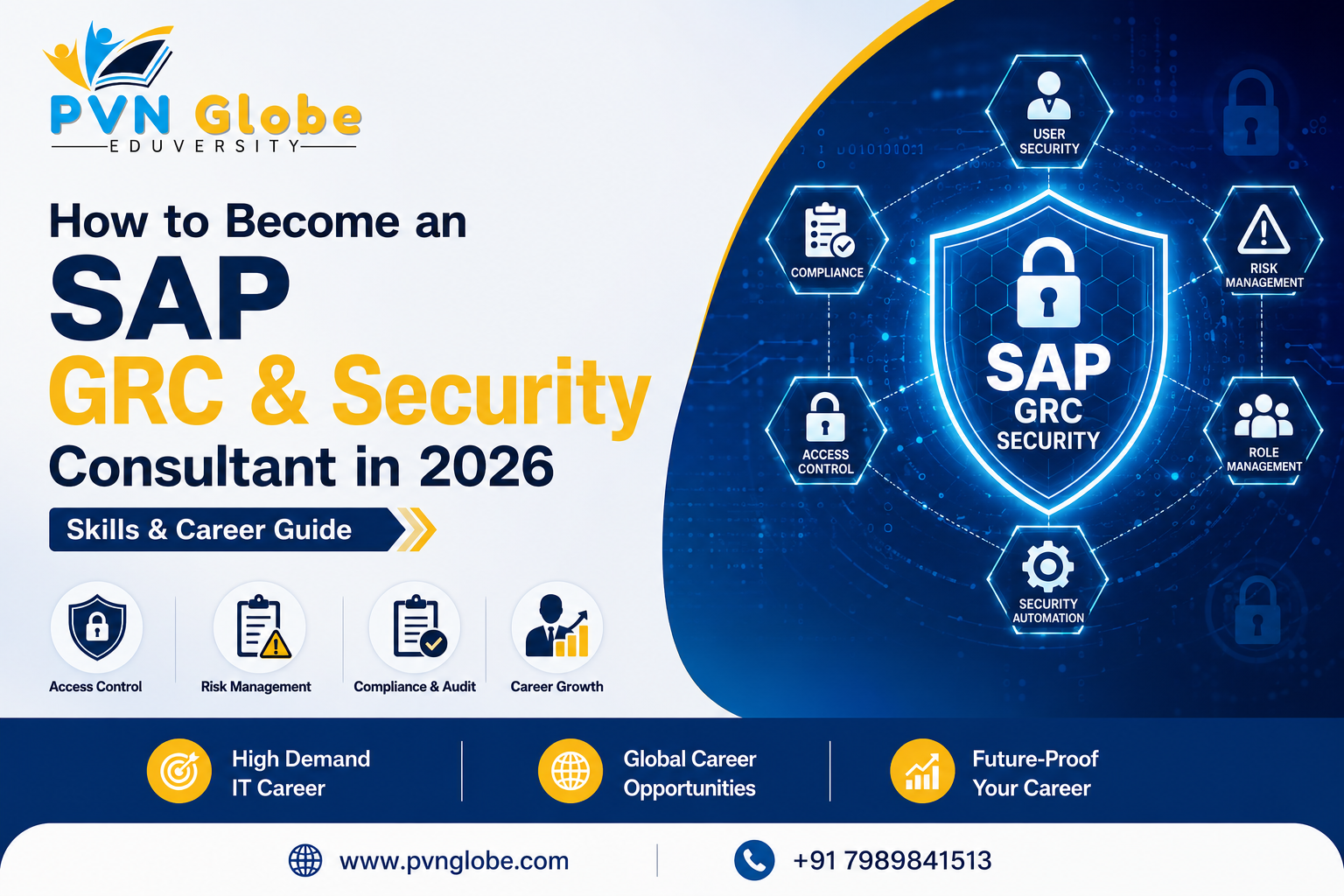
How to Become an SAP GRC & Security Consultant in 2026
Enterprise applications contain some of the most valuable information within an organization. Financial records, customer information, vendor details, employee information, procurement data, sales transactions, and operational information may all be managed through SAP systems. Because of this, organizations cannot treat SAP access management as a simple administrative activity.
SAP Security provides the technical foundation for protecting SAP environments. It focuses on users, roles, authorizations, authentication, access controls, and security administration. SAP GRC expands this approach by introducing governance, risk management, compliance, access risk analysis, access requests, emergency access, and other controls.
The combination of these areas creates a specialized career opportunity for technology professionals.
SAP GRC & Security Training in Hyderabad can help learners understand how SAP access is designed and controlled in enterprise environments. A well-structured learning journey should connect technical authorization concepts with practical business scenarios.
PVN Globe Academy focuses on career-oriented technology education and can provide learners with a structured path to understand SAP GRC and Security concepts, practical scenarios, projects, certification preparation, and interview requirements.
Who Is an SAP GRC & Security Consultant?
An SAP GRC & Security Consultant is a professional who helps organizations manage secure and compliant access to SAP systems.
The role combines SAP Security administration with governance, risk, and compliance activities. Depending on the organization, consultants may work on user administration, role design, authorization troubleshooting, access requests, risk analysis, segregation-of-duties analysis, emergency access, compliance requirements, security testing, and audit support.
The consultant needs to understand both the technical and business sides of SAP.
For example, if a business wants an employee to perform purchasing activities, the consultant must determine what access is required and whether granting that access together with the employee’s existing permissions could create a business risk.
This is why SAP GRC & Security is more than simply assigning transactions to users. The consultant must understand who needs access, why the access is required, what permissions are involved, what risks exist, and how those risks can be controlled.
Why SAP GRC & Security Is Important in 2026
Organizations are increasingly focused on cybersecurity, regulatory requirements, internal controls, identity governance, and protection of business-critical systems.
SAP environments are often connected to multiple applications, databases, identity platforms, cloud services, and third-party systems. As environments become more complex, access governance becomes increasingly important.
A poorly designed role can provide excessive privileges. A user who retains access after changing departments can create unnecessary risk. A combination of permissions may create a segregation-of-duties conflict. Emergency access may need monitoring and review.
SAP GRC helps organizations establish processes around these challenges.
At the same time, SAP Security professionals need to understand modern SAP environments, including S/4HANA and cloud-oriented landscapes. This creates demand for professionals who can combine traditional authorization knowledge with modern security and governance concepts.
For people searching for SAP GRC careers in 2026, developing both SAP Security and GRC skills can provide a stronger professional profile than focusing on only one area.
Understanding SAP Security Fundamentals
SAP Security begins with identity and authorization.
A user must be identified, authenticated, and provided with appropriate access. SAP roles are used to organize permissions, while authorization objects help control specific activities.
Understanding users, roles, profiles, authorization objects, authorization fields, organizational levels, and role assignments is fundamental for an SAP Security Consultant.
Role design is particularly important. Organizations should avoid giving users broad access simply because it is convenient. Instead, access should be aligned with actual job responsibilities.
A consultant may also troubleshoot situations where a user receives an authorization error. This requires understanding how SAP checks authorization and how the assigned role configuration affects the user’s access.
Professionals searching for SAP Security Training in Hyderabad should therefore look for training that explains authorization concepts through practical scenarios instead of focusing exclusively on definitions.
Understanding SAP GRC
SAP GRC stands for Governance, Risk, and Compliance. Within SAP environments, GRC capabilities can help organizations manage access and evaluate security risks.
One of the most important areas is access control. Access Control supports processes related to access risk analysis, access requests, role management, and emergency access.
GRC introduces a business perspective to SAP Security.
Traditional security administration may ask whether a user technically has permission to perform a particular transaction. GRC goes further by asking whether that combination of permissions creates a business risk.
For example, if a user can create a vendor and process payments independently, an organization may consider this combination a potential segregation-of-duties concern.
An SAP GRC Consultant needs to understand how these risks are identified, evaluated, documented, and addressed.
Important SAP GRC Modules and Components
A successful SAP GRC Consultant should understand the major areas associated with access governance.
Access Risk Analysis is used to identify potential access risks and segregation-of-duties conflicts. Access Request Management supports controlled processes through which users request access and appropriate people review and approve those requests.
Emergency Access Management supports controlled temporary or exceptional access when users require additional privileges for urgent activities. Business Role Management helps organizations manage business-oriented roles and their associated access requirements.
The exact SAP GRC landscape can vary according to the organization’s architecture, SAP version, implementation approach, and business requirements.
Rather than memorizing module names, learners should understand the purpose of each capability and how the components interact.
This practical understanding is one of the important outcomes of a good SAP GRC Course in Hyderabad.
Skills Required to Become an SAP GRC & Security Consultant
An SAP GRC & Security Consultant needs a combination of technical knowledge and business understanding.
The technical foundation includes SAP users, roles, profiles, authorization objects, role maintenance, user administration, authorization troubleshooting, authentication concepts, and security controls.
GRC skills include access risk analysis, segregation of duties, access request management, emergency access, business role management, compliance concepts, and risk mitigation.
Knowledge of SAP functional modules can also be valuable. Understanding the basic business processes of SAP FICO, SAP MM, SAP SD, and other modules helps security professionals understand why particular access combinations may create risks.
Professionals should also develop analytical and communication skills. Security consultants frequently communicate with functional consultants, business users, auditors, technical teams, managers, and security stakeholders.
A strong consultant should be able to explain a technical access problem in business language and explain a business requirement in technical terms.
Tools and Technologies Used by SAP GRC Professionals
SAP GRC professionals work with different technologies depending on the organization’s SAP landscape.
SAP Security administration involves tools and capabilities related to user management, role maintenance, authorization analysis, and security administration.
SAP GRC Access Control provides capabilities for access risk analysis, access requests, emergency access, and business role governance.
Professionals may also work with identity management technologies, authentication solutions, directory services, monitoring systems, ticketing platforms, and audit tools.
Modern SAP landscapes can involve integrations with enterprise identity and access management systems. Therefore, understanding how SAP connects with broader identity ecosystems can be valuable.
For an aspiring consultant, the objective should not be to memorize every tool. Instead, the focus should be on understanding what the tool does, where it fits into the security process, and how it supports business requirements.
SAP GRC & Security Projects
Hands-on projects are an important part of becoming an SAP GRC & Security Consultant.
A beginner project can simulate user administration and role creation for different departments. Learners can create users, assign appropriate roles, test authorization behavior, and troubleshoot access issues.
An intermediate project can focus on role design. Different business departments can be given different access requirements, and the learner can design roles around those responsibilities.
An advanced project can simulate an SAP GRC Access Control implementation. The project can include access requests, approval workflows, access risk analysis, segregation-of-duties analysis, emergency access, and reporting.
Another valuable project can involve analyzing an existing role structure and identifying excessive permissions or potential conflicts.
Projects should be documented carefully. Candidates should be able to explain the business requirement, technical approach, security considerations, testing process, and outcome.
This project experience can be especially useful during SAP GRC interviews.
SAP GRC Certification Roadmap
Certification can be a useful component of an SAP career strategy. It can demonstrate structured knowledge and provide a framework for learning.
However, certification alone does not make someone a strong consultant.
An SAP GRC professional should combine certification preparation with practical training, hands-on exercises, projects, troubleshooting, and scenario-based interview preparation.
Before selecting a certification, learners should review the current SAP certification catalog and identify the certification that aligns with their experience and career objective.
For beginners, it is generally useful to establish SAP Security fundamentals before moving toward specialized GRC topics.
Experienced SAP professionals may be able to build on their existing knowledge and move more quickly toward advanced GRC and security responsibilities.
PVN Globe Academy can help learners structure their preparation around technical concepts, practical scenarios, projects, and certification objectives.
SAP GRC Career Path for Freshers
Freshers can enter SAP GRC and Security by building a strong technical foundation.
The learning journey can start with basic SAP concepts and an introduction to enterprise business processes. The next stage involves understanding SAP users, roles, profiles, authorization objects, and access management.
Once the security foundation is established, learners can move into GRC concepts such as access risk analysis, segregation of duties, access requests, emergency access, and business role management.
Practical projects should be completed throughout the learning process.
Freshers should also develop the ability to explain concepts clearly during interviews. Knowing a definition is not enough. Interviewers may ask candidates to explain why a user cannot execute a transaction, how a role should be designed, or what a segregation-of-duties conflict means.
A fresher who can combine theoretical knowledge with practical scenarios can create a stronger entry-level profile.
SAP GRC Career Path for Experienced Professionals
Experienced IT professionals may have several routes into SAP GRC and Security.
An SAP Basis professional may move toward SAP Security and then specialize in GRC. An SAP functional consultant can develop security knowledge related to their functional area. An identity and access management professional can connect existing IAM experience with SAP GRC.
Cybersecurity professionals may also find SAP Security attractive because it combines enterprise application security with identity and access governance.
Experienced professionals should focus on understanding business processes and implementation scenarios rather than simply learning configuration steps.
At advanced levels, professionals may work on role redesign, S/4HANA security, access governance, identity integration, compliance, security architecture, or large-scale SAP implementations.
Continuous learning becomes increasingly important as organizations modernize their SAP landscapes.
SAP GRC Jobs and Career Opportunities in Hyderabad
Hyderabad is an important technology and enterprise IT market in India, with organizations and service providers working across SAP implementation, support, consulting, cybersecurity, cloud, and enterprise applications.
SAP GRC and Security professionals can explore opportunities with consulting organizations, system integrators, enterprise companies, managed services teams, implementation projects, and SAP support organizations.
Possible job titles include SAP Security Consultant, SAP GRC Consultant, SAP Access Control Consultant, SAP Security Administrator, SAP GRC Analyst, SAP Authorization Consultant, and SAP Security Lead.
Career growth depends on technical expertise, experience, project exposure, communication skills, certifications, and specialization.
A professional who combines SAP Security + GRC + S/4HANA + Identity Management + Compliance can build a broader career profile.
For candidates searching for SAP GRC Jobs in Hyderabad or SAP Security Jobs in Hyderabad, practical project experience can be an important differentiator.
SAP GRC & Security Interview Preparation
SAP GRC interviews often include both technical and scenario-based questions.
A fresher may be asked what SAP Security is, what a role is, what an authorization object does, or what segregation of duties means.
Experienced candidates may receive scenarios such as a user receiving an authorization error, a role containing excessive access, an SoD conflict appearing during risk analysis, or an emergency access request requiring approval and monitoring.
Candidates should prepare to explain the reasoning behind their decisions.
For example, rather than simply saying that a user needs a particular role, a consultant should be able to explain how the business requirement was analyzed, how the role was designed, how risks were evaluated, how testing was performed, and how the access was reviewed.
PVN Globe Academy can incorporate interview-oriented scenarios into SAP GRC & Security Training in Hyderabad so learners can develop confidence with both conceptual and practical questions.
Why Choose PVN Globe Academy for SAP GRC & Security?
Learning SAP GRC and Security requires more than studying terminology. The field involves technical authorization, business processes, risk analysis, governance, compliance, troubleshooting, and practical implementation scenarios.
PVN Globe Academy provides career-oriented technology training for learners and professionals who want to develop specialized SAP skills.
A structured SAP GRC & Security Training in Hyderabad can help learners progress from SAP Security fundamentals toward advanced GRC concepts. The learning journey can include users, roles, authorization objects, role design, access control, risk analysis, segregation of duties, emergency access, business role management, security troubleshooting, projects, certification preparation, and interview readiness.
For freshers, the objective is to build a strong foundation and practical confidence.
For experienced professionals, the objective can be to strengthen existing SAP or IT knowledge and move toward specialized GRC and Security responsibilities.
The most effective career path combines:
SAP Fundamentals → SAP Security → Roles & Authorizations → User Administration → SAP GRC → Access Control → Risk Analysis → SoD → Emergency Access → Business Role Management → S/4HANA Security → Projects → Certification → Interview Preparation
The exact sequence can be adjusted according to a learner’s background and career goal.